On our way to Lihue Airport on Kaua’i Sunday afternoon we stopped for lunch at Duke’s, an island eatery known for great seafood and exotic cocktails. I decided to try a Spicy Wahine to go with my ahi poke but substituted local Kaua’i Koloa dark rum for the bourbon. This concoction, with passion fruit and a slice of jalapeño, which added the spice to the drink, was so delicious I had two of them. The jalapeño reminded me of an island in a sea of rum and, seridipitously, it is almost the shape of the island of Kaua’i.

2018—Spouting Horn with Rainbow
The Hawaii license plate features a rainbow and I know why. I’ve been on Kauai for six days and I have seen more rainbows in those six days than I’ve been in my entire life including double rainbows and complete rainbows that cover 180°. We see rainbows every day because it rains every day and the sun is out every day. The Spouting Horn is a fascinating phenomenon where the incoming waves force water through a hole in the lava rock creating a spout that occurs with every wave. On the late afternoon we visited, a rainbow highlighted the scene.
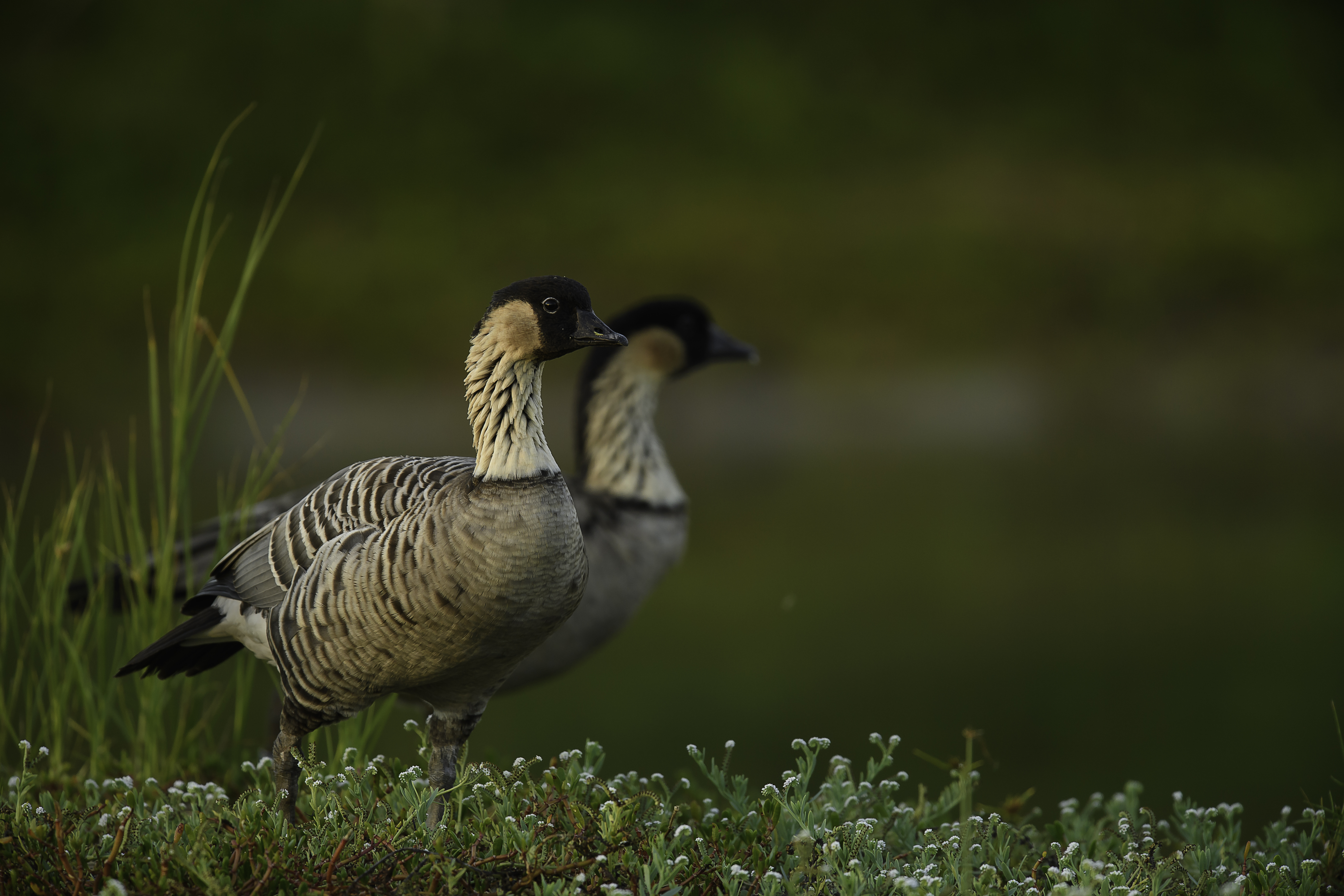
2018—Nēnē
Hawaii’s state bird is the Nēnē or Hawaiian Goose. On the verge of extinction a few decades ago, the bird is considered an endangered species but is slowly gaining in numbers. Evidence that the bird is beloved here in Kauai is everywhere, and the yellow diamond shaped Nēnē Crossing signs along the highway warn drivers that the goose has the right of way to cross in front of them. When we visited a small Hawaii State Wetlands Refuge near Waimea on late Thursday afternoon, as the sun dipped out of sight, we watched a small flock of Nēnē circle overhead and land directly in front of us. It couldn’t have been a more perfect setting. How exciting it was for all of us to not only see these birds up close but to be able to photograph them in an ideal setting as they nibbled on local flora and settled in for the night.
2018—The Right Camera
We spent a breezy Tuesday afternoon at the Kilauea Lighthouse getting sunburned and photographing birds in flight. We were surrounded by Red-tailed Tropic Birds, White-tailed Tropic Birds, Great Frigate Birds, Brown Boobies, Red-footed Boobies, Laysan Albatross, and others as they soared and skimmed the waves just off the lighthouse point, presenting us with lots of opportunities to capture birds in flight. The challenge continues to excite me and to elude me and so I now own the perfect combination of camera and lens for me to succeed in my quest to photograph birds in flight. My Nikon D500, a crop sensor camera that when paired with my Nikkor 300mm PF lens and if needed, a Nikon 1.4X teleconverter, makes the ideal combination to photograph birds in flight.
Of course, the combination works only if it is used. And, it can only be used if it is at hand. How I managed to pack my camera bag, knowing that this trip to Hawaii’s island of Kauai was specifically for the purpose of photographing birds and NOT include my primary tool for photographing flying birds is beyond me. Yes, I neglected to pack my Nikon D500. And, it was a conscious decision because somehow my brain didn’t register the need for a “birds in flight” camera. Of course I had my Nikon D5 which is my primary wildlife camera and I love it. But, I also love the D500 and have used it primarily for photographing birds in flight since I got it. It is lightweight, has most of the attributes that I love about the D5 (especially fast firing speed). But I did not bring it with me.
So, when faced with the need to photograph birds in flight, I used my Nikon D5 with the 300mm lens instead. Don’t get me wrong. The D5 is my favorite camera and it does a superior job. However, the D5 is a larger, heavier camera and it is a full frame sensor so subject size in the frame is smaller from the same distance. I screwed up. When Moose asked me why I was using my D5 and not the D500, I did not have an answer other than stupidity. Sometimes for me, it’s one step forward, and two back. I did manage to capture some birds in flight without my preferred camera/lens combination but I regret not having it with me. This is a Red-tailed Tropic Bird. I was lucky that the right wing was not clipped but it sure came close. If only I’d had the right camera.

2018—First Birds
I’m on Hawaii’s island of Kauai, far from the Big Island of Hawaii where an angry Pele has wreaked havoc with the eruption of Mt. Kilauea. Here in Kauai, it is warm and breezy, partly cloudy and occasionally rainy, and there is a high surf advisory with no volcanic activity. On Monday afternoon, we spotted our first sea birds flying close to the surf. We were told a shearwater had been spotted down the beach by our hotel. We walked down the beach to investigate and after about 15 minutes, we spotted four birds flying in formation toward us, into the wind. Instead of the expected Shearwater, our iBird Hawaii confirmed them to be Red-footed Boobies, another bird I’ve never seen.

2018—That’s a Lot of Bull

2018—Expectant
This Pronghorn doe looks expectantly as we photographed her from our vehicle. In fact she is an expectant doe. While we were at Custer State Park, last month, we saw lots of bison calves but we didn’t see any young fawns. This pregnant doe looks as if she is nearly ready to give birth. By now, I’m sure there are pronghorn fawns throughout the park, including one from this expectant mother.

2018—Hummingbird Practice
It’s not too early to start practicing for my July trip to Madera Canyon, AZ to photograph hummingbirds. The hummers have been active in my yard again but it is either females or juveniles. I haven’t seen any brilliant red gorgets so far this spring. There are several skirmishes each day at the feeders. I’m not sure if it is young males or aggressive females but it seems only one can feed in the yard at a time, despite the three feeders, each with four spigots. I’ve never understood that about my feeders. Others have one feeder that is crowded with hummers. I have three feeders and only one bird in the yard at a time.
I first thought this was a female Anna’s Hummingbird but on closer inspection, it might be a juvenile male Anna’s Hummingbird. It is hard to tell because they both have white on their tails and some colored feathers on their necks. The bird(s) visited the feeder over a 30 minutes period that I sat outside. One of the birds had buff sides which might indicate it is a female Black-chinned hummingbird. I got only one shot (not a great shot) of that bird which shows the buff sides and the different coloring under the beak. I’ll have to try to get better photographs when I try this again
We’ll be using flash a little differently in Madera Canyon this year. Instead of using a reflector, we’ll be using two mini soft boxes on the same mount we used last year. I won’t get a chance to practice using that rig until I’m home from my next trip because my order from B&H won’t be arriving until Friday, too late for me to try it out. Instead, I just mounted a single flash in the hot shoe and used Shutter Priority instead of Aperture Priority. Nikon D500, 300mm PF, 1.4x TC @ 1/250 second shutter speed and with high speed sync to allow the flash to work with the faster shutter speed. My goal was to pay attention to the background to avoid clutter and to avoid getting feeders in the shot since the bird opted for the feeders and not the flowers.

2018—Hey! Where Is Everybody?
A lone prairie dog in Custer State Park, SD.
