2016—Where There’s Smoke

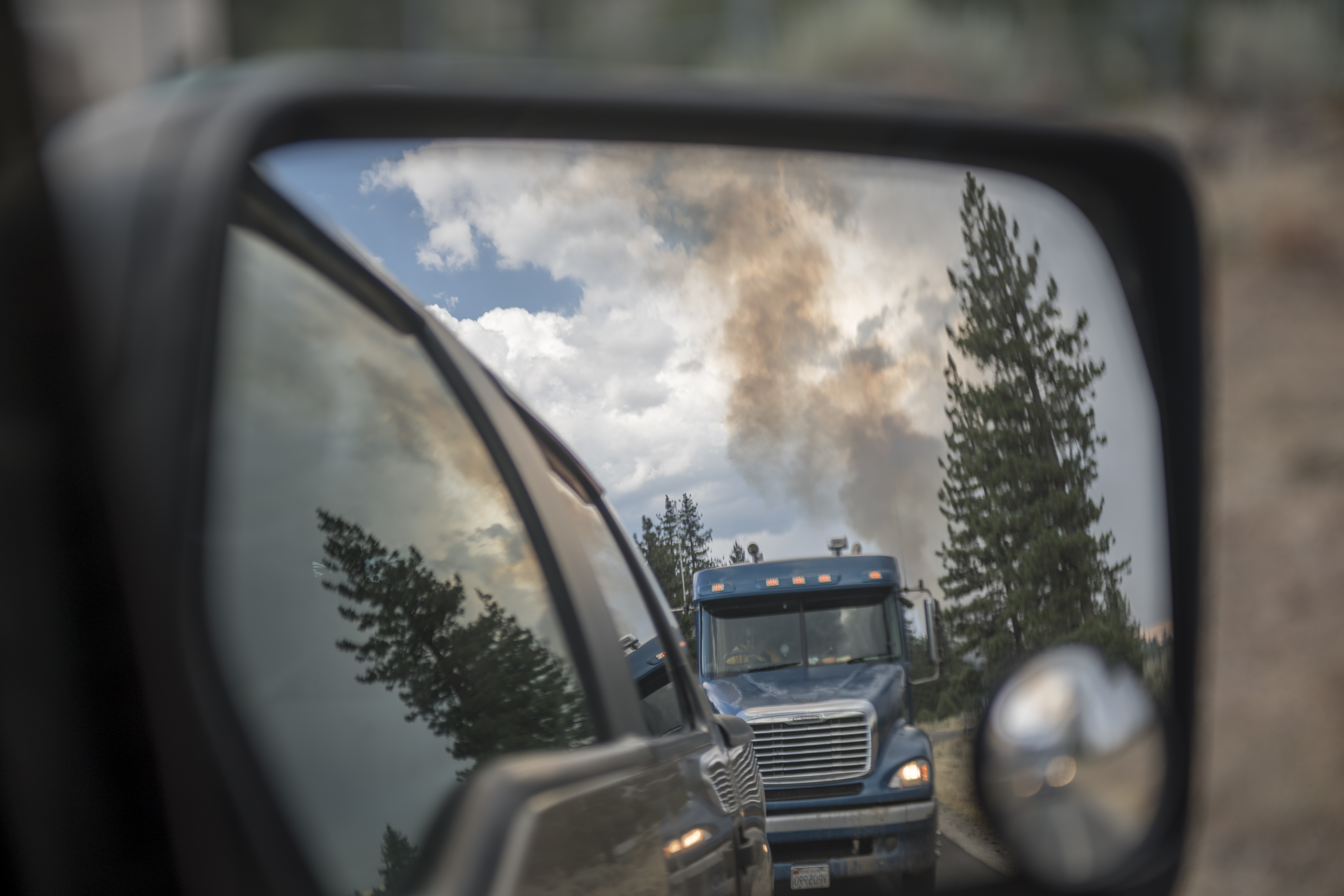
The other day while driving home from Monitor Pass where we photographed the Arboglyphs (coming soon to this blog) I noticed what appeared to be a cloudy, orangey brown haze underneath the dark storm clouds that portended lightning, torrential rains, and hail.  After puzzling about the color for a few minutes, I realized the brown haze was smoke from a fire likely started by the lightning strikes of moments before and not clouds.  As we drove on Highway 89, I kept looking for the source of the smoke, never finding it and suddenly it disappeared entirely.  Then, while we waited at a road construction site unable to move for about 15 minutes, Bruce alerted me to the smoke’s presence behind us.  I have no idea how we passed it when it was clearly ahead of us.  Nor can I explain  why the truck is tilted so much and the tree is straight in the second shot.  At least it straightened a little when I photographed the smoke in one of the exterior rear view mirrors.  Finally a lone fire engine made its way past us heading to the fire.  Then, the road crew directed us forward and we never did see the actual fire, only its telltale smoke.

Fire 1-HDR-1Fire 2-HDR-1


Fire 3-HDR-1


2016— Summer Mountain Storm

On Thursday, I went on an adventure with my camera club buddy Bruce.  We drove all the way past Markleeville to Monitor Pass close to the Nevada border on Highway 89, almost 3 hours from Auburn, to photograph arboglyphs, which are sort of like petroglyphs but on trees instead of rocks and from just this past century, not from thousands of years ago.  The arboglyphs were etched into the bark of aspen trees by lonely sheepherders.   More on the arboglyphs in a future post.  We were compelled to leave…or maybe I should say I retreated to the truck…when the clouds darkened, lightening stuck nearby with thunderous clamor, and the rain and hail pelted us.  We were soaked through walking back to the truck just a few hundred feet away from the grove of aspens and in just a couple of minutes.   It was almost 4PM and it poured for at least 30 minutes as we drove along one of the bumpiest dirt roads I’ve ever traveled on back to HWY 89.  Hail covered the roadway and mud and rocks washed across one area of the road for at least 50 feet as the rain eroded the hillsides and lightning repeatedly struck the hills nearby.    I didn’t have my new lightning trigger with me so I couldn’t put it to the test but here’s a feel for the storm.  The temperature dropped from the mid 80’s earlier in the day to the mid 50’s, a welcome respite from the triple digit heat we knew we were returning to in a mere three of hours of driving back down to the valley.

I took the first shot right after I climbed back into the truck.  I had my camera set to bracketing so I merged three shots into an HDR image.  The second shot is another HDR image of hail on the highway with sheets of rain visible in front of the trees.  The third shot is the hazy mountains in the distance (we were at 8300 feet elevation) when the rain calmed enough for me to open the window of the truck and take a shot but the rain is still visible.


windshield rain-HDR-1


Hail-HDR-1


mountain haze-HDR-1

2016—The Feeder

I was cooking dinner and looked out to see whether I needed to refill the hummingbird feeders.  There was something odd about one of the feeder cups…something greenish,  that wasn’t a hummingbird, was on it.  On closer inspection, a praying mantis was perched there.   Of course I had to photograph it.  Despite the 106° temperature at 7 PM, there was the slightest hint of a breeze so the feeder was swaying just a bit.  I used my macro lens and the tripod with the lens set to f/16 for a greater depth of field, but the breeze kept it from being tack sharp.  I noticed the hummingbirds were not in evidence but I think praying mantises eat other bugs,  not hummingbirds and this mantis was not as big as a hummer.  I have had an ant problem on the feeders when I forget to fill the top receptacle with water and the yellow jackets have been hanging around them, too.  Maybe this mantis will take care of the ant and the yellow jacket problem.

praying mantis 2.jpg

2016—Morning Light

I was practicing focusing on the hummers again Monday morning with the speed light.  The male Anna’s hummer kept moving from twig to twig.  When he landed on this twig, the morning sunlight was perfect.   The speed light reached that far, probably thirty-five feet—I had to dust off my fading memory of the Pythagorean theorem to calculate that figure— and the speed light added just enough extra illumination to give definition to his body feathers without overpowering or looking too flashy.  But then there’s the telltale pinpoint in his eye.

Focal Length 850mm; Shutter Priority 1/160; f/5.6; ISO 400; high speed crop

Morning Anna's 1.jpg

2016—Introducing Mr. and Mrs….

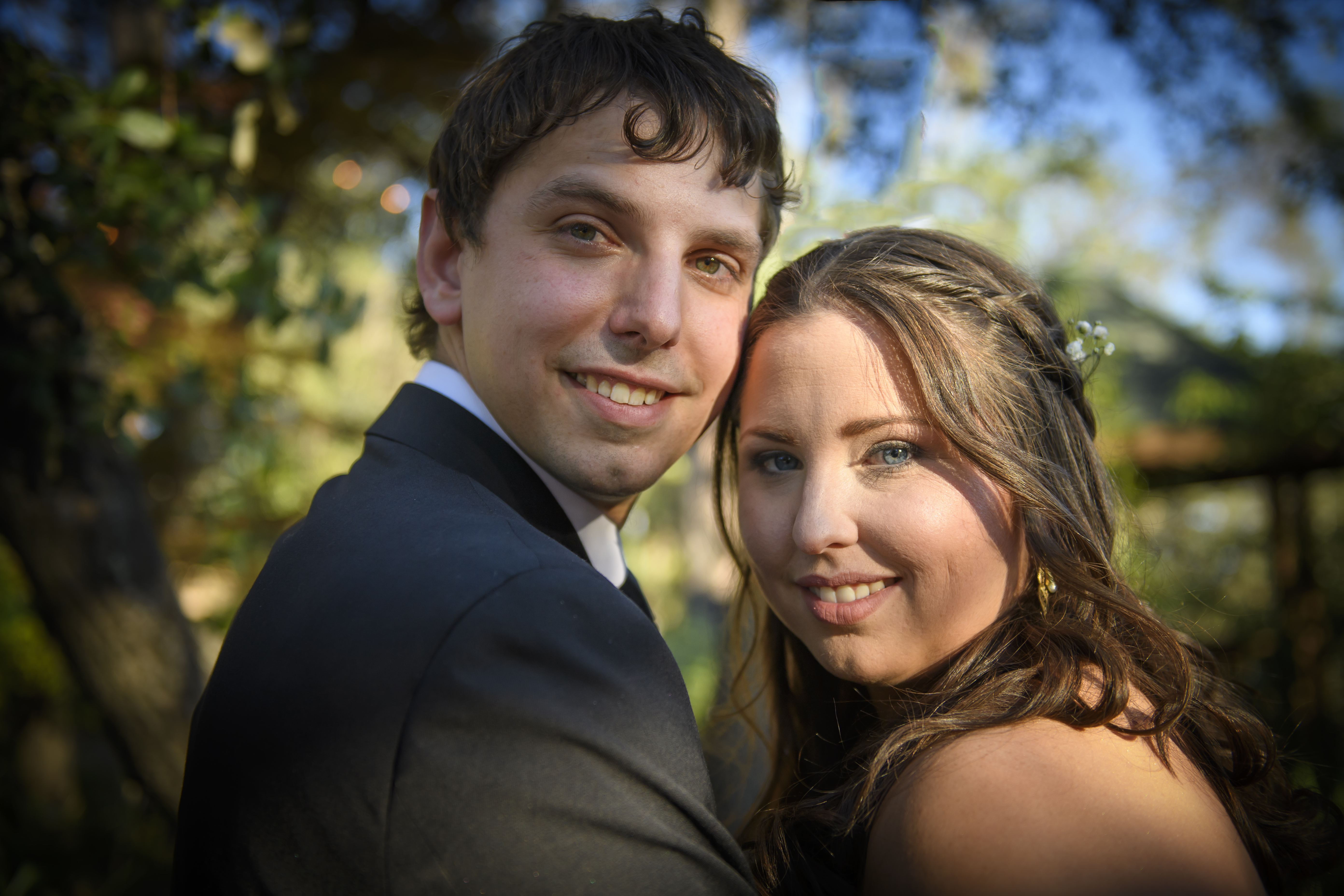
A few weeks ago, I photographed the wedding of a dear friend, a promise I made several years ago.  I was flattered and honored that the bride asked me to document this once in a lifetime memory for her but I was worried and nervous about whether I could do it well. She was  aware that my primary interest in photography is birds (and sometimes frogs…she is a wildlife biologist who is partial to frogs) but she entrusted me with this most important of days and I wanted to do my best.   For me, it is much more stressful photographing people than birds or frogs so I was worried that I might not meet her expectations.  In the end, though, I discovered that my initial concerns were  unfounded.  The vast majority of the photographs turned out well. And, most importantly, the bride and groom are happy with them. 

Here, with the bride’s permission, are two of  my favorite photographs from the wedding.  Allow me to introduce the bride and groom,  Carly and Justin.

C&J fave copy.jpg

Walking away copy.jpg

2016—Howling Bristlecone Wolf

The texture of the bark of the ancient bristlecone pine trees in the White Mountains in Inyo National Forest is extraordinary.  These ancient, slow growing trees, some several thousands of years old, have very distinct features.  Most have trunks that are twisted and ridged, whorled and striated.  I was charmed by the look of this stump with its burned out center and broken off top.  Even at the time I took the photograph it reminded me of a wolf howling at the moon.

Howling Bristlecone Pine Wolf.jpg

2016—Black-chinned Hummer

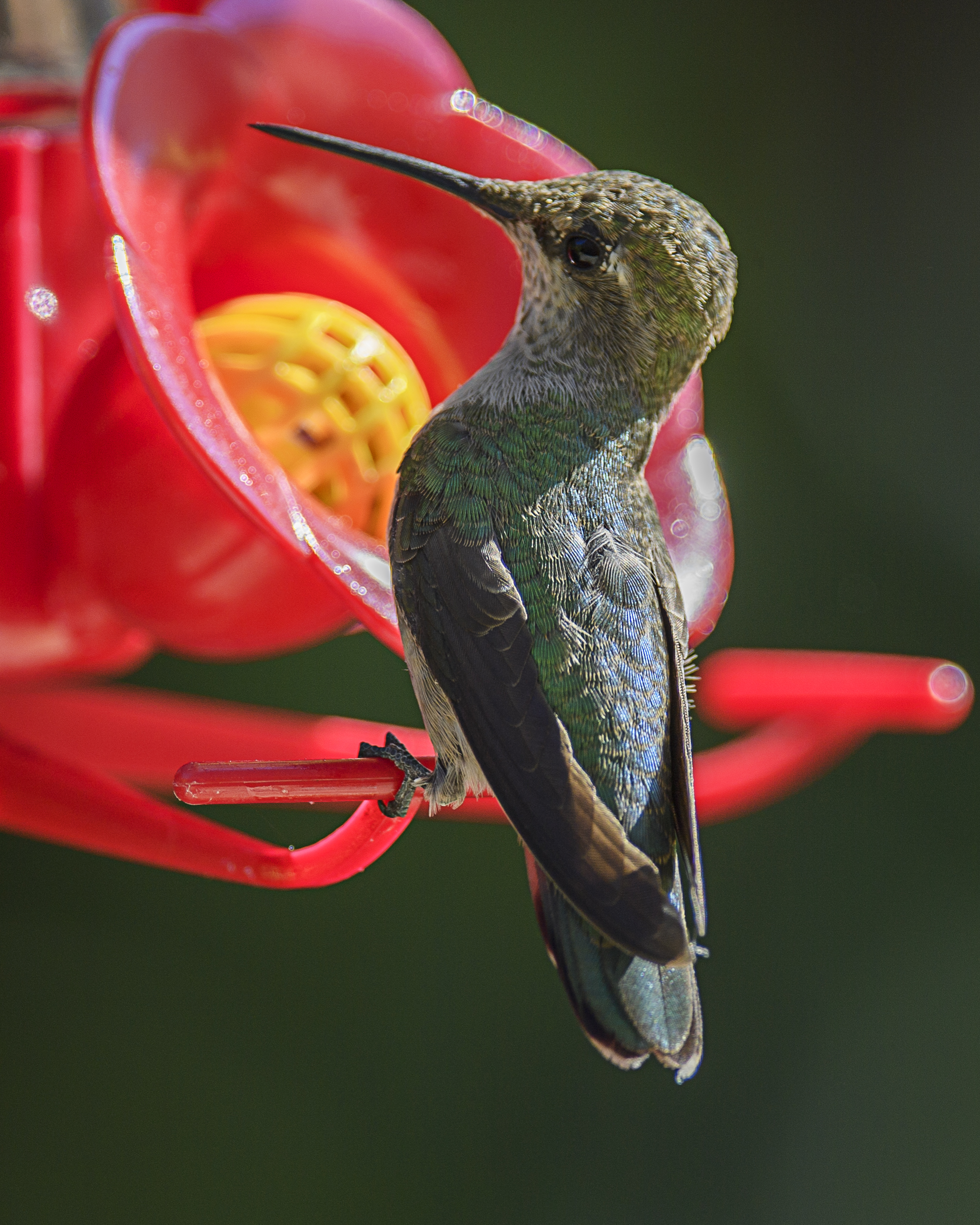
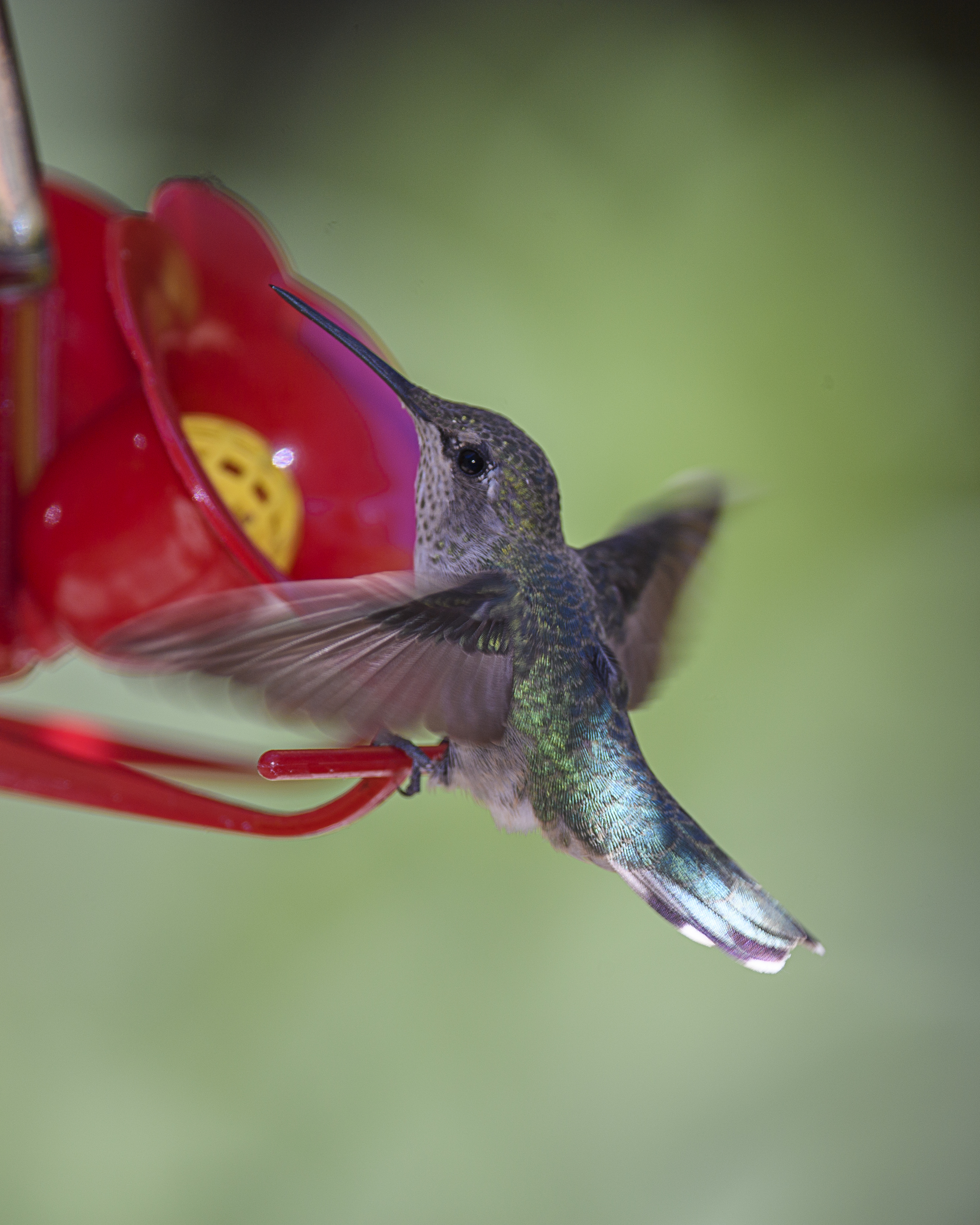
I’ve long suspected that there might be more than one kind of hummingbird living here but despite the hundreds (probably more like thousands) of hummingbird photographs I’ve taken, I’ve never been able to definitively identify any in my yard except the Anna’s who live here year round.  Due to the unceasing vigilance that keeps the male Anna’s hummer the dominant bird in the yard,  I know when an interloper is near because I hear his squeaky alarm sound.   Usually, when another hummer flits near the fountain or lands at a feeder, the male Anna’s is quick to dive bomb the unwanted visitor and usually succeeds in forcing it out of the yard.   I always thought that the Anna’s hummer was chasing another Anna’s hummer off the feeder, either its mate (or former mate–they don’t mate for life) or just another Anna’s from the neighborhood.  But I have noticed that sometimes the hummer at the feeder has a slightly different look—taller, thinner neck, longer beak although the colors are almost the same and with females, without a colorful gorget, they are harder for me to identify.

Saturday morning, I had Big Bertha set up facing the feeders and had been photographing the male Anna’s hummer high up in a dead branch overseeing his territory.  I noticed a female at the feeder furthest from the male hummer.  I was surprised that the male Anna’s didn’t take action to chase the bird away but it gave me a few moments to take some shots.    As I looked at the shots, I just felt there was something different about this bird so I reviewed hummers in my Sibley Guide to Birds (first edition) and realized that the bird was in fact a different species:  a female Black-chinned Hummingbird.  Now I’m going to have to keep my eye out for a male of the species.  The identifying factor for me was the tiny cluster of white feathers behind the eye.  In the Anna’s, the white feathers are almost like an eyebrow.  And the female Black-chinned hummers don’t have a small patch of red under the beak like the female Anna’s do.  Now I’m going to have to go back through my humming bird photos and see which ones I may have misidentified.

The sun was harsh and in the first shot, I hadn’t set up to use my flash which would have helped the back lit situation.  But I eventually did set the flash up and I took the second shot, with the sun higher in the sky, about four hours later using shutter priority so I could get a faster shutter speed and freeze some of the wing movement.  You can tell I used flash in the second shot because of the pinpoint dot in the eye; in the first shot, you can actually zoom in and see the sky and the roof of my house reflected in the eye.  I’d love to get one of the birds in focus and in flight without the distracting (and “hand of man”) feeder looming in the background.  A goal for me to work on.  I’ve done it before, I know I can do it again.

Black chinned hummer female.jpg

Black chinned hummer 3


2016—Waning Gibbous

When I walked out to get the newspaper Thursday morning, I noticed the full moon as it was setting in the west.  Technically, the full moon was a couple of days ago so it is really a  waning gibbous moon.   By the way, gibbous, as it relates to the moon, means “having the observable illuminated part greater than a semicircle and less than a circle.”  The moon in the early morning (6 am-ish) light was a bit lackluster so I applied the dehazing filter in Adobe Camera Raw and that helped but I decided to convert it to black and white and it became a much more interesting shot in black and white.  The shadows of the redwood tree branches to the right make me think of fingers reaching toward the moon.

Focal Length 850mm (600mm lens + 1.4xTC); ISO 100; f/5.6; 1/1000; exposure compensation: -1/3; high speed crop

Full morning moon B&W.jpg

2016—I Feel Your Pain

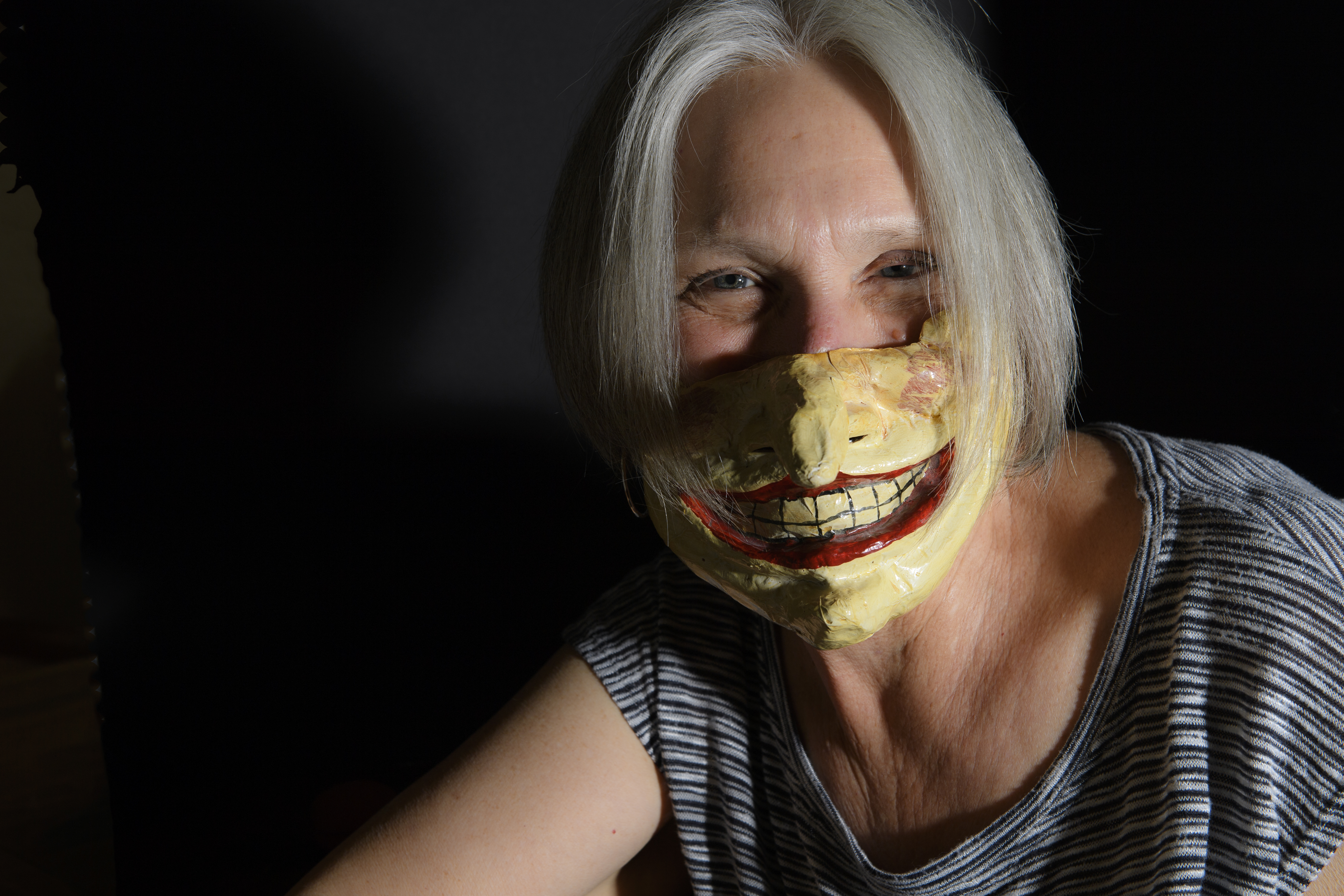
Well, I can’t really feel her pain.  But I’m hoping to alleviate it just a little bit with some humor.   My dear friend Susan had surgery on the tip of her nose yesterday.  I sent her get well greetings using these images in a card so she’d know she wasn’t the only one with a funny-looking nose!  I’m happy to report that the surgery, which was not cosmetic, was successful and that her plastic surgeon did a great job so she won’t have to resort to wearing one of these silly noses or contacting Michael Jackson’s nose prosthesis  guy.

red nosecreepy mask nosegroucho nose

2016—Old Bodie Wagon

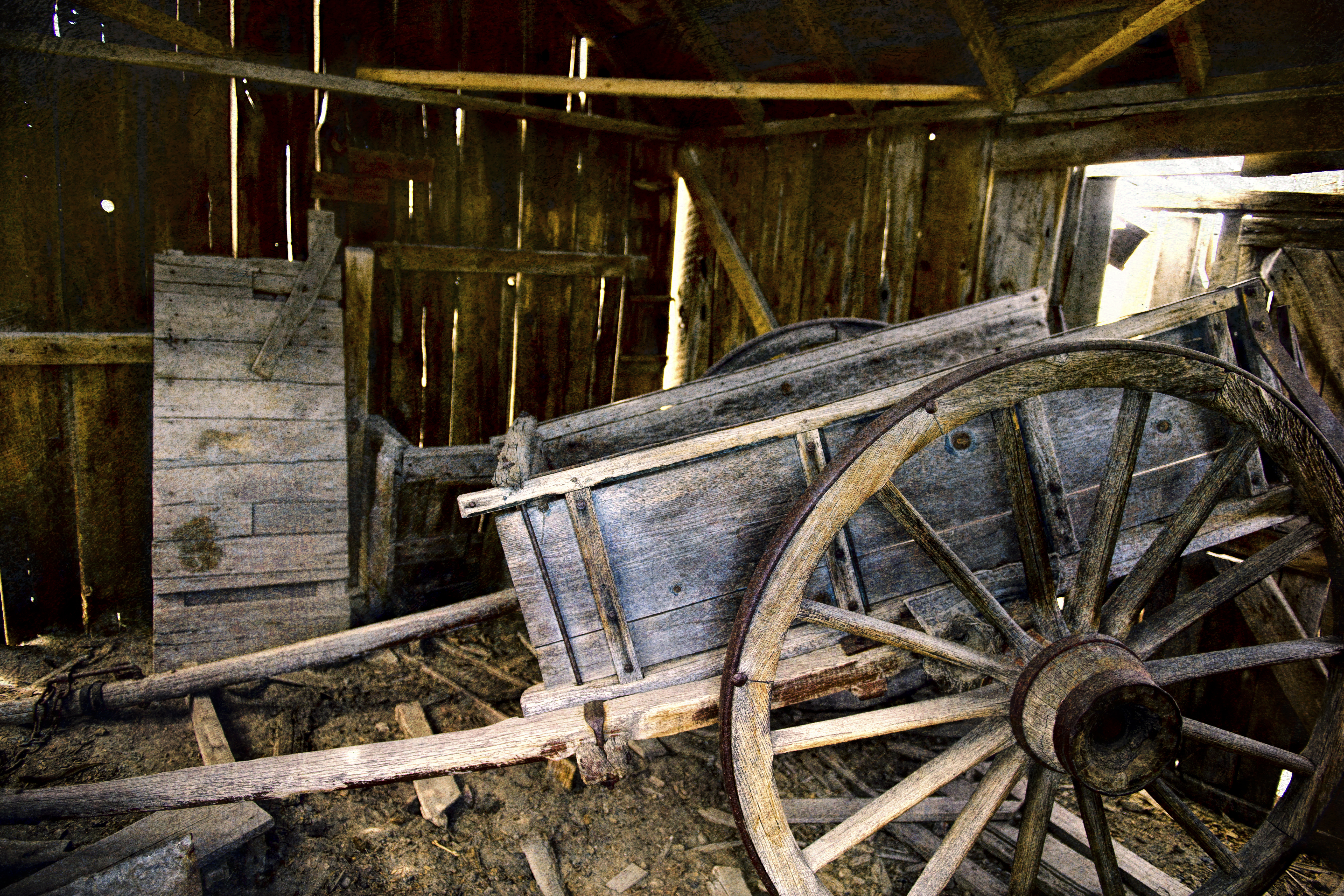
On a windy and overcast day several weeks ago, we  visited Bodie, a ghost town in the Eastern Sierra at an elevation of more than 8000 feet. What remains of Bodie is a fascinating ghost of its gold-mining past, long since abandoned to the elements.  A gold strike in 1859 was one of the richest gold strikes in California and for a time, Bodie became a boomtown and both gold and silver mines operated there for decades.  Bodie is now in a state of “arrested decay” after fading away in the 1940’s and it is now a California State Park.

Bodie wagon.jpg

2016—Woot!

The Placer Camera Club’s annual awards presentation took place Tuesday evening.  There were two kinds of awards presented at the meeting:  awards for best projected images, selected from those images that members submitted for judging during the year; and awards for best prints selected by popular vote from the membership.  We were allowed to submit 8 images in the projected image competition and three prints.  I have focused my photography so narrowly this past year  that most of my images eligible for the competition were wildlife, in the Nature category, and I had to choose which images to submit for final judging.  In the end, I submitted 5 Nature images and 3 Open category images.  The Open category is a catch-all for images that don’t fit any of the other categories.  For the print part of the competition, I submitted 2 Nature prints and one landscape print.

Every year as a way to announce the annual winners, the president of the club puts together a magnificent slide show that features each of the winning images by category, starting with honorable mentions and ending with images of the third, second, and first place awards.  The slide show exhibits the best images from club members and there is a lot of talent in my camera club.  It is always a thrill to see one of your own images projected as one of the honorable mentions or place winners.  This year, I was astounded to win first place in the two projected image categories in which I submitted entries.  And, in the print competition, again I was amazed to win first place in both of the categories in which I submitted prints.  I am honored, humbled, and simply blown away by my awards.  But the biggest thrill of the evening for me was to see that the slide show’s final image was my photograph of “The Fish Thief” and that image is the Placer Camera Club’s 2016 Photograph Of The Year!  Woot!

First Place: The Fish Thief –Nature Category-Projected Images
Photo of the YearHaines, AK Day 3-5931


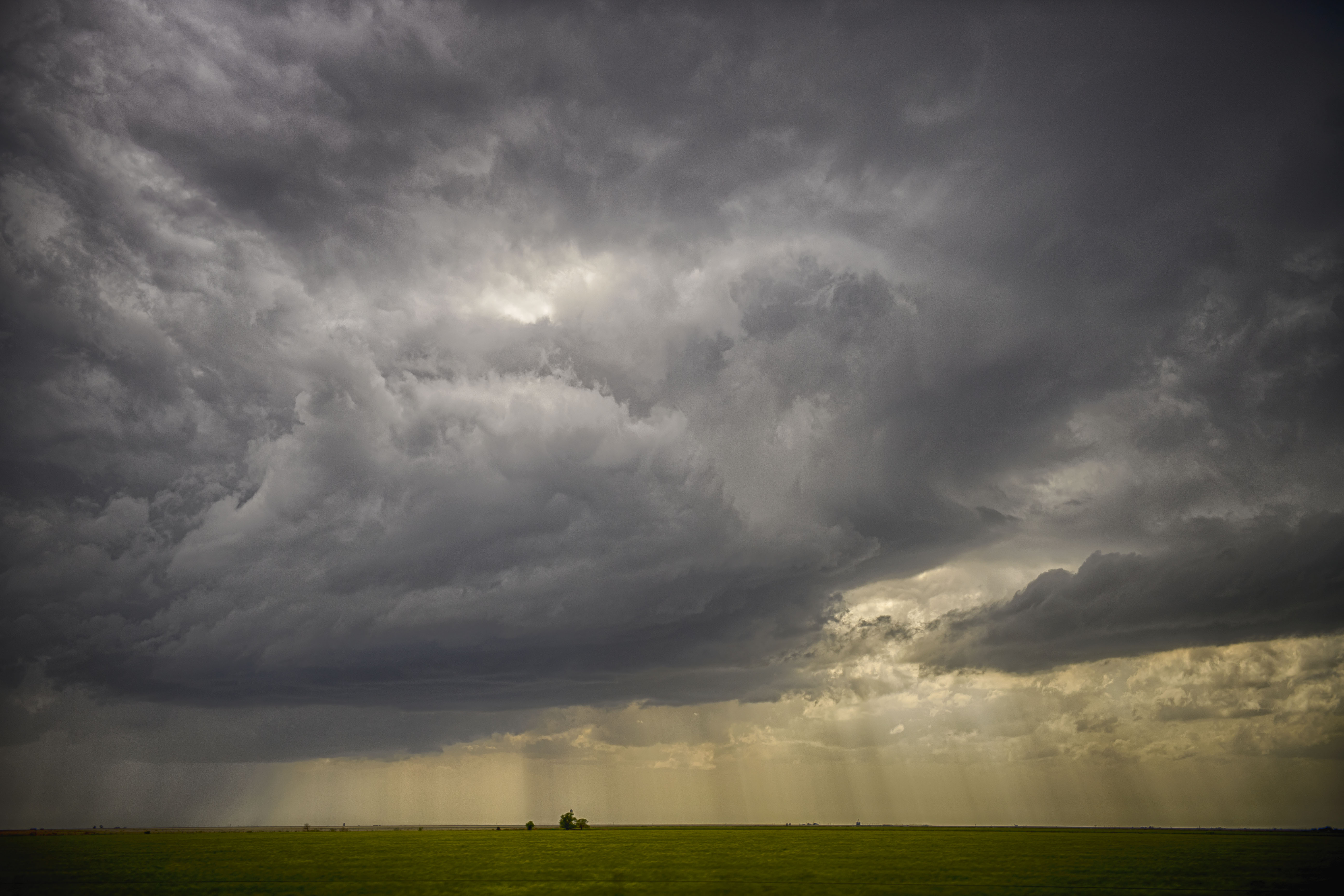
First Place: Storm Brewing –Open Category-Projected Images Storm Brewing

First Place:  Great Egret In Breeding Plumage – Nature  Prints CategorySt. Augustine Day 3-0238

First Place:  Milky Way – Landscape  Prints Category Milky Way 20161627-1


2016—Produce Of USA

I wish I could pass off these lovely tomatoes as my own but the prominently featured “Produce of USA” sticker prevents me from doing so.  My own paltry tomato crop, such as it is, remains green, not a hint of red on any of the fruit.

Tomato Truth.jpg


2016—Study In Red And Blue

The weather has been very mild today so mid-afternoon, I took Big Bertha outside to see what I could see.  There was a lot going on, actually.  The hummers were complaining about the nearly empty feeders and one male was keeping another hummer from feeding at all and the fledgling scrub jay was lurking in the shrubbery and the lesser gold finches were bathing in their separate fountain baths.  I saw a red flame skimmer dragonfly whiz by and land on the tip of a dead branch at the top of the shrubs.  Dragonflies tend to sit for long periods so I never did get a shot of it in flight and it was parallel to the twig it perched on so the body is somewhat obscured, but the wings were outstretched and I thought the stark contrast between the red dragonfly and the brilliant blue sky was interesting.

Study in red and blue.jpg

2016—Baby Blue

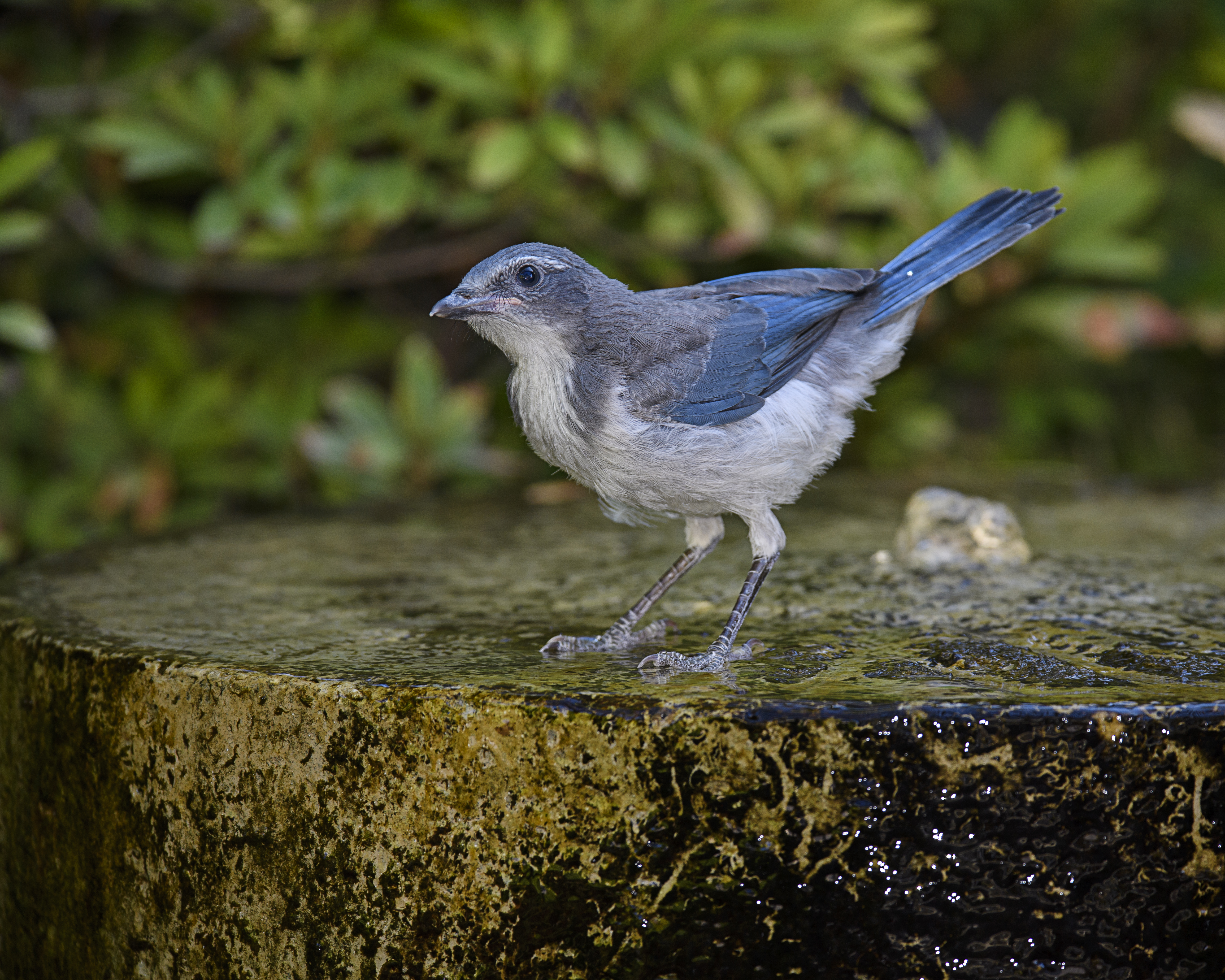
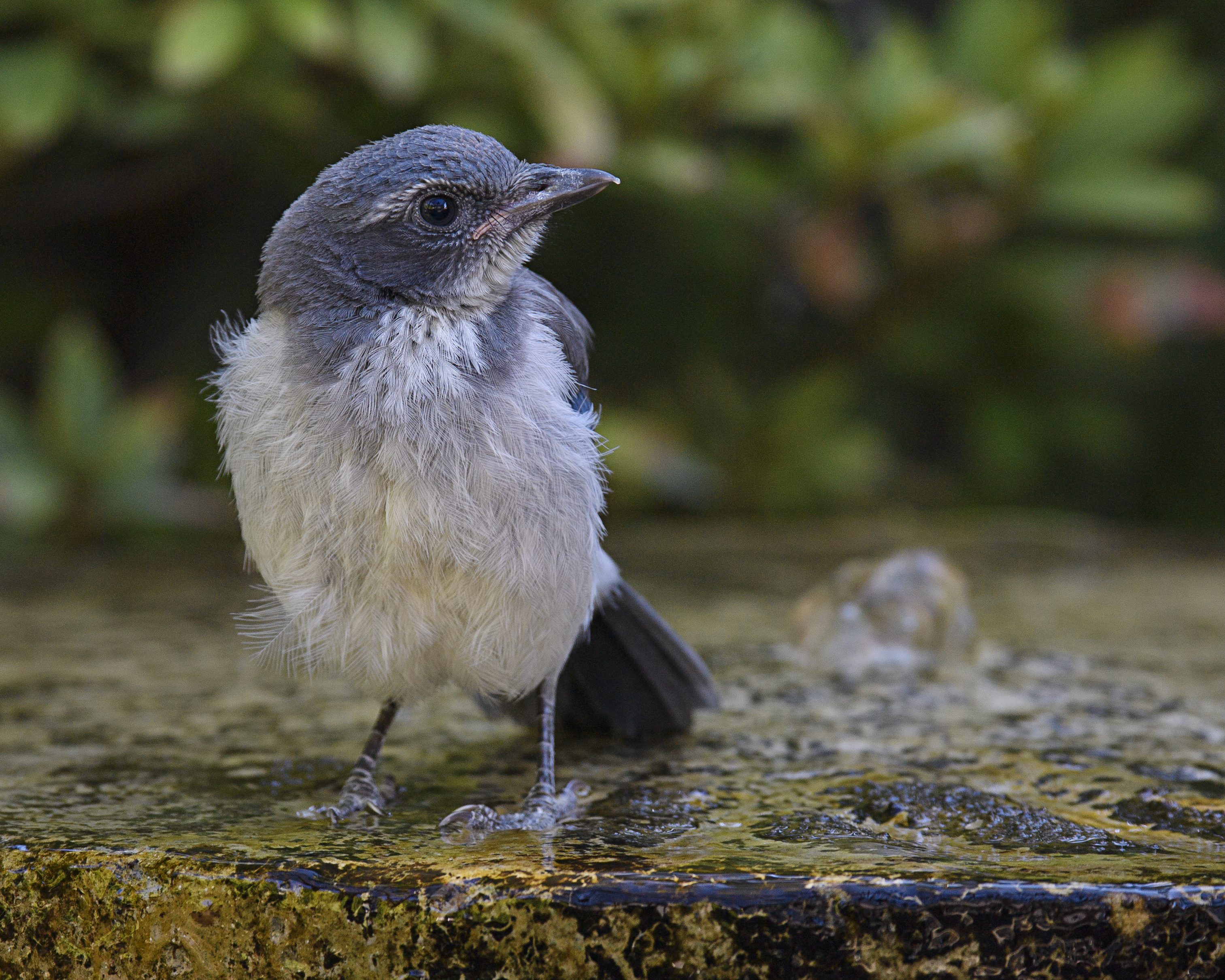
The scrub jays seem to have had a late season nest and this is the result.  I’m not sure if there are more nestlings than this one.  I watched the jiggling leaves in the shrubs behind the fountain so I was ready when this little one made its way down to drink and take a quick bath.  The first was full frame; the second, high-speed crop.

Baby Blue 2Baby Blue


2016—A Place For Everything…

… and everything in its place.  I have slovenly tendencies and things pile up around here quickly. If I didn’t get electronic bills I’m certain I would have long ago drowned in a sea of paper pulp.   But my camera gear gets better treatment than my everyday piles of newspapers, magazines, and endless papers.  I have tried different approaches to storage of my cameras, lenses, tripods, and related gear but until now, nothing was conveniently in one place.  I had some lenses and cameras in a couple of drawers, tripods and heads leaned in a closet,  other related gear upstairs, downstairs,  and in drawers and closets.  It was maddening to find a filter or a remote when I needed it quickly.  That all changed when I found the perfect tall chest at Crate & Barrel.  It was delivered the other day and I was ready for it with pick and pull foam to line the drawers to keep things from moving.  The chest fits three tripods in the bottom drawer, ten lenses, three cameras, 3 teleconverters  in the three middle drawers; chargers and batteries fit in one of the top drawers and the cupboard holds flashes and everything else on two shelves with a couple of organizers inside.  I still have one large drawer almost empty and one of the top drawers is completely empty.  The only thing that doesn’t fit inside is my 600mm lens which would actually fit in one of the large drawers if I took the lens hood off, which  I don’t want to do. For now, Big Bertha remains in her safe hiding place.  So now, I can finally say about my camera gear, I have a place for everything and everything is in its place!

When I took the photo, it was getting dark.  The lamp turns on automatically about 6PM.  I couldn’t get an exposure that would show off the colors of the glass lampshade and the colors of the recycled wood on the fronts of the drawers of the tall chest.  The three center drawers are faced with metal painted black.  I finally decided to bracket and merged the photos into an HDR photo.  The HDR still doesn’t show off the colors of the lamp well.

Here’s my new tall chest; it sets in my living room.  I haven’t yet framed the Milky Way shot perched on top, but when I do frame it, it will hang beneath the moon photograph.

New tall chest.jpg

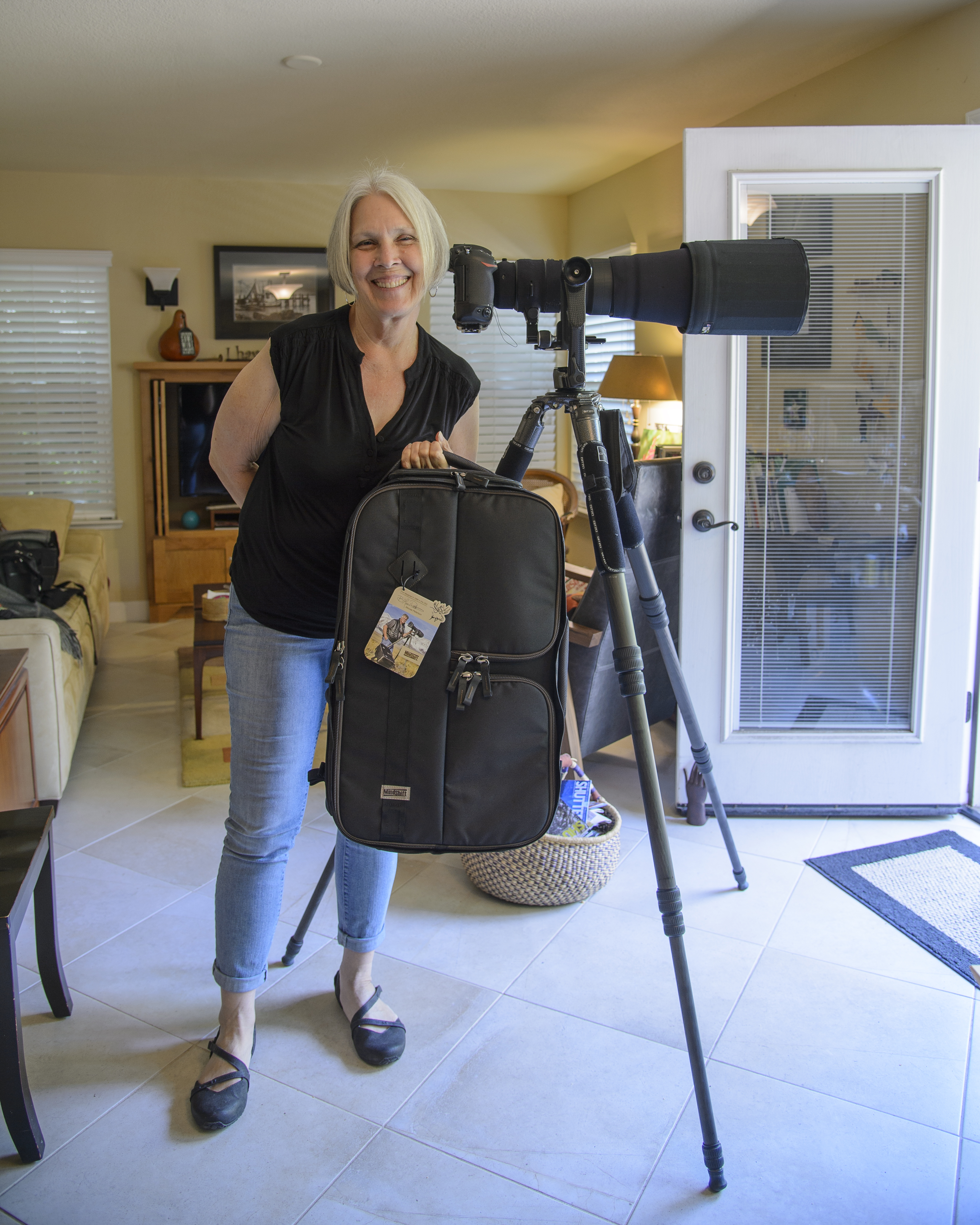
The other new photographic organizer that just arrived is my new MP-1 V.2, a Moose Peterson designed backpack that will hold my 600mm lens with the D5 attached along with another camera, several lenses, speed lights and everything I need for one of my many upcoming photographic safaris.  Whenever I go on a photography trip, I agonize over what to carry my gear in, fearing that it might not fit in the airplane’s overhead compartment.  This is not a problem in large jets but regional airplanes have very limited space and most carryons won’t fit in them so they must be tagged and gate-checked, something I won’t do with my expensive camera gear.  In fact, on two occasions earlier this year I was ready to leave the airplane when the flight attendant insisted on gate checking my gear but in both cases, a sympathetic pilot intervened and allowed me access to the crew’s closet.  The beauty of the MP-1, which has been out of production for several years and was not available until Moose recently redesigned it, is that it will fit into any airplane overhead.   I was at Moose’s house last December for some one-on-one instruction for using my 600mm lens the same day the final version of the MP-1 arrived at his house.  I have been on several trips with Moose since then and I have watched him even fit the case into a bus overhead compartment.  I’ve wanted one for years and now, I have my own.  No more worries or near melt-downs when I board an airplane with my gear.  I took this shot to send to Moose to let him know 1) that my MP-1 arrived and 2) that I’m practicing with my big lens.

mp-1v.2.jpg

2016—Echoes Of Color

When my friend Melinda was visiting San Francisco from Arizona a few weeks ago, I took the opportunity to visit her there and we spent the day wandering along the Embarcadero.  Our original plan was to spend the day with our cameras taking photographs but we stopped for lunch at La Mar Cebicheria Peruana, a delightful Peruvian restaurant on the waterfront, and found ourselves catching up . . . for about three hours!  The entry to this very upscale restaurant featured rows of tall vases filled with water and with a comparably tall flower submerged in each.  This is a shot that I enhanced with one of the oil paint filters in Topaz Impressions.

Echo Vase.jpg

2016—Almost, But Not Quite

They say chicken should be cooked to 165° F. in order to be safe from food borne contaminates.  These rosemary lemon chicken skewers I was grilling Wednesday evening are a degree shy of safe in this photograph but within seconds, I’d overcooked them because I was fiddling around trying to take photographs when I should have been paying attention to the food.  I decided to take photographs of my new instant read kitchen thermometer that had arrived earlier in the day.  After my third digital instant-read thermometer in as many years bit the dust I decided to splurge on what I know to be an excellent piece of kitchen equipment.  The Thermapen has been recommended by Cook’s  Illustrated , the same people who produce America’s Test Kitchen, for many years that I know about.  But, instead of paying $99 to get something reliable that would pay for itself, I kept buying cheaper versions ranging in price from $10 to $40.  My new Thermapen MK4 (hmmm, I’m wondering if there might be a connection to my Lincoln MKZ!) arrived Wednesday just in time to let me instantly check the temperature of the food I was grilling.  And, unlike all of the other thermometers I’ve tried, this one DOES read instantly.  I won’t have to wait  for the thermometer to get to temperature  anymore while my hand sizzles from the hot coals.

Thermapen.jpg

2016—Impressionist Sunflower

Not quite Van Gogh-ish  but still a little impressionistic.  My friend Cheryl and I ventured out to photograph sunflower fields in Woodland at sunset last week.  The sun dipped down and the light disappeared almost immediately.  There was no after glow.  I had a flash with me and used it but I couldn’t get it set to create a natural looking light.  Then the wind came up and any chance of getting a decent photograph disappeared.  I also discovered that the shutter speed on the D5 wouldn’t go below a setting I used for flash, even with the flash turned off so most of my photographs were disastrous.  I contacted Nikon to ask what I might have been doing wrong.  Nikon responded that they were assessing the problem.  So, I asked Moose Peterson.  He told me that there is a bug he first reported to Nikon more than a month ago.  It turns out software that allows the D5 and the SB5000 speed light to work together wirelessly erroneously limits the shutter speed whether or not the flash is on.  I’m keeping my fingers crossed that Nikon will upgrade the firmware soon to fix the problem.  At least the problem goes away when I disconnect the wireless controller.

CEzanne Sunflower.jpg