The California Foundation for Birds of Prey’s open house last Sunday featured several free flight demonstrations. This is a Saker Falcon that Tony Suffredini flew over the open area at CFBP headquarters.

The California Foundation for Birds of Prey’s open house last Sunday featured several free flight demonstrations. This is a Saker Falcon that Tony Suffredini flew over the open area at CFBP headquarters.
The California Foundation for Birds of Prey’s annual Open House was Sunday afternoon in Lincoln, CA. I met several new birds this year and I also met Tony Suffredini who rehabs eagles for the CFBP. Tony is an animal trainer and his film credits are extensive. But for me, his most memorable achievements are the Windex commercials with the Pied Crows playing pranks on unsuspecting homeowners.
Tony brought several birds for a presentation but the highlight was a female Golden Eagle, as yet unnamed, who came to the CFBP a little over year ago as a non-thriving fledgling. After a year with Tony, she thrives and within another year, she’ll be released into the wild. Tony flew the eagle in a free flight demonstration that was a first for her and Tony in front of a crowd of people. She performed beautifully, chasing a remote controlled car that towed a jack rabbit lure. Unfortunately, the eagle flew away from the crowd, not toward the crowd. I hope that will change next year.
Here are two shots that I was able to get just before the flight demonstrations. The sun was harsh and directly overhead with no shade and I couldn’t move because I was wedged between a table and a tent. The bird has a few white feathers on the top of her head which are blown out from the sun beating down.


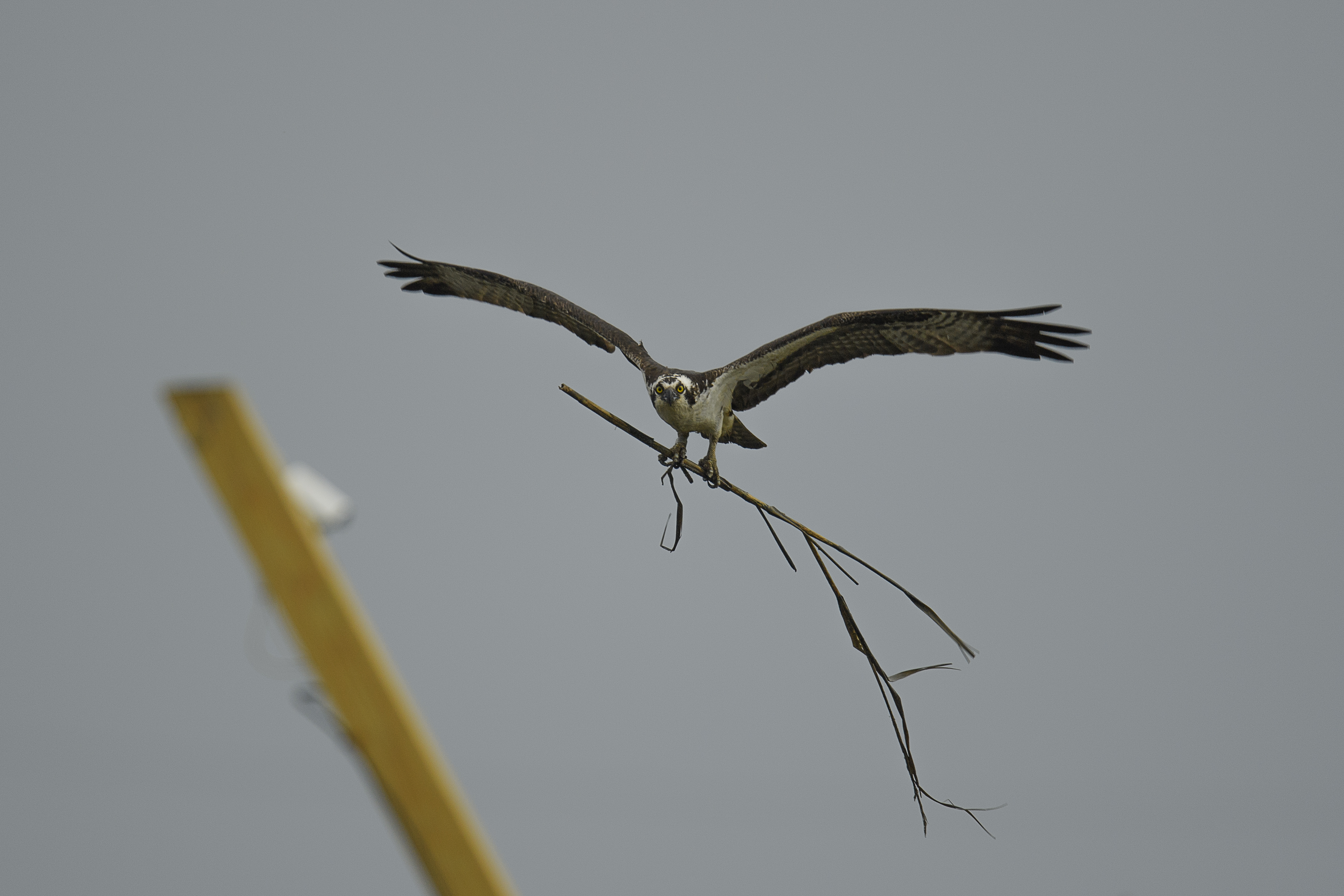
Although I’m starting to get the hang of photographing birds in flight, there seems always to be the proverbial “fly in the ointment.” We were photographing osprey building a nest near the East Point Lighthouse in Heislerville, NJ. An osprey platform had been recently constructed by a local 4-H Club and the osprey pair would fly off one at a time and return with a large stick to add to the growing nest. I had my 600mm lens focused on the area above the platform so that I could get a good shot as the large bird flew toward the nest and landed in it. At this distance it was impossible to avoid the dreaded man-made structure with its “osprey cam” on the left side of the platform but that didn’t concern me. It was what I discovered after I took the photographs that distressed me. As in the photograph I posted of this osprey a few days ago, the stick the osprey carries extends out of the frame and it appears that the bird is perched precariously on the thin stick instead of flying “free as a bird” so to speak. Aarrgggh! One more thing to consider. But, just to prove that the osprey isn’t precariously perched on a thin stick, I’ve include a second shot, taken a second or two before the first shot below, when the bird was a bit further away so the entire stick shows.
As I searched for the name of the nest location, I came across this disturbing article and video about the nest we photographed. The incident happened a few days before we were there but the article about it appeared a day or so after so I’m not sure when the incident was discovered. A group of disrespectful kids, hamming it up for the camera tossed a cigarette pack into the nest. There is a reward out for the identity of the perpetrators. The birds were not around when the incident occurred and seemed undeterred with the presence of trash in their nest. However, I must admit it wouldn’t have bothered me to see those large birds smacking those juvenile delinquents around a little. According to one article I read, the osprey have already buried it underneath more nesting material.
To follow the progress of the nest, you can view the live stream here.

The shorebirds were feeding in the mud flats in the Heislerville Wildlife Management Area near Delaware Bay in New Jersey. The winds were fierce much of the time we were in New Jersey and it was a challenge to steady the long lenses to maintain focus. Between gusts there were periods of calm and this was one of those times which allowed a nice reflection of this Lesser Yellowlegs.

In the past few years, since my introduction to wildlife photography by Moose Peterson, I have witnessed innumerable fascinating natural phenomena that I never dreamed I’d see — and some I didn’t even know I was missing. A case in point is one of the most amazing spectacles that I witnessed this week in New Jersey on Delaware Bay. In an annual ritual that has played out for hundreds of millions of years and lasts for only a brief period between the May and June new moons, thousands of shorebirds are drawn to Delaware Bay to feed on the eggs laid in the edge of the surf by horseshoe crabs, a primitive looking crustacean that predates dinosaurs. The eggs, about the size of BBs, provide a primary source of fuel for the shorebirds who are beginning their long spring migration to their northern breeding grounds.
In the morning hours just after dawn, we watched, awestruck, as masses of Sanderlings, Ruddy Turnstones, Red Knots, Willets, Sandpipers, and Dunlin, all in breeding plumage, performed aerial ballets over the water’s edge. The sound of their calls, along with the screeches of the gulls, was deafening. As they waited for the tide to ebb and reveal the eggs, they flew back and forth looking like massive schools of fish that instantaneously reverse direction en masse.
These Dunlin in breeding plumage effortlessly perform perfectly synchronized aerial maneuvers .


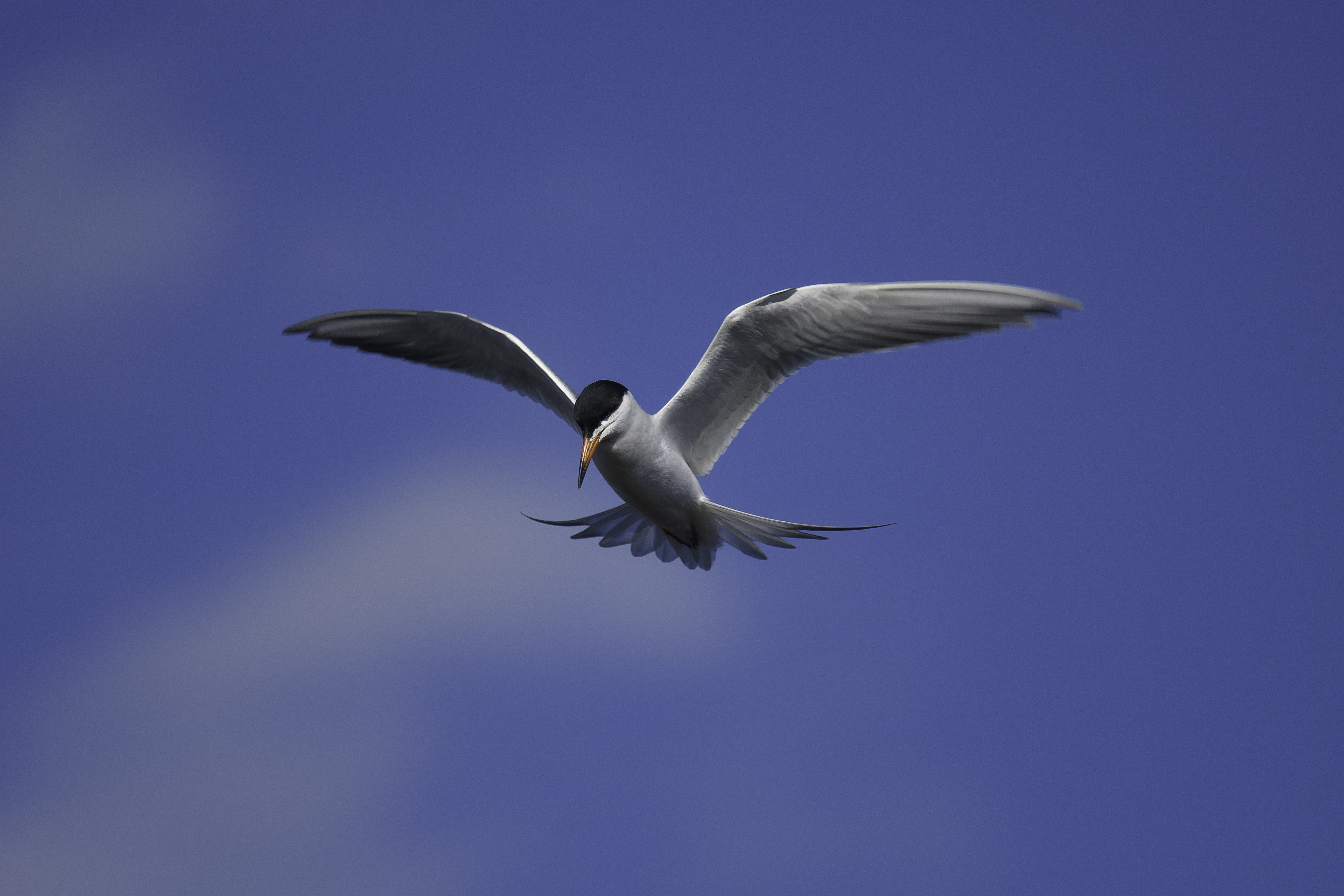
We returned to the terns Wednesday as these Forstner’s Terns continued their courtship rituals. The males hover in place over the water looking for a fish, their eyes providing a sort of 3D view of the water to aid in their search. Once they spot the gift, they plummet to the water to capture it and, if successful in their fishing efforts, they present their catch to their potential mates as a courtship offering. There was quite a bit of activity as several terns took turns hovering near us searching for the perfect morsel. Once again we had optimal conditions with the sun and wind at our backs so the terns faced us as they hovered.
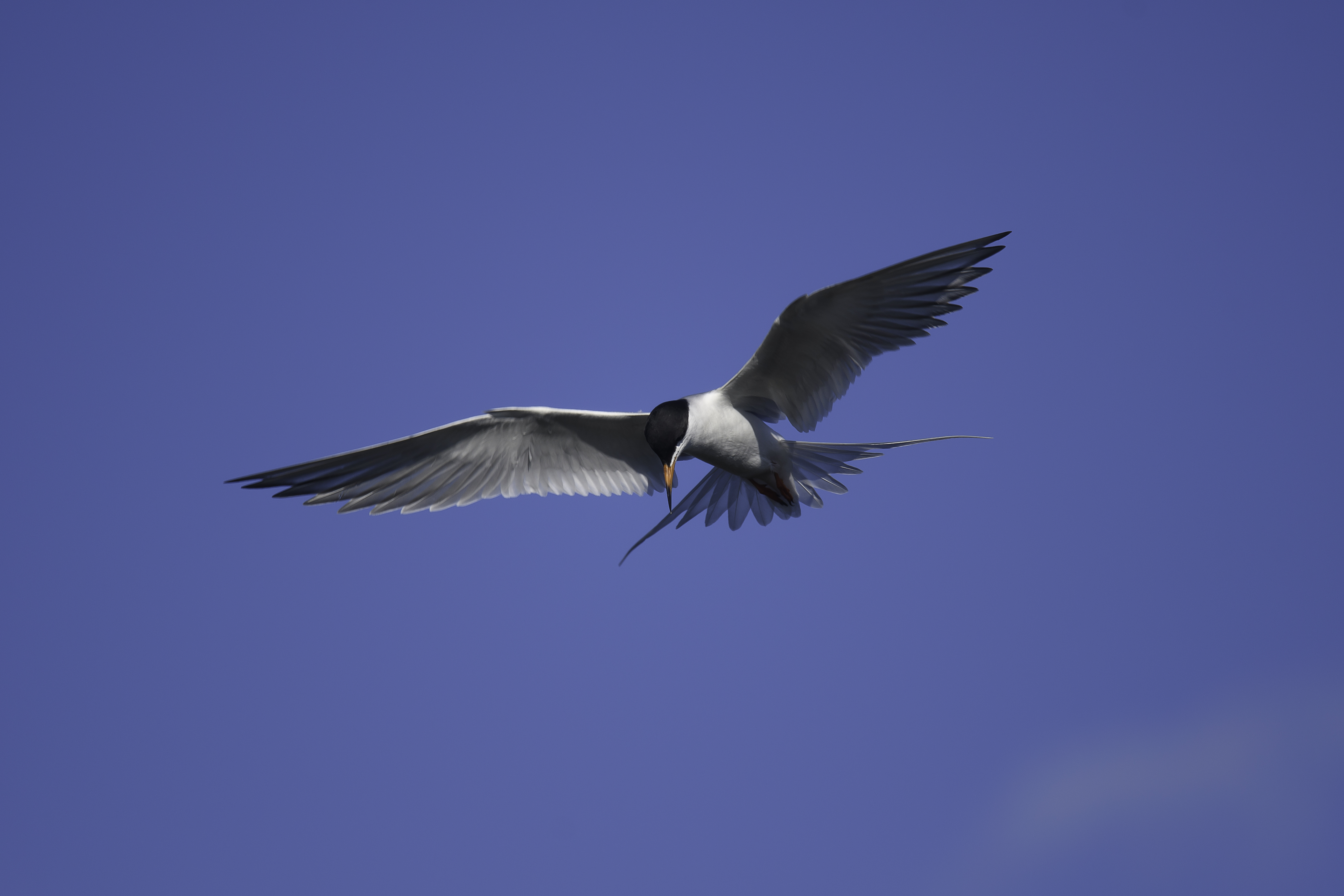
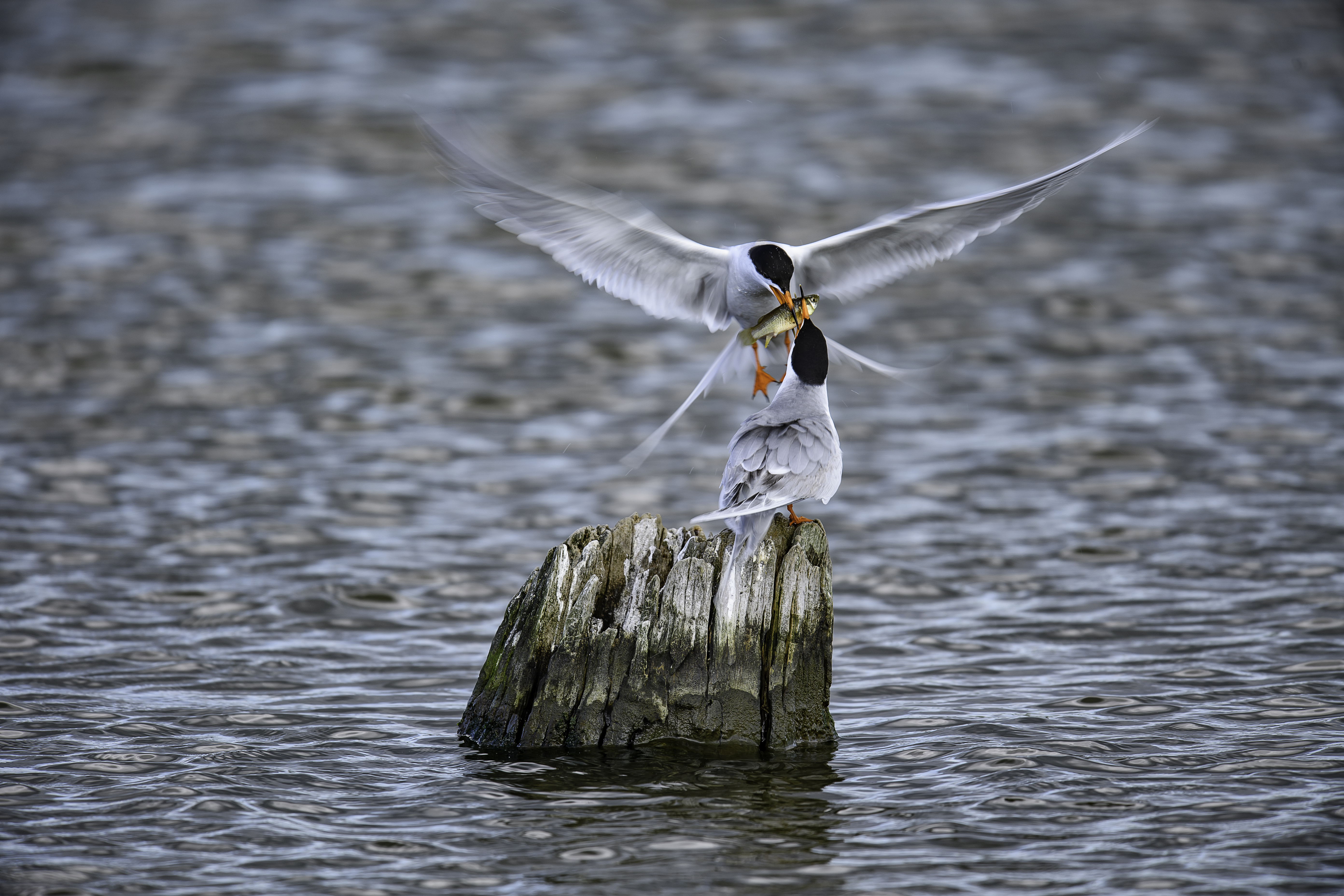
On our first afternoon in the Cape May, NJ area, we visited the Heislerville Wildlife Management Area and found a pair of Forster’s Terns perched on a stump jutting out of the water. We stopped to photograph the pair who were exhibiting mating behavior that we were hoping to capture in photographs. The male flies in and presents the female with a fish as an incentive to copulate. We watched for a couple of hours and took lots of photographs but, as Moose pointed out, there were two major elements needed in order to capture the behavior we sought and one was missing. To capture a good photograph of a bird in flight, it is essential that the light be on the bird so it needs to come from behind the photographer. The sun was behind us, when the sun was out. But, it mostly was a grey day and there was little sun in evidence. We watched the male fly in time after time but we couldn’t get the kind of photograph be sought because the wind, which was gusting at least 20MPH and probably more, was in our faces. Like airplanes, birds take off and land into the wind. As a result, they faced away from us when they took off and landed. If we were lucky, we got a side-landing shot.
On the second afternoon, we returned to the same spot and the same pair were on the same stump. Luck was with us or, as Moose pointed out, the wind gods were with us on this day. The wind was coming from behind and the sun was also, when it wasn’t behind the clouds. The previous day’s very high winds seemed to have kept many of the terns from doing much more than perching. Now, with the winds calmed a bit and the sun out, activity in the area increased. There were lots of terns seeking approval of a mate or trying to make a move on another tern’s potential mate. Our opportunities for good photographs increased significantly.
Here are a couple of examples:
First day, wind in our faces:

Second day, wind at our backs:
The sun was out for this shot and the male is landing into the wind, making a more dramatic and interesting landing photograph.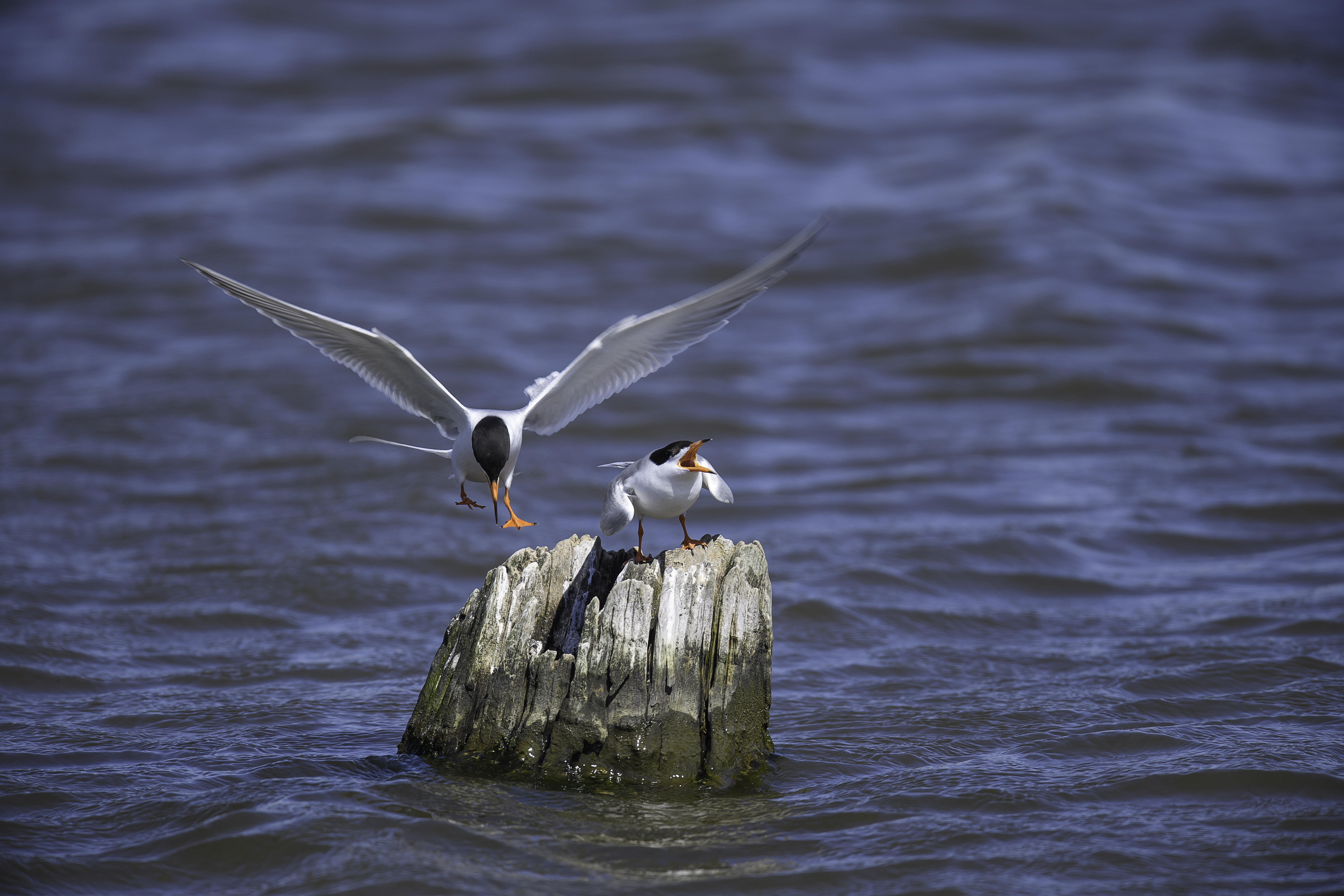
And, in this shot, although the sun had disappeared behind a cloud changing the light, I was able to capture the moment of the exchange when the male presents the fish to his mate. If the wind had not been at my back, I wouldn’t have been able to see the male presenting the fish to the female. Once again, one of the many lessons I’ve learned from Moose Peterson was proven true.
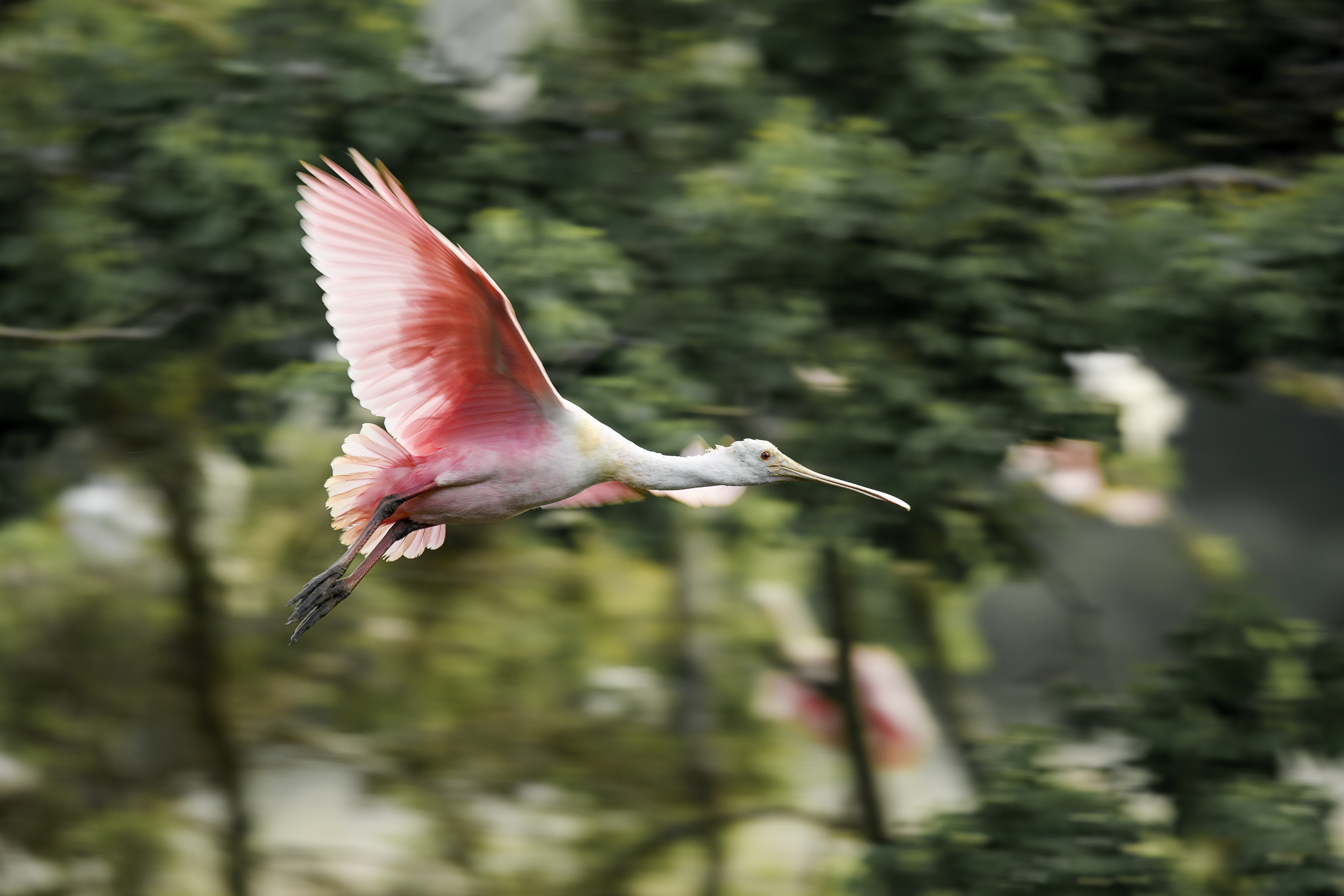
The Smith Oaks Rookery on High Island, TX was filled with Great Egrets, Snowy Egrets, Double-Crested Cormorants, and Roseate Spoonbills who were all competing for nesting space and nesting materials. This Roseate Spoonbill flies past nests in the rookery in search of its own nest or perhaps nesting materials. The white and pink blobs in the background are nesting Egrets and nesting Spoonbills.