2018—A Global View

The beautiful  C45 Expeditor held lots of fascination for me.  I couldn’t resist photographing  its gleaming nose reflecting the sky and the grassy field.  It started when Moose showed me a shot he’d taken that showed the horizon cutting through the center of the nose.  Richard took the shot one step further by using the fisheye lens at 8mm, creating a circle.  It was like a bubble in a bubble.

I tried but couldn’t get the shot because I’m a few inches shorter than Moose and Richard.  Even by stretching my arms up as far as possible, I couldn’t get the same effect.  So, I got a step stool and enlisted Richard to stand behind me in case I toppled over backwards.  I got the shot I was after.  Then, after a little Photoshop magic, I disappeared from the photograph.

FL - Hit & Miss Project 0532-1.jpg

And, here is the pre-Photoshopped image.   I am stretching up as far as possible on my tippy toes atop the step ladder, Richard supporting me to keep me from falling backwards.

FL - Hit & Miss Project 0532-1preedit.jpg

2018—Invasion Stripes


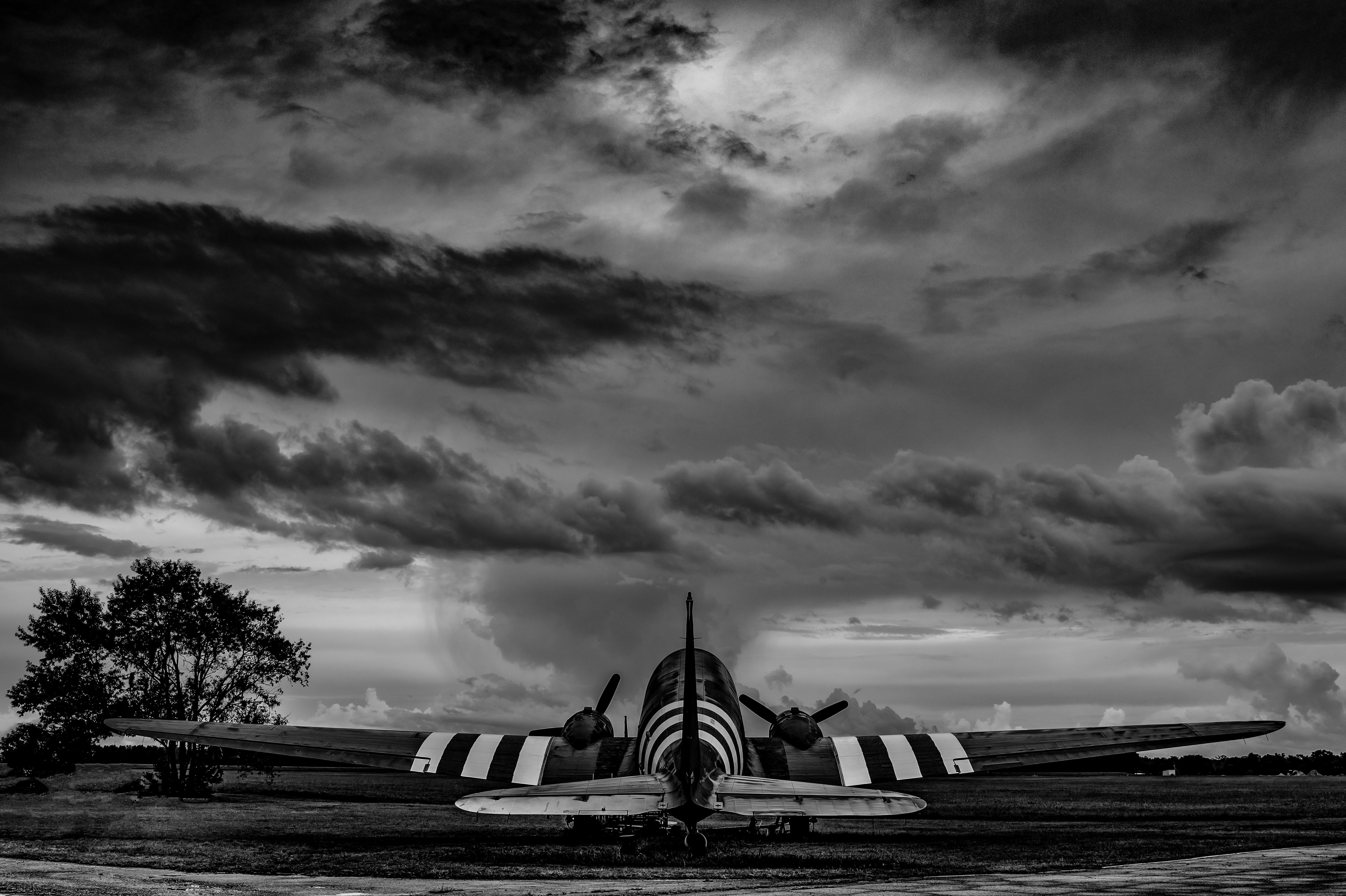
“In 1944, in the months leading up to the invasion of Nazi occupied France, the Allied planners of Operation OVERLORD realized that on the day of the invasion – D-Day – the skies over the invasion zone would be filled with aircraft: waves of Allied fighters and photo reconnaissance planes, bombers, troop-carrying gliders and their tow planes. They were expected to be met by fierce Luftwaffe opposition. The planners feared friendly fire – anti-aircraft fire from Allied naval vessels and Allied troops – against their own air flotilla, and pilots mistakenly engaging in dogfights against their own comrades in arms. The existing system for identifying friendly aircraft, Identification Friend or Foe (IFF), would in all probability be overwhelmed by the sheer number of aircraft over the beaches. To avoid fratricidal incidents, the D-Day planners called for paint and brushes, and ordered that the aircraft of the Allied Expeditionary Air Force and supporting units be painted with alternating black and white stripes on wings and fuselage – 18 inches wide on single-engine aircraft, and 24 inches wide for twin-engined craft. They were called invasion stripes.”

            —Above excerpt from the archives of  Smithsonian National Air and Space Museum

In this photograph, the C47 Hit or Miss from the Normandy Bound Project, in her newly painted invasion stripes is shown as she would have looked on D-Day.

FL - Hit & Miss Project 0916-1.jpg

2018—Another WWII Vet

During my three days volunteering on the Normandy Bound Project, I admired another WWII warbird at the site, a C45 Expeditor.  This beautiful, gleaming airplane, once used to transport military Brass, is going to accompany the squadrons of C47s flying to Normandy next year.  We arrived early Thursday morning so that we could capture it with the gorgeous cloud-studded sunrise behind it.

And, I’ll never forget the experience for several reasons.  First, it was my introduction to aviation photography and we had beautiful skies, an ideal background, and an eye-catching subject.   This was the kind of introduction that might get one hooked on the genre.   Second, the reason for our visit, the privilege of working on the C47, is memorable in and of itself.  And, lastly, this was my introduction to Florida’s mosquitos.  Although I’ve been to Florida for bird photography a couple of times, I have never been bothered by mosquitos.  But, for this early morning shoot, we stood on the grassy field, apparently the hang-out for these man-eating critters.  This is when I discovered that Florida has mosquitos that are not deterred by Deet or clothing.  Since I have rather violent reactions to mosquito bites, I try to avoid them.  But to my surprise, the Deet I applied to my exposed arms and ankles had only the slightest effect because they still nibbled my Deet-covered ankles and arms in a few places.  Even worse for me, as I was shooting and moving around to capture the best light, I could feel the mosquitos stinging my back through my shirt.  I ended up with more than 30 bites on my body and legs through my shirt and my jeans.  Several days later, I’m still dealing with the itching, the welts, and the blisters.  I actually own something called a “bug shirt,” a bulky, ridiculous-looking garment that envelopes the upper body completely and is meant to protect one from biting insects more treacherous than mosquitos.  It was home in California but if I find myself returning to Florida to work on the project again, it will most certainly accompany me.

FL - Hit & Miss Project 0251-1.jpg

2018—Normandy Bound Project

I just spent three days in Zephyrhills, Florida volunteering on the Normandy Bound Project.  The project includes the restoration of a World War II C47 that will join squadrons of other C47s from the US and fly to Normandy, France in June of next year to commemorate the 75th anniversary of the Allied Invasion that began June 6, 1944, commonly known as D-Day. It changed the course of history and ultimately led to victory by the Allies in western Europe.   My participation in the project was on behalf of my friend and photography mentor, Moose Peterson whose company, Peterson & Sons, is filming a documentary that begins with the restoration effort and will culminate in the celebration in France next year.

This C47 is called “Hit and Miss.”  I met her on Wednesday morning.   She is an impressive Lady and although she was not one of the aircraft that invaded on June 6, she did arrive in Normandy on D-Day + 9.  She got her name because on another mission, she led a squadron of C47s and she was the only airplane in that mission to return home.

On that first morning, my friend Richard and I were assigned the task of degreasing her underbelly in preparation for painting.  The weather was hot and muggy and the work was messy and dirty, but “Hit & Miss” shaded us from the most brutal of the sun’s rays.  We spent hours scrubbing grease, grit, and grime away from the rivets.  At the end of the day, we were greasy, gritty, and grimy ourselves and our clothes were saturated with whatever chemicals we used to scrub it clean.  Every so often, intermittent summer rainstorms forced us to retreat to the hanger where we watched the lightning strikes and waited for the deluge to stop  before returning to the task at hand. 

It is an honor and a privilege to contribute to this effort and to actually touch a part of history.  This group of dedicated people is making sure that future generations will be able to appreciate the importance of D-Day and the Allied Victory in WWII.   Please click here for more information about the project.

FL - Hit & Miss Project 1134-1.jpg