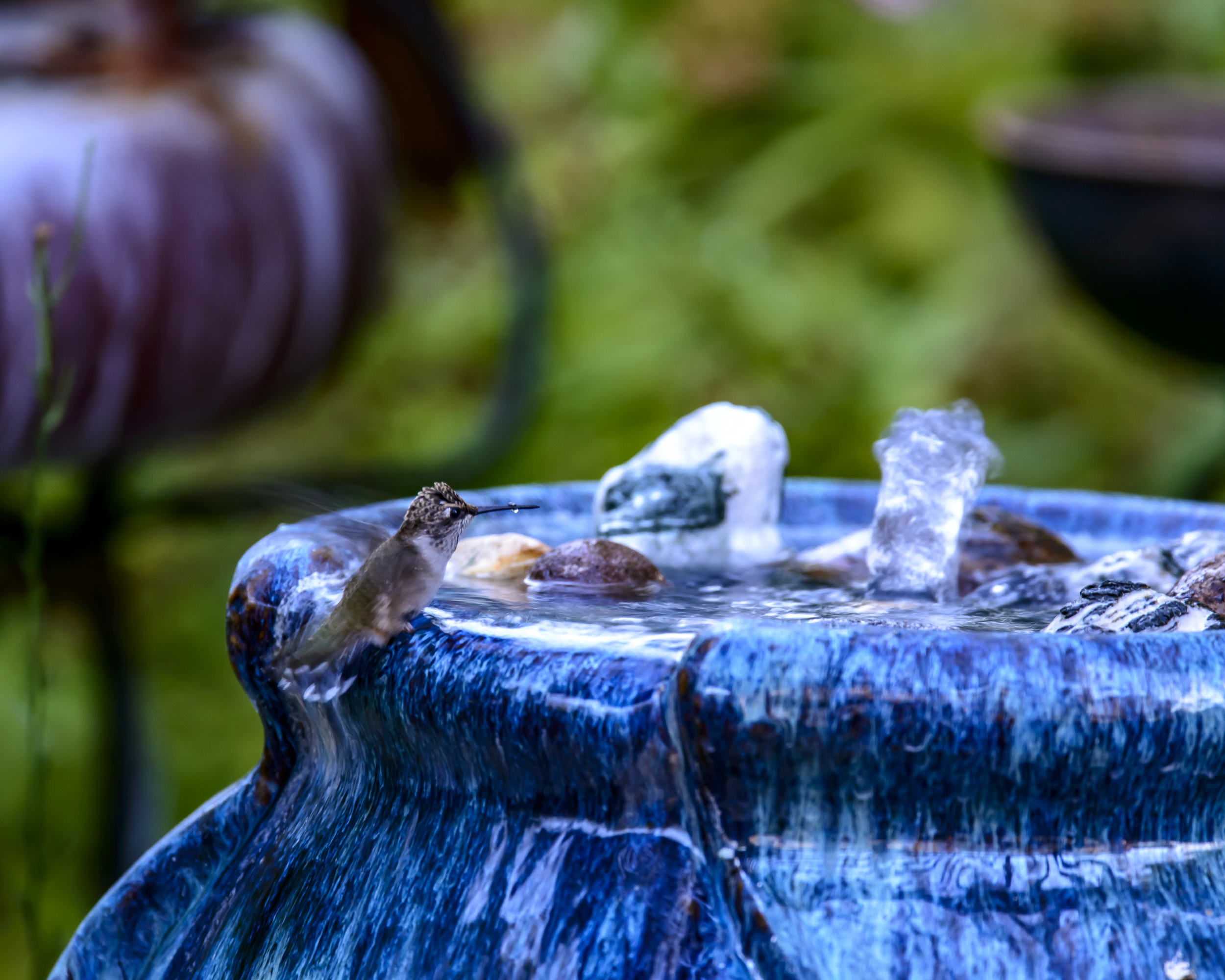
I’m still practicing on the hummers with the 600mm lens. I think these shots of the female hummer as she wallows in the runoff from the fountain are priceless so I cropped them for a closer look.


I’m still practicing on the hummers with the 600mm lens. I think these shots of the female hummer as she wallows in the runoff from the fountain are priceless so I cropped them for a closer look.
The dehazing filter in Lightroom really helps add drama and clarity to photos. I have been reviewing more of my photos from my Moab trip last April and I’m finding more that I like, thanks to the dehazing filter. The skies were really quite dramatic.
I took the first two shots at Double Arch using the fisheye lens. The other two shots feature petrified sand dunes in the fore ground. The Le Sal Mountains are in the background of the second shot.


I thought I’d take a break from birds (not that I didn’t take hummingbird photos on Friday – I did) and a break from my latest project, decluttering my house. I took three full carloads of clutter to the SPCA Thrift Store, and that is just the tip of the iceberg. To offer a bit of variety to my blog topics, I finally took a look at my Flickr Daily Challenge group topics. I’ve been so busy with so many things lately that I’ve neglected my Flickr group which has for years, supplied me with ideas for my daily blog photos. A quick check and I realized I had already unknowingly met one of the challenges from a couple days ago, Multiples, with my More Bathing Bushies post. Another recent topic was Fragile and it brought to mind a book called The Primer that my mother used herself in 1923 when she was about 6 years old, the age at which children used to begin to learn to read. I have had possession of this book for as long as I can remember and I know all of its stories and vintage illustrations well, probably as well as the Dick and Jane series that taught me to read. And it is apparent that I had possession of it as a young child because there are red crayon and pencil scribbles throughout the pages along with the occasional awkwardly crayoned word. The pages are frayed and yellowed and torn and taped together in several places with yellowing cellophane tape that has cracked over time. Both the book and its repairs are quite fragile. And I didn’t consider it clutter so I kept it.
I processed the photo using Perfect Effects 9 to add an even more fragile and vintage look to the pages.

Even I’m starting to get bored with some of my hummingbird shots. They are so repetitious and the light is so poor when I shoot them that they are hardly interesting. I’m happy that I’m managing to get decent focus but I need to take my friend Richard’s suggestion to get out the Better Beamer that we used in Costa Rica to illuminate the darkness of the rain forest. He suggests it might add a little pizazz to my hummingbird photographs. But, I’ll try that another time.
I’m still practicing with Big Bertha and trying to get used to the heft and feel of her as I pan and shift the ball head. I have trouble walking and chewing gum at the same time so this action is proving quite difficult for me. I’m trying to picture myself carrying the entire massive contraption including the tripod on my shoulder and walking through the rain forest or through a snowbank or across a rocky precipice. My fellow photographers all did it so I’m hopeful that I’ll be up to the challenge before I head to Alaska in November. I hope that time and practice will be my friend and also that the gimbal head arrives soon. I hope I’m not expecting too much from the gimbal head, but time will tell.
As I reviewed the shots I took of the male hummer on Thursday morning, I wondered what would happen if I aligned and blended them in Photoshop like I do with some of my macro shots. I was tickled with the outcome. These are four separate shots of a single bird, the male hummer. I blended two shots into each composite. I found that when I tried to add a third shot, one with the hummer laying in the water on the fountain, only parts of that bird were visible and crucial parts, like the beak and part of the head, disappeared. So, for now, I’m happy with two blended into one. I love the magic of Photoshop.


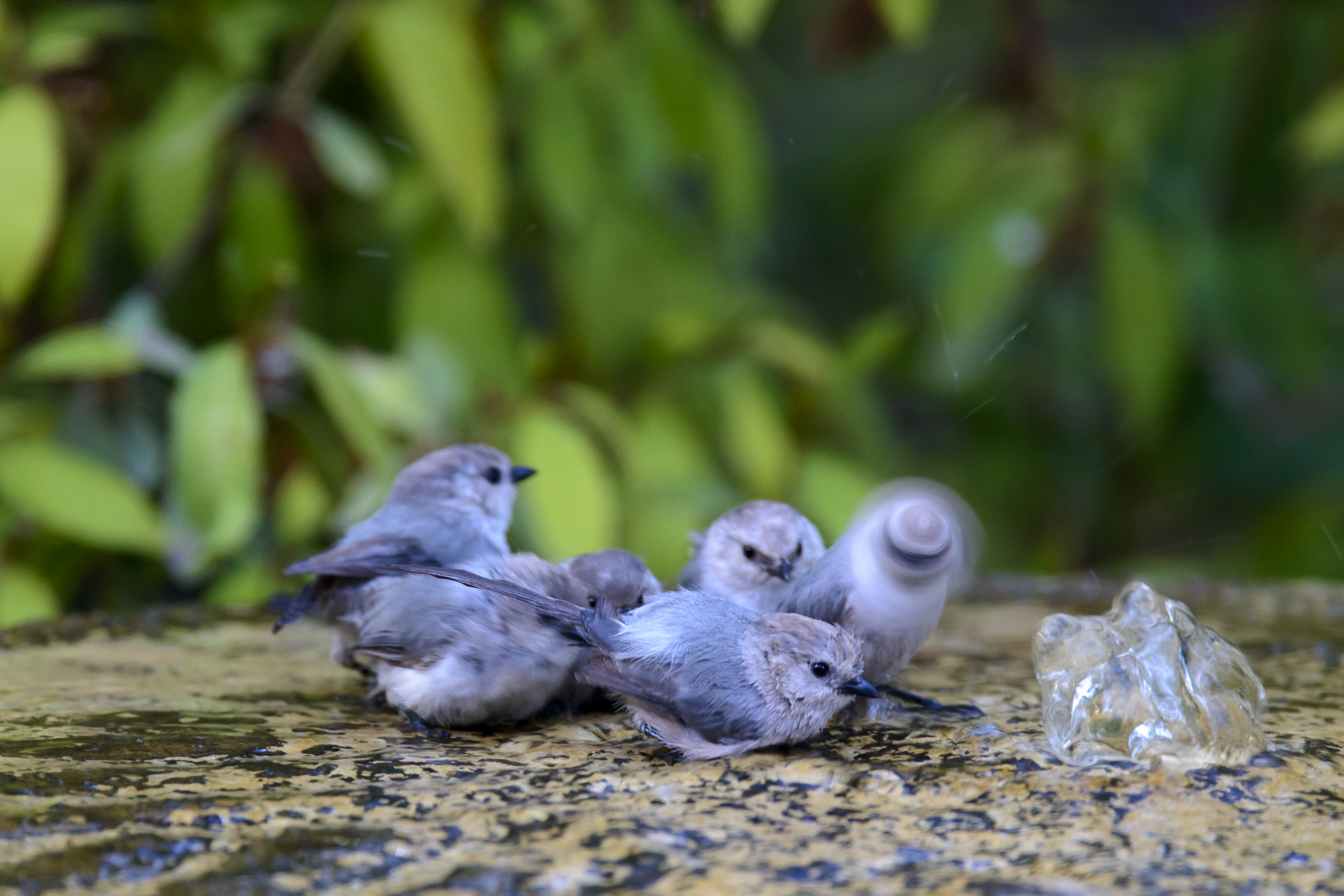
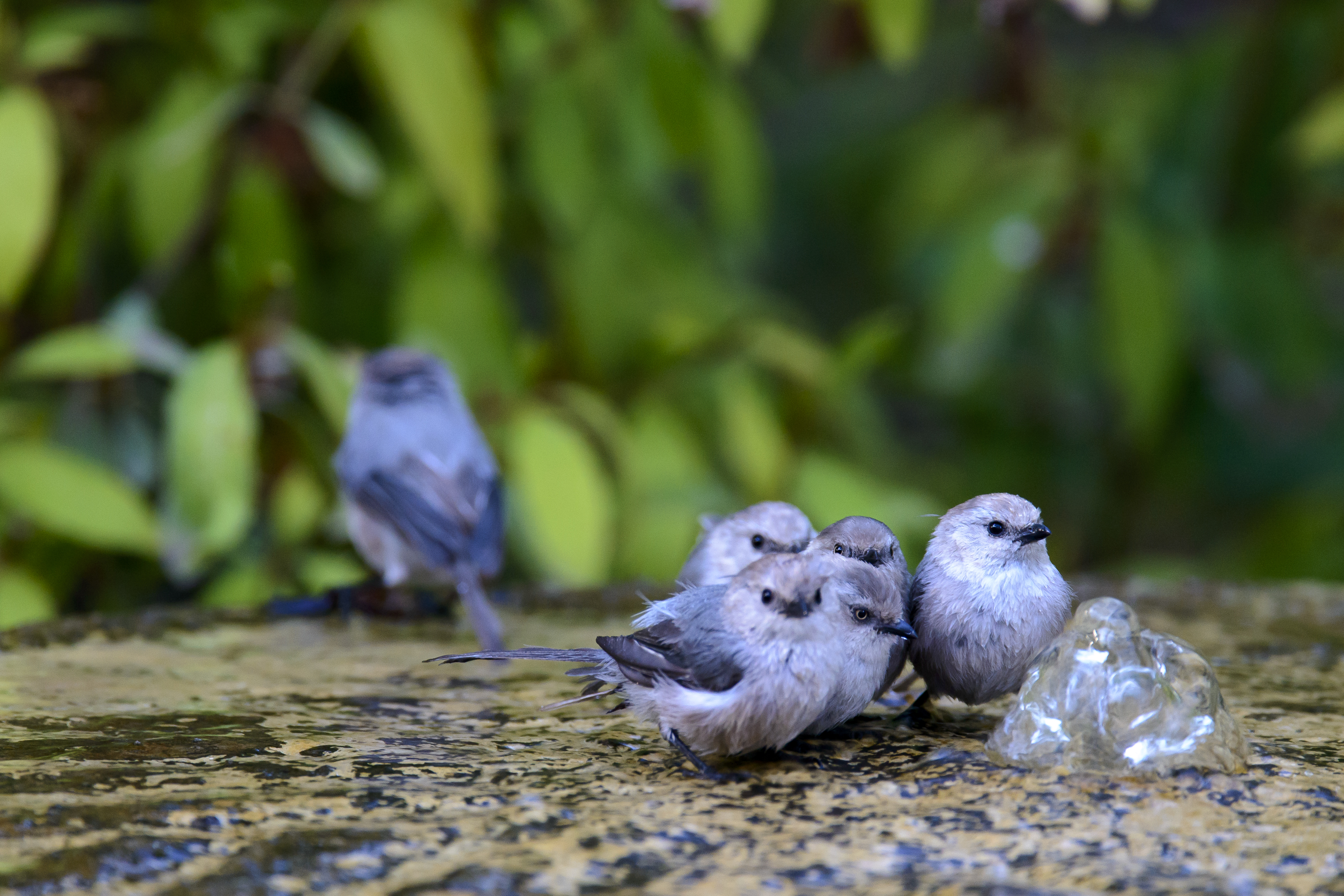
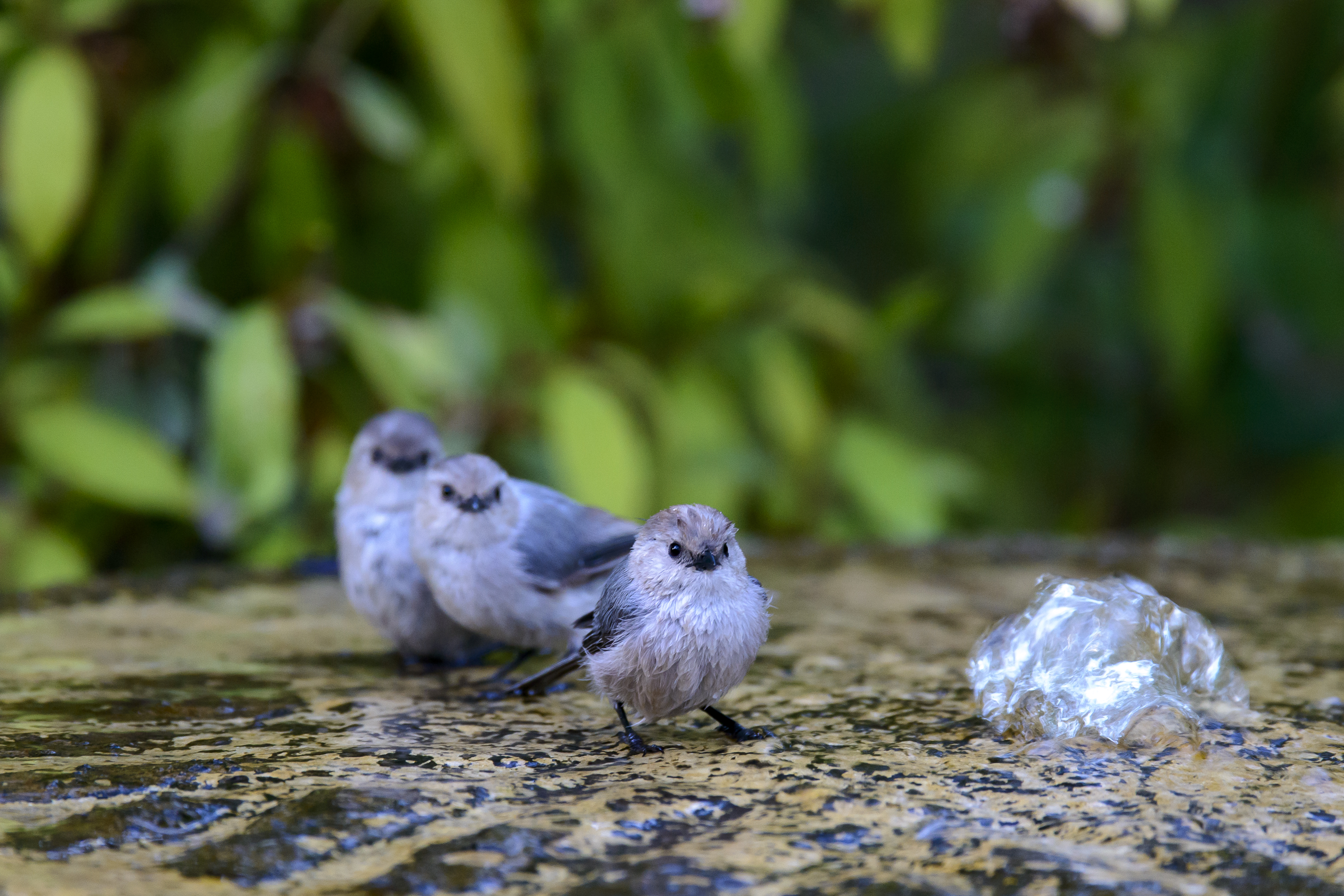
The little bushtits who spend most of their time in the oak tree in front of my house, arrived Tuesday evening to bathe in the backyard fountain. At one point, there were nine bathing at once but I couldn’t fit them all into the viewfinder! I had lots of wingtips and tails. I had set the D800 to high speed crop mode which, in effect, turns the camera into a DX camera. Add to that the 1.4x teleconverter and the 600mm lens, and the focal length is about 1200mm. From my patio doorway to the bubble in the fountain, the distance is 29 feet. These shots are not cropped.
The little bushies are only about a half inch larger (and a bit stockier) than the hummers so they are tiny little birds. I love their intense stares as they concentrate on their baths. They appear to be staring right into the lens which may be, as the seven inch diameter lens is really hard to miss! The males have black eyes and the females have a yellow cornea that makes them appear angry all the time.


Big Bertha and Big Nik finally met. Big Nik (AKA my Nikon D800) was gone for three weeks being cleaned and serviced by Nikon. During that time, Big Bertha (AKA my Nikon AF-S NIKKOR 600mm f/4E FL ED VR Lens) arrived so my D7100, a DX camera, got to try out BB first. Tuesday morning was Big Nik’s first real test with Big Bertha. And, I am thrilled with the results. I attached the 1.4X teleconverter making the lens 850mm.
I noticed the female hummer flitting near the blue fountain again and directed the lens there. I managed to capture a few shots in decent focus at a very slow shutter speed. This lens is exceeding expectations. I took the first shot at f/5.6, ISO 1000, 1/30 second shutter speed and the eye is in good, not tack sharp, but good focus. I upped the ISO to 8063 which resulted in a shutter speed between 1/200 and 1/250 for the other shot. By this time, the hummer had finished bathing and was preening. I was very happy to capture some preening shots with really great gestures, including this one. Mani-pedi anyone?
I cropped both shots to 8X10 to move the bird out of the center of the frame and to make up for my poor composition.
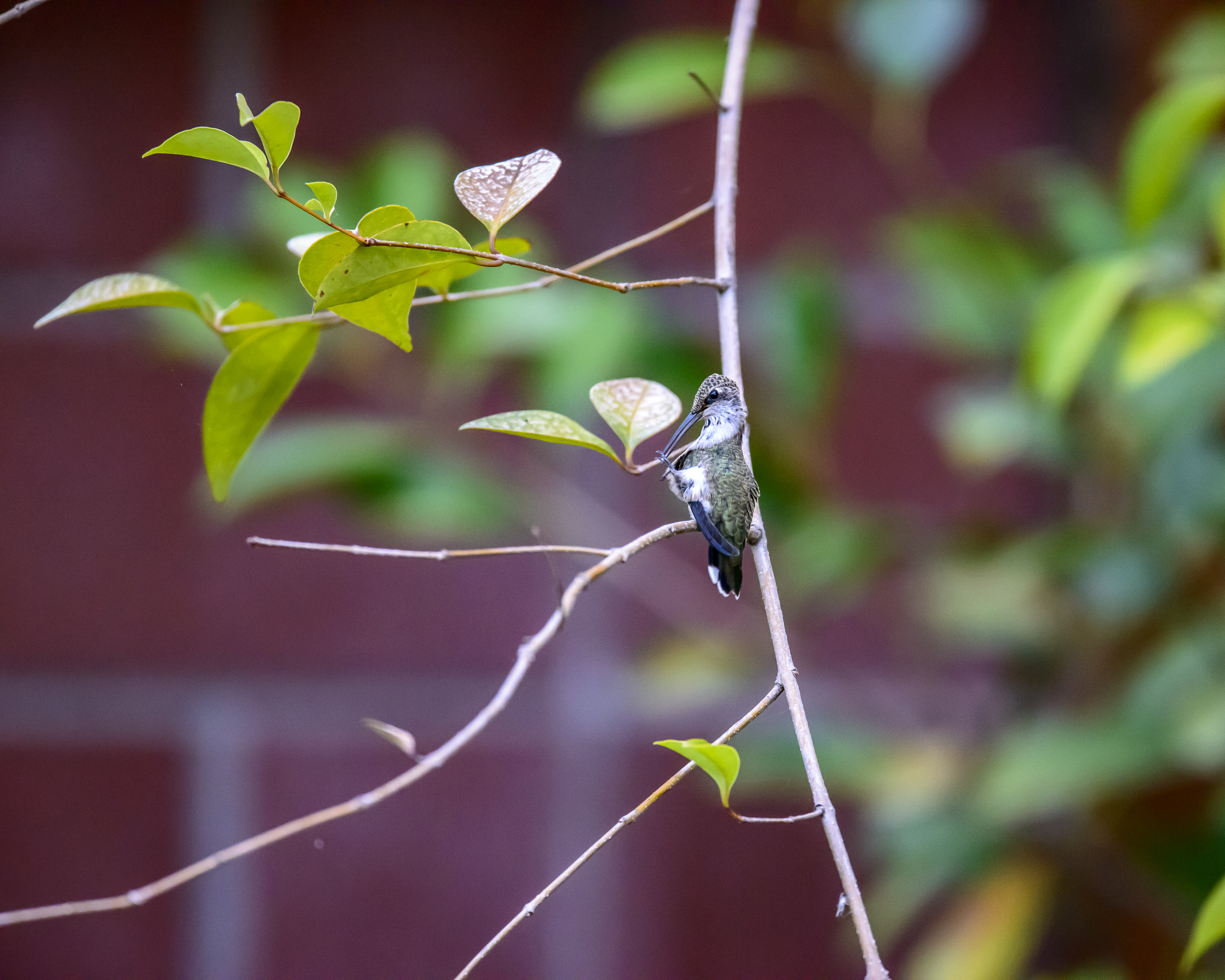
If it is not yet apparent to anyone who reads this blog, I love hummingbirds. I have three feeders in my yard but only one pair of Anna’s Hummingbirds lives here year round. I’ve never found their nesting sites and I’ve never recognized any of the hummers as their offspring. The hummers in my yard are vigilant and keep most other hummers away. And, I never tire of photographing them.
With the 600mm lens now almost continuously focused on the feeders or the fountain, I’m trying to work on perfecting (or at least approaching adequacy) my bird photography. I’m struggling with composition because I’m trying to figure out how to quickly adjust the ball head without letting the heavy lens flop down out of control. Consequently, successfully focusing on the eye while at the same time moving the lens for the best composition seems to be eluding me. I’m anxiously awaiting the arrival of that gimbal head which should, once I figure out how to use it, help me with this problem.
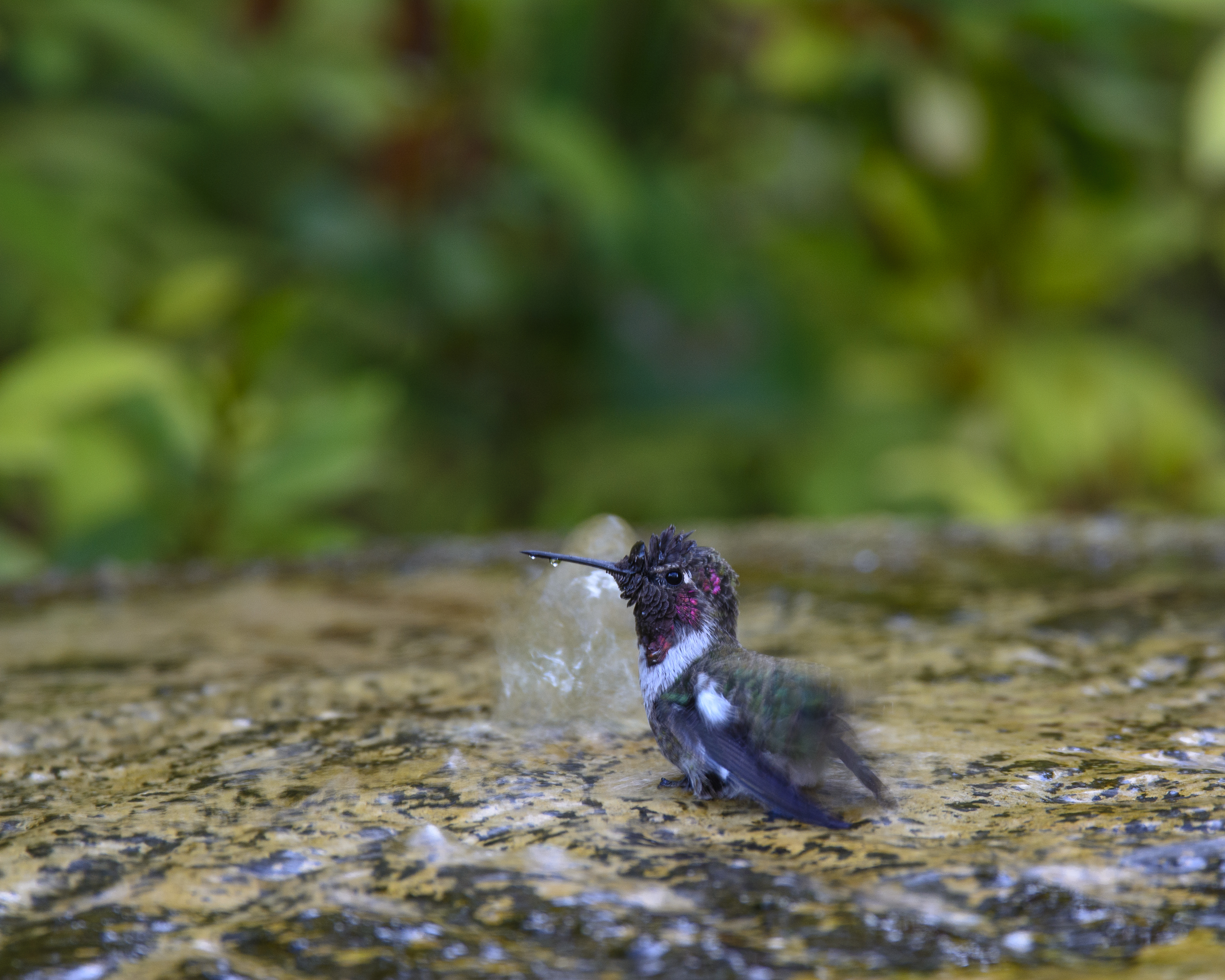
Monday morning, even though I was dressed and ready to head off to the gym, I couldn’t resist taking more bathing shots of the male hummer. With the 1.4x teleconverter attached, the smallest aperture was f/5.6 and I had neglected to increase the ISO from 250 so the shutter speed was a lethargic 1/15 second. When I looked at the shots, though, I was amazed that the hummer held his head so still that it’s in crisp focus as he shakes the water drops off his tail. I cropped the shot to an 8×10 format for better composition. Then, just as I was about to grab my water bottle and head out the door to the gym, the female hummer appeared at the new fountain. I had to quickly open the door again, move the camera into position, adjust the focus and try to follow her as she wasn’t sure where or whether she could land to bathe. She finally did alight on the edge where the water streams back into the fountain but I couldn’t achieve focus. This is the only shot I got of her that’s partially in focus. I had already increased the ISO to 800 so the shutter speed was a bit faster (1/80) but the composition was entirely on the right side of the photo so I cropped the shot vertically to an 8×10 format.
Oh, I never did make it to the gym but I did manage to arrive on time to my 10 o’clock dental appointment.

I’m looking forward to the return of my Nikon D800. UPS advised me it will delivered home today. Three weeks ago, Nikon notified me that they would clean and service my camera at no charge and that if any thing needed replacing, they would do that at no charge as well. I took them up on their offer because I knew the camera needed a thorough going-over and it had a few things that I was a bit concerned about, including more than 133,000 clicks of the shutter. Since I had the D7100, I felt fine about sending it away. But I have become so used to having two cameras available that the past three weeks have been oddly stressful for me.
The earlier than expected arrival of the 600mm lens has relieved my stress a bit and I have taken very few shots with other than the super telephoto lens in the past couple of weeks. With that, though, comes a different kind of stress. At first I was stressed over the tripod mounting plate which I had to jerry-rig until the proper one arrived from Really Right Stuff. With that stress alleviated, I’ve been trying to capture activity at the fountain and hummingbird feeders with varying degrees of success.
I’ve tried to anticipate where the hummers will be so that I can prefocus and compose the camera and have the remote shutter release set so that no matter where I am if I see the hummer at the feeder or the fountain, depending on where I’m focused, I will be able to get a shot. I also decided to attach the 1.4 teleconverter which makes the focal length a whopping 1200mm on the D7100. On the D800 it would be 850mm.
The best laid plans don’t always result in success. The ball head I have now is a fabulous improvement over the one I used in Costa Rica where I finally gave up shooting from a tripod because I wasn’t capable of manipulating the ball head efficiently. I now realize that what I really need, and what is on order but not here yet, is a gimbal head to make my super telephoto lens adjustable at the touch of a finger. The gimbal head was a special order item from B&H Photo and I’m not certain how much longer I’ll have to wait for it. Sunday morning, as I struggled to follow the hummer cavorting in the fountain, I had trouble with composition because I couldn’t quickly move the huge lens smoothly enough and then refocus on the hummer’s eye to get a clear, crisp shot.
The best shot I got is in focus and does have a bit of a gesture, though, so I’m happy about that, plus, this shot is not cropped. I took it from the back door, about 30 feet away.

To paraphrase Shakespeare (or Ray Bradbury, for that matter) something wicked came my way over the past few days. I don’t know if it involved witches (or alternatively, a sinister traveling carnival) but something wicked visited my yard and decimated my small, but greatly anticipated, tomato crop. The BLT I was planning to enjoy when the Brandy Boy I featured a week or so ago fully ripened, disappeared with hardly a trace. I couldn’t believe what I was (or wasn’t) seeing. Only a tiny shard of reddish skin clung to the stem, splatters of red tomato juice and a few seeds stained the backs of the large leaves beneath it, and a few more shreds of skin lay scattered on the dirt. An identical twin remained; it is barely visible in the upper right corner behind the “now gone” tomato in the “Future BLT” post. That was Friday. On Saturday afternoon, I went out to survey the tomato vines again and, the other tomato? gone! I fretted over what wicked creature was decimating my farming efforts. On Sunday I grilled the remaining eggplants for fear they would be next. My gym buddies have suggested that it was a skunk, an opossum, or a raccoon. I’ve had skunks and possums in my yard but I’ve never seen a raccoon. One friend offered me a humane trap. I declined, having so few tomatoes that it probably wouldn’t be worth the effort.
With the hot weather preventing the tomato vines from setting new fruit, there are no more tomatoes on the Brandy Boy plant and there was only a single tomato on the Brandywine plant. Sadly, the Brandywine was next on the wicked something’s menu. I went out Wednesday morning and it was half eaten. Thursday morning, the rest of it was gone without a trace.
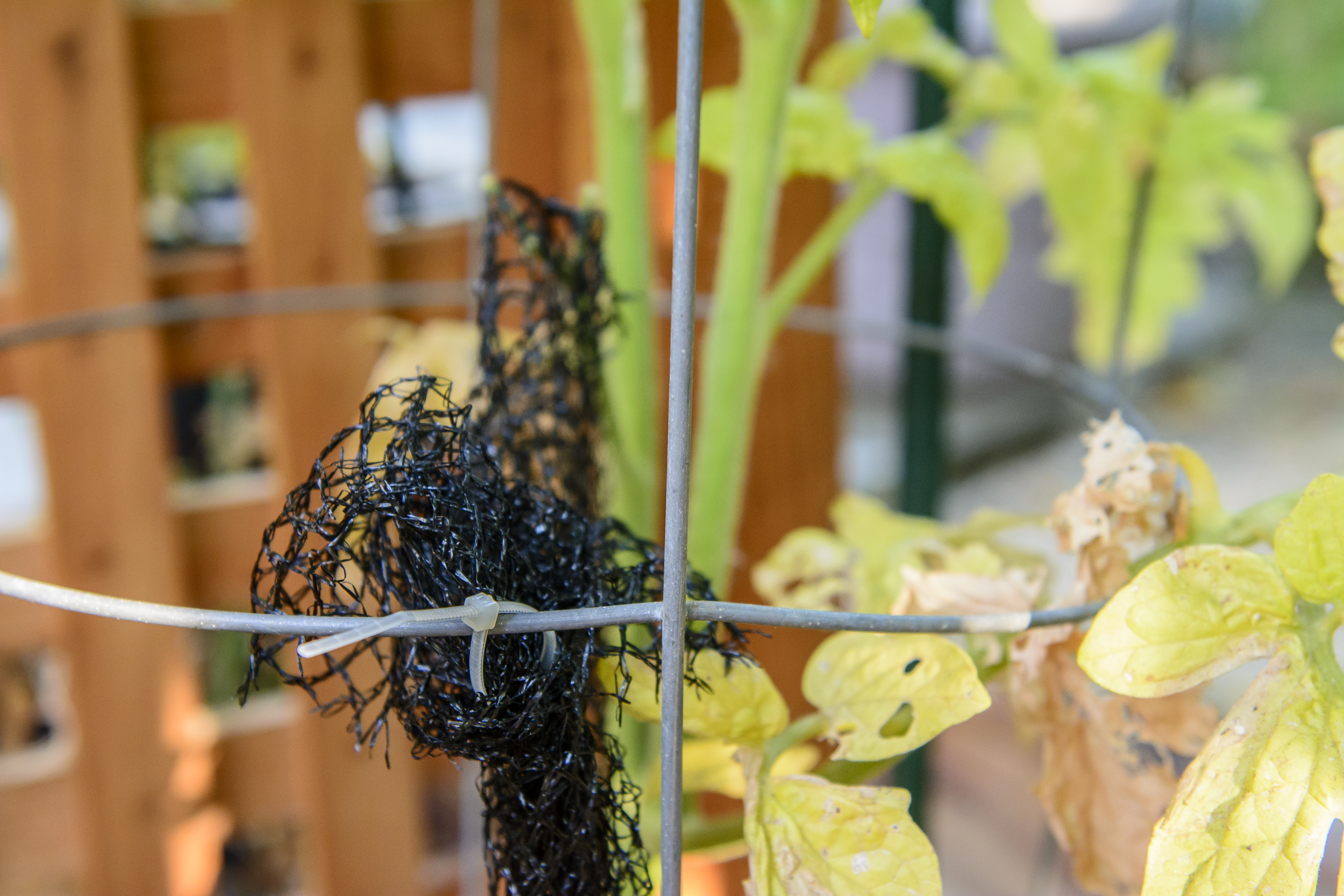
The four ripening tomatoes on a Patio tomato plant were all that was left of the crop. I first thought they were not quite as convenient or easily reachable as the other tomatoes. Was I wrong! I didn’t act quickly enough to save those. A cluster of three disappeared without a trace on Thursday night. Finally, on Friday, I took action. I encased the single remaining ripening tomato, just a few days from perfection, in a mesh bag and zip tied it to the tomato cage in two places. Too little, too late. On Saturday morning, the bag hung limply and empty from the tomato cage.
As I said, something wicked this way came. Here is the half-eaten Brandywine and what was left of my protective netting.

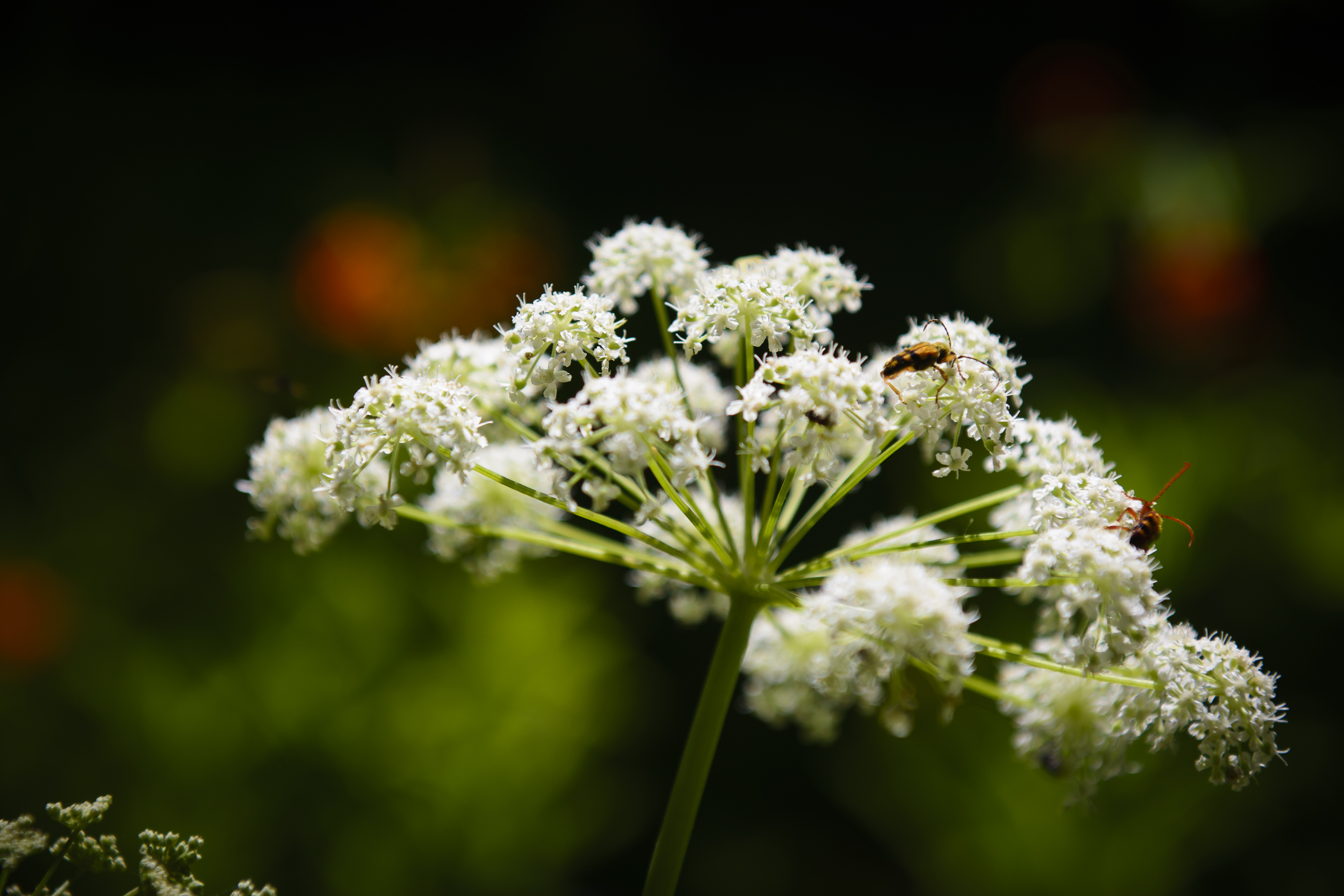
We were fascinated by the beetles that were scurrying around these lovely white clusters of flowers in the meadow near the tiger lilies. I thought they might be some sort of Queen Anne’s Lace. I took a photo of the leaves so that I could identify it later. As I reviewed the photos and wondered about the bugs, I thought first to identify the flower. My Audubon Society Guide to Western Wildflowers quickly offered an identification. It’s in the same family as Queen Anne’s Lace, all right so I was going in the right direction. The carrot family, which includes Queen Anne’s Lace but also consists of edible plants such as carrots, parsnips, celery, cilantro, caraway, anise, parsley, and dill, also includes some not-so-edible plants. This show stopper of the meadow, however, is also a heart stopper … literally. It is called water hemlock and it is highly toxic; ingestion of even a small amount of it can result in convulsions and death within a few hours. I was worried about a tiny cluster of leaves I thought might be poison oak. Bruce assured me it wasn’t. But we neither one gave a second thought to spending time around these poisonous beauties. Although I wasn’t tempted to eat them, what if I’d picked a bouquet of them? Is the sap poisonous, too? Yikes. I know it’s a crime to pick wild flowers, but the punishment shouldn’t be a death sentence. I still haven’t been able to identify the beetle. After discovering the truth about the flower, it didn’t seem quite as critical to identify it, although it is obviously no affected by the toxins.
My nephew informs me that the beetle is a flower longhorn, latin name, Leptura obliterata. We speculated that the “obliterata” in its name comes when the beetle consumes too much hemlock pollen!