2018—Dusty

My friend Charleen grew up on a farm near a town in the Palouse called Dusty.  We didn’t get a chance to visit Dusty on this trip but I think I can see how it got its name.  The Palouse is a rich farming region and crops are rotated throughout the growing seasons so there are always tractors plowing and discing tracts in preparation for planting.  The fields are dry so tractor treads and  wheels kick up voluminous clouds of dust.  The early evening we visited Steptoe Butte, farmers were still plowing their fields as long as there was light and the dust clouds wafted across the fields beneath us.   The tractor kicking up the dust in this photograph is somewhere to the right out of sight.  The tree and shrub in the lower right appear at a road intersection.  With very rare exceptions like these, the rolling hills are bare of trees.

Dusty.jpg

2018—Off on a Lark

On a lark Saturday morning, I decided to pack the camera gear that I am taking on my trip to South Dakota this week and sharpen a skill that I’ll need on the trip—shooting from a stationary vehicle.   The problem is that while I’m used to carrying my 600mm lens with my D5 on my tripod when I’m outside, maneuvering that camera and lens while seated inside a cramped space can be challenging.  I’ve done it number of times, but each was a very different experience and Saturday’s was no exception.  Shooting from my Lincoln MKZ, a streamlined  car that wraps itself around you, turned out to be more of a challenge than I expected.  The good news is we’ll likely be shooting from a Chevy Suburban or another SUV with more cabin space.

I quickly discovered that my challenge was not just in maneuvering the camera.  I had to first maneuver my car to  a desirable location with a safe place to pull over.  I started at  a spot in Lincoln where I photographed Burrowing Owls perched on fence posts a while back.  When I arrived, I didn’t see any owls but there were quite a few Western Meadowlarks on fence posts and they seemed unconcerned with my presence.  I was encouraged because one of the birds I’m looking forward to photographing in Custer State Park in South Dakota is the Western Meadowlark.  Unfortunately, this road is narrow and there is no safe place to pull out of the  lane.  And, not only is my car streamlined on top, it’s also very low slung so pulling off onto uncertain terrain is not an option.  While I admired the singing Meadowlarks, a truck turned onto the road so I drove forward into a gateway to get out of the way.  Of course they signaled that’s where they were going.  Drat. The commotion of both vehicles sent all the birds away.  I waited a while longer but none came back and I suspected more vehicles might be arriving as the gateway leads to a remote business so I left in search of another place to practice.

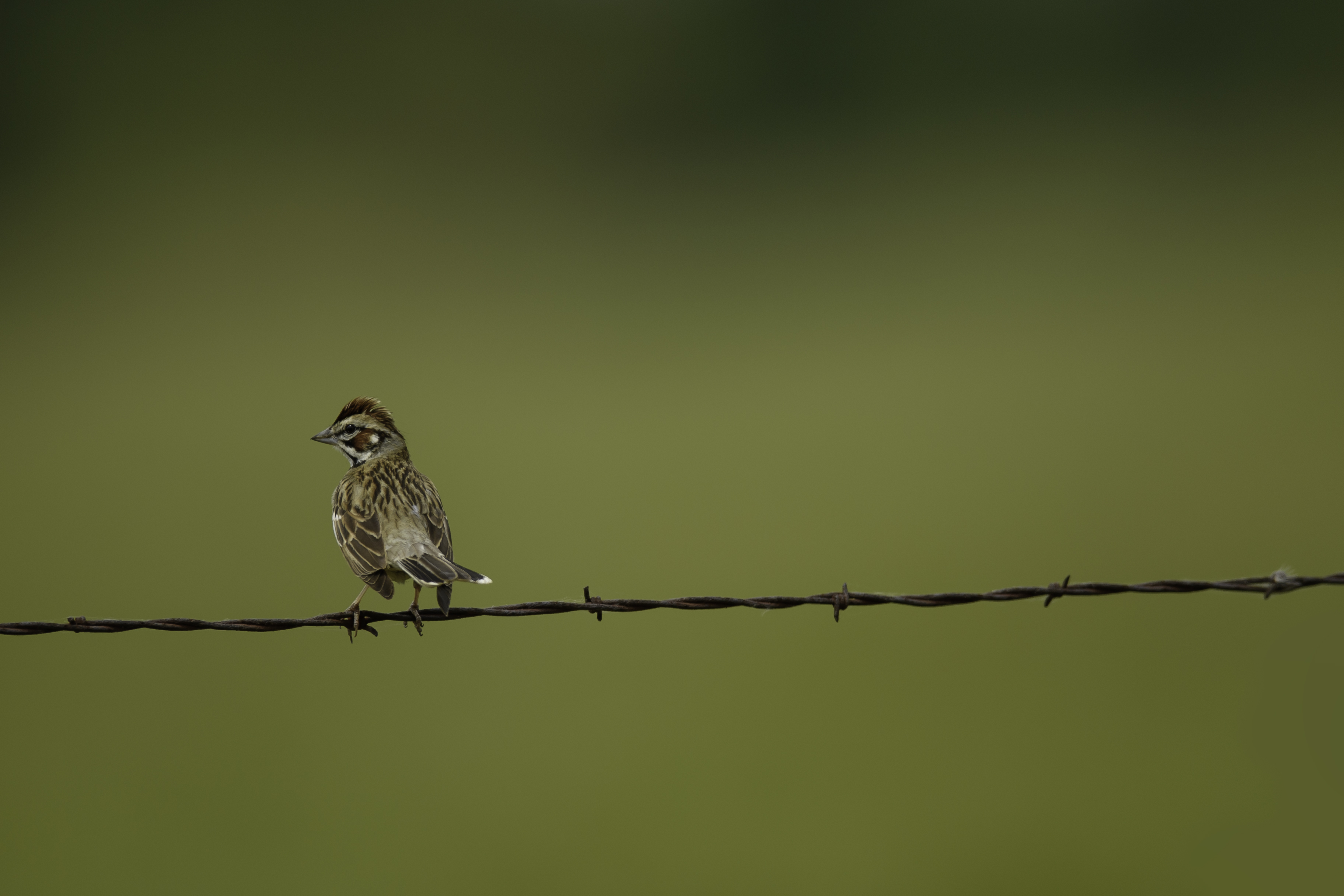
Rural roads near Lincoln, CA can be very busy and I kept turning from one onto another until I found a place to safely pull off the road and a place that also had potential.   I set up the camera, placed my no-longer-manufactured Puffin Pad (thank you for the long-term loan, Bruce) over the door so I could rest my lens on it and waited.  Suddenly, a sparrow landed right in front of me.  I did not have the teleconverter on so I was shooting at 600mm.  When I switched to high speed crop to bring the bird closer in the frame, a car drove between me and the bird.  I managed only 2 shots before the bird flew off.  For the next 30 minutes, I watched patiently and there was no activity so I put my gear away and drove home.

The Sibley Guide to Birds revealed the little sparrow to be a Lark Sparrow, a kind of sparrow I’d never seen.  So, despite what began as a rather disappointing effort, my little lark turned out to be a good lark after all.  And the two birds I did see up close were actually (sort of) larks!

Lark Sparrow.jpg

2018—The Little Church on the Knoll

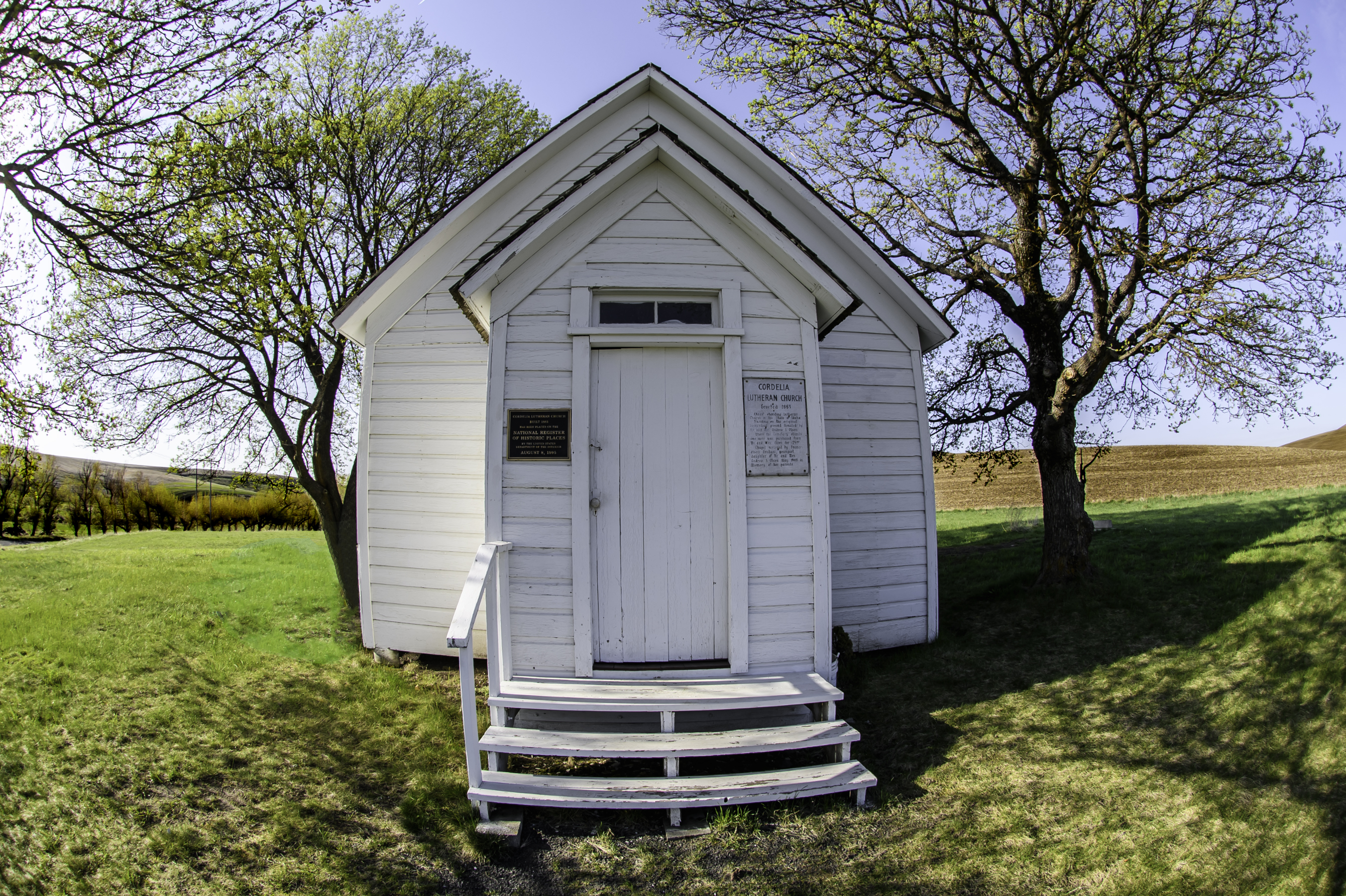
One of the most charming sights we came across in the Palouse was the Cordelia Lutheran Church.  This tiny wood-frame building, constructed in 1883 and still in use today, is perched atop a knoll surrounded by vast, rolling farmlands.  We couldn’t go in but a peek through the windows revealed several rows of wooden pews filling the small interior with a tiny pulpit and small pump organ at one end.  It is a simple structure, no stained glass or steeple, but the little house of worship needs nothing more than its simple and serene setting to stir one’s spirit.

As we marched slowly up the knoll toward the church, I took the first two photographs with the 14-24mm wide angle lens, the first at 19mm, the second at 14mm.  When I was almost at the top, I decided I wanted to use the fisheye for a different effect, so I ran back to the vehicle and switched to the 10.5mm DX fisheye on the D850.  Both lenses distort the subject to some degree, but in slightly different ways.  Upon review of the photos, I am partial to the first one, taken with the 14-24mm lens.  It shows the austere, isolated church beckoning passersby to its tranquil, idyllic setting.  And, although the skies were bald or hazy for most of our time in the Palouse, a few wispy clouds punctuated the azure sky to better feature the little church on the knoll.


The little church on the k noll 3

Little church on the knoll 4

Little church on the knoll 2

Little church on the knoll

2018—Red Barn

Red barns in various sizes, shapes, and stages of decay are sparsely sprinkled throughout the vast picturesque farm lands of the Palouse.  The morning sun reflects on the windows of the barn, making it appear as if it is lit from within.

Red Barn 2 Day 4.jpg

2018—Bridge to Nowhere

The rusted railroad trestle, its rails long since removed for whatever purpose steel was needed when the tracks were removed, spans the Palouse River but goes nowhere.  The ghost town of Elberton, WA has few remaining structures from its heyday when it had a flour mill and a sawmill.   A devastating fire in the 1930’s destroyed the town.  The bridge to nowhere now has a “danger, cross at your own risk” sign to warn of potential problems if one sets foot on the structure.

The rounded appearance is the result of using my DX 10.5mm fisheye lens on the D850, essentially turning the D850 into a crop frame camera.


rusty trestle palouse.jpg

2018—Stairway to Heaven?

The stairway leading to the boarded up United Brethren Church in the ghost town of Elberton, WA made for an interesting photography challenge: a handheld vertical shot.  I was determined to get this shot without resorting to my tripod.   After quite a few attempts, I managed to handhold vertically (much more challenging for me than horizontal) at a shutter speed of 1/20 sec. something I’ve practiced but have not always achieved.  The additional challenge was viewing the scene while the setting sun to the left shined into my left eye if I moved forward or backward and lost the protection of the tree.  D850, 70-200mm f/4 lens at  92mm, f/5, ISO 64, SS 1/20 sec. not straightened or cropped.


Stairway to heaven.jpg

2018—Gradient

Standing close to a looming granary with a telephoto lens can produce interesting results.  Here, I used a telephoto lens, the 70-200mm f/4, set at 150mm on the D850 at ISO 64, f/5, 1/160 sec.  The challenge was to show the natural gradient produced by the cylindrical shape of the granary.  But, to do this correctly, the right edge had to have just enough light reflecting on it to create the rounded depth without revealing anything but the edge of the metal structure.  When you’re hand holding, it can be a challenge to keep the camera  perfectly horizontal.  It took a few tries, but, to my own amazement, I was able to hand hold, keep the camera horizontal, and keep the right side of the frame at the very edge at the structure without getting any of the sky behind it in the frame.  I did not crop or straighten the shot in Photoshop and the gradient in this photograph is natural lighting, not a Photoshop gradient.

Silo Gradient 3.jpg

2018—Sense of Scale

It was almost 7:30 PM when I photographed the tractor and the truck parked on top of a knoll, retired for the day waiting for the dawn to begin discing the fields again.  Looking down from the top of Steptoe Butte, the farm vehicles provide a sense of scale to the area.  Although these two vehicles had suspended operation for the day, others were creating clouds of dust that hazed the sky and dimmed the sun.  Some of the dust clouds crept into the right side of this photograph. I converted the photo to black and white so the details in the field are enhanced.

black and whitewith truck.jpg

2018—Granaries

The wheat and grain has to be stored somewhere in the Palouse.  These cylindrical granaries are a common site throughout the region.  As the sun rose, we stopped to photograph them.  Using my 10.5mm fisheye on the D500 I captured  the sunburst through the gap between the two structures.


Palouse Granaries 1.jpg