2016—Spinebill

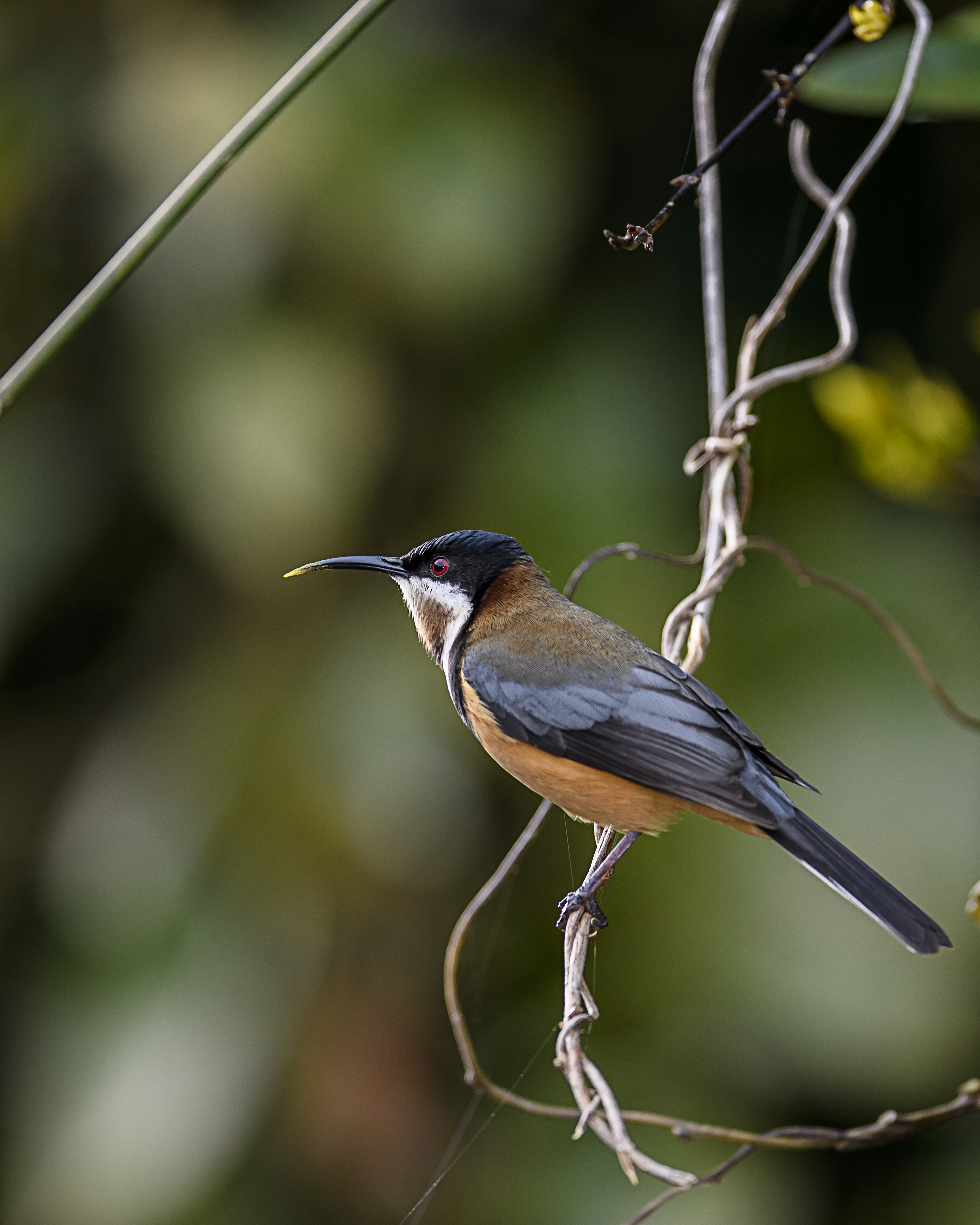
TheEastern Spinebill, a type of honeyeater, is one of a few types of honeyeaters we saw in Australia.   It was difficult for me to photograph because he moved so quickly from branch to branch that I couldn’t easily follow his path with my camera and lens on the tripod.  I was lucky to get these shots as we walked back to the lodge one afternoon with our heavy camera rigs and found him in a vining flowery shrub on the side of the road.

eastern-spinebill-2

eastern-spinebill

2016—Flitting About

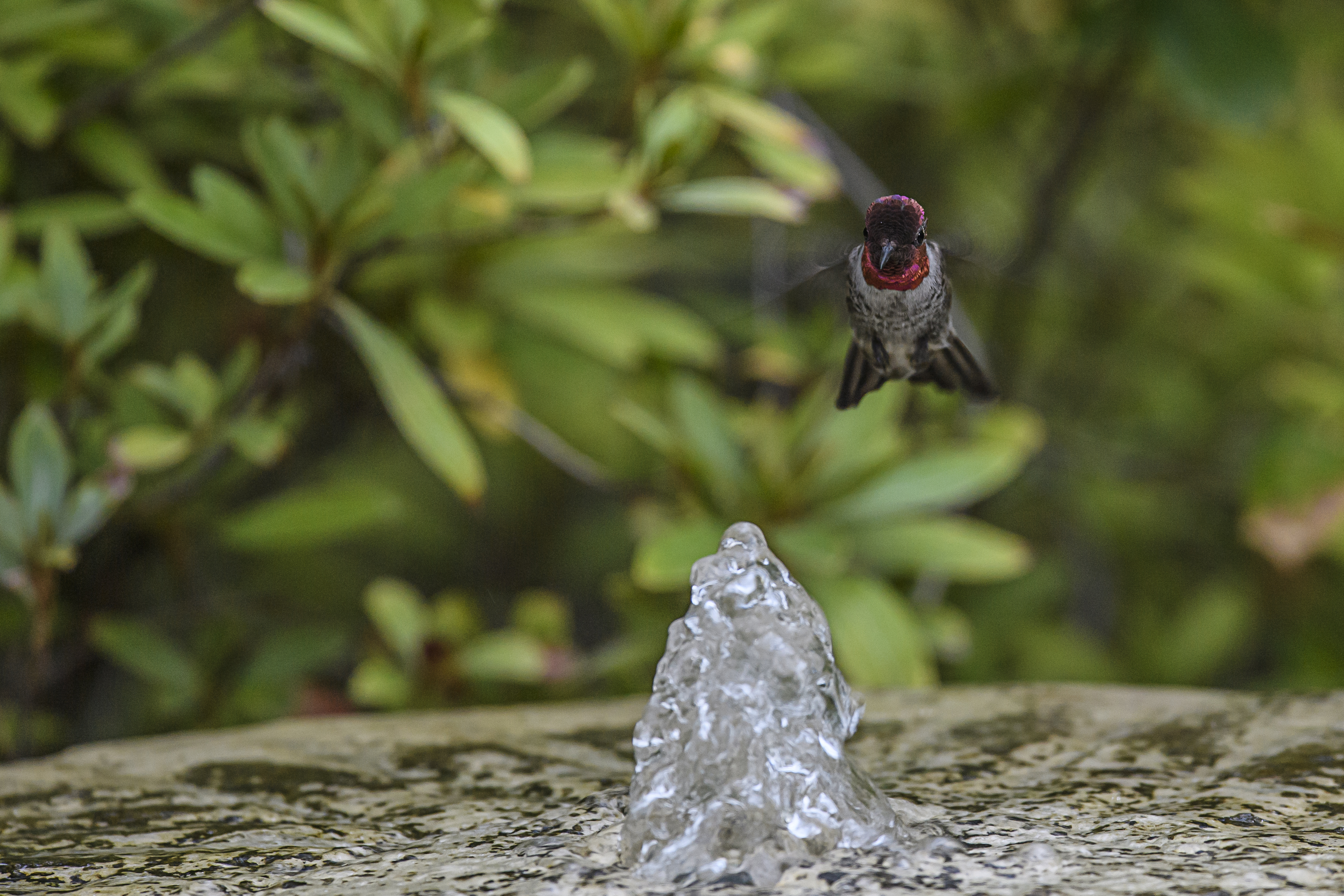
Early Thursday morning, I looked out to see the male Anna’s hummer flitting around the fountain, apparently unsure about the newly vigorous water flowing from the center bubble.  He darted back and forth above the bubble but didn’t seem to have the courage to land.  A few times he extended his tongue as if to drink from the bubble while he was still in the air.  The patio door was already open so I moved Big Bertha, already set up on the tripod, into position and took several shots.  It was one of the first times I was able to focus on a flying hummer and keep focused on it for more than a single shot because the bird was so riveted on the bubble that it flitted and hovered over the fountain at about the same level for a full minute.  That is not to say all of the shots I took were in focus.  My focus changed depending on whether the autofocus points zeroed in on something in front of the bird, like the bubble of water.  I’m still working on the challenge of keeping moving objects in focus with manual override.  In these shots, the morning light, with a little help from the speed light on the camera, illuminated the brilliance of his gorget, especially in the last shot.

flying-hummer-fountain-3

flying-hummer-fountain-2

flying-hummer-fountain-4

flying-hummer-fountain-1

2016—Offering A Hand

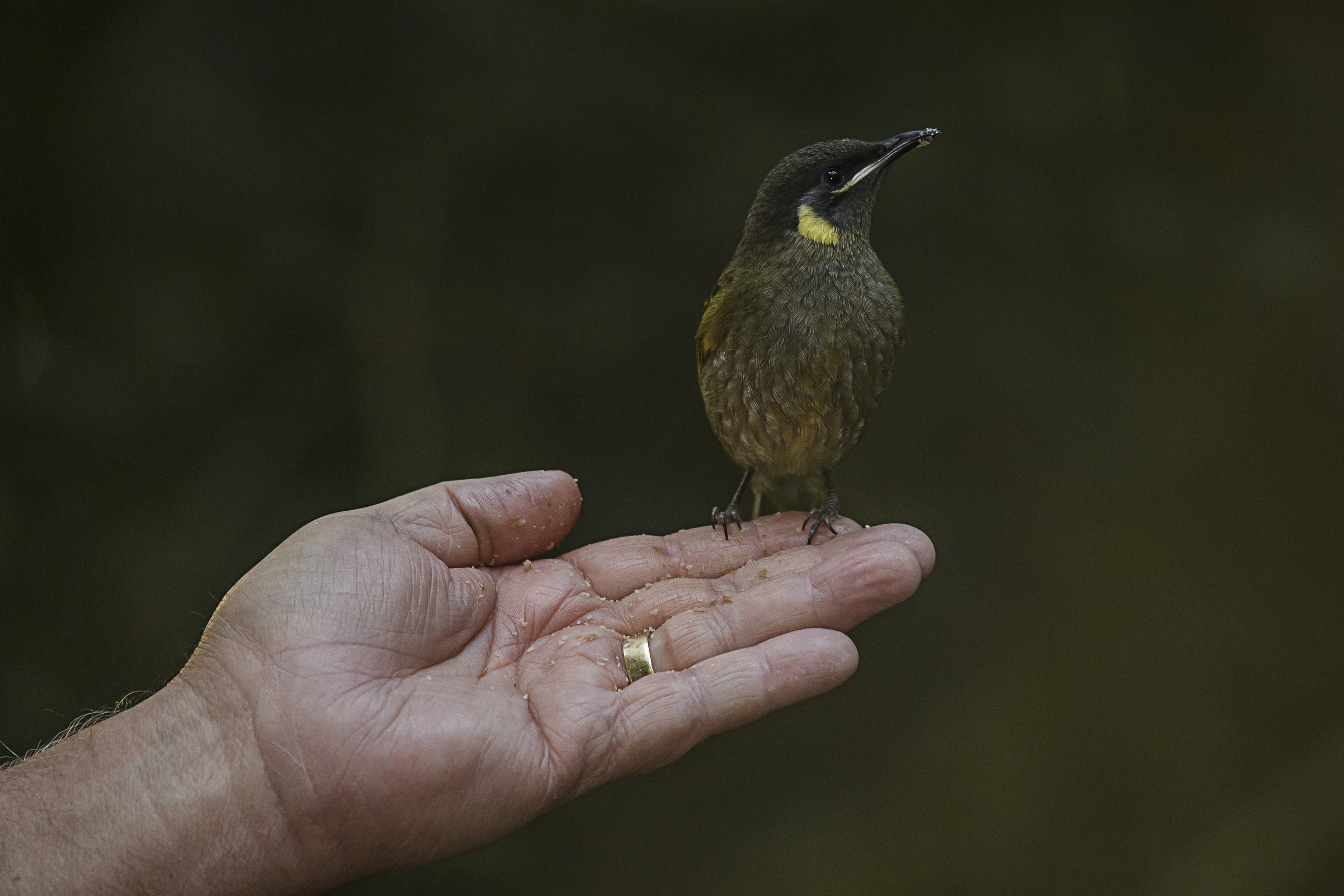
Many of the wild birds at O’Reilly’s in Lamington National Park in Queensland, Australia are so acclimated to humans that they have little fear and know that often, the human hand offers food.  This is a Lewin’s Honeyeater.   One of these little guys  persisted in entering my room at the lodge because I kept the patio doors open and I had to keep shooing him out.  He came in like he owned the place.   Here is one, eating walnuts (their diet isn’t all honey) from  Moose Peterson’s hand, then perching on his fingertips when all of the goodies were gone.

honey-eater-hand-2honey-eater-hand-of-man

2016—Back In The Bubble

My millstone fountain was on the fritz while I was in Australia but my multi-talented bird-sitter, Cody, repaired it, replacing the pump.  The new pump bubbles vigorously and produces a much larger bubble than before so at first, all the birds in my yard were wary of it.  But, after a few days of acclimation all the “regulars” —hummingbirds, scrub jays, mourning doves, lesser goldfinches, and now, even the bushtits—have finally tried it and seem to enjoy it.  My post yesterday showed the lesser goldfinches on the other fountain but later in the day, they gravitated to the new, big bubble.

As regular readers of this blog are aware, whenever I can photograph the bushtits bathing at the fountain, it’s a treat for me and here they are, enjoying being back in the bubble.

bushtits3

bushtits2

bushtits1

2016—Love Is Blue

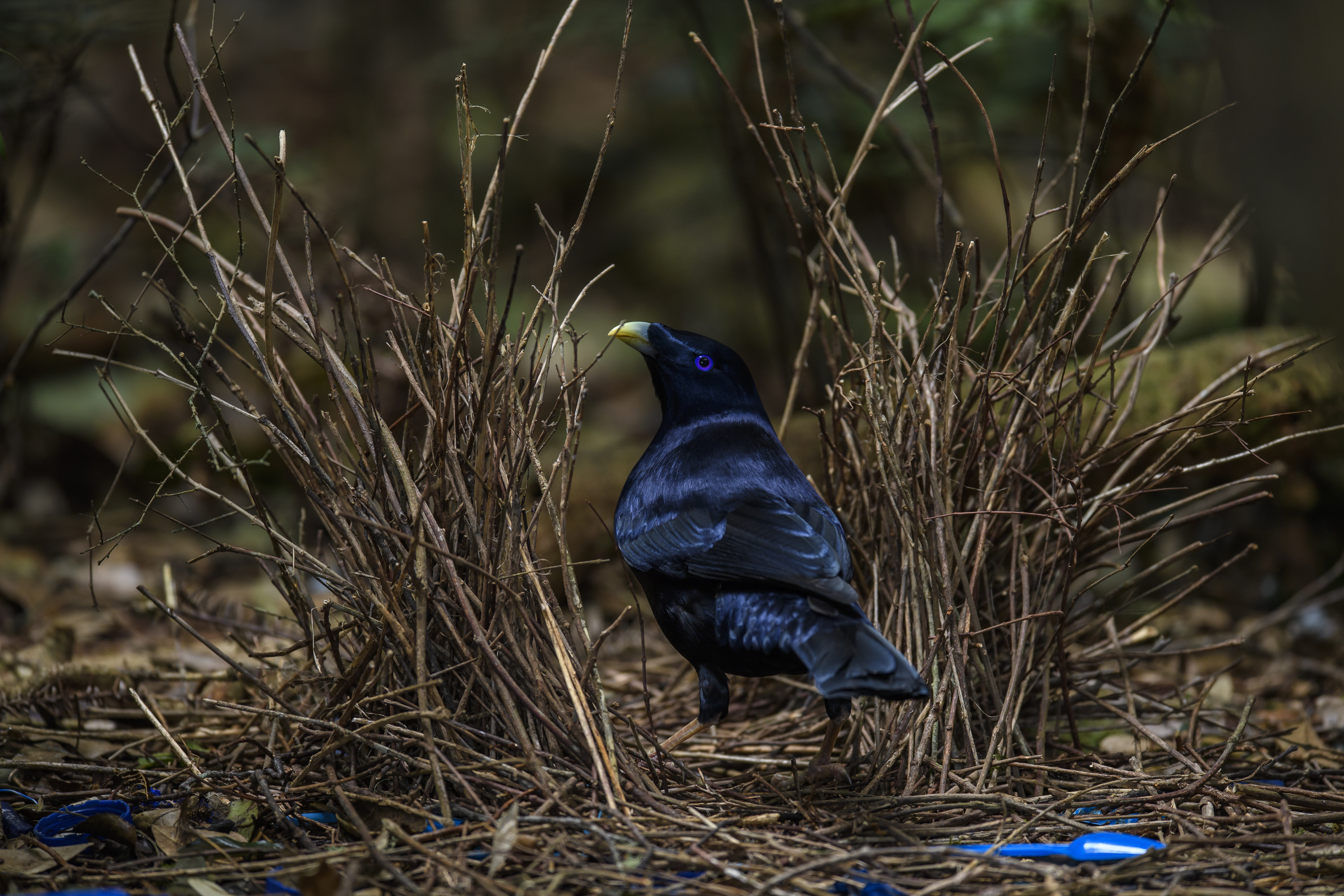
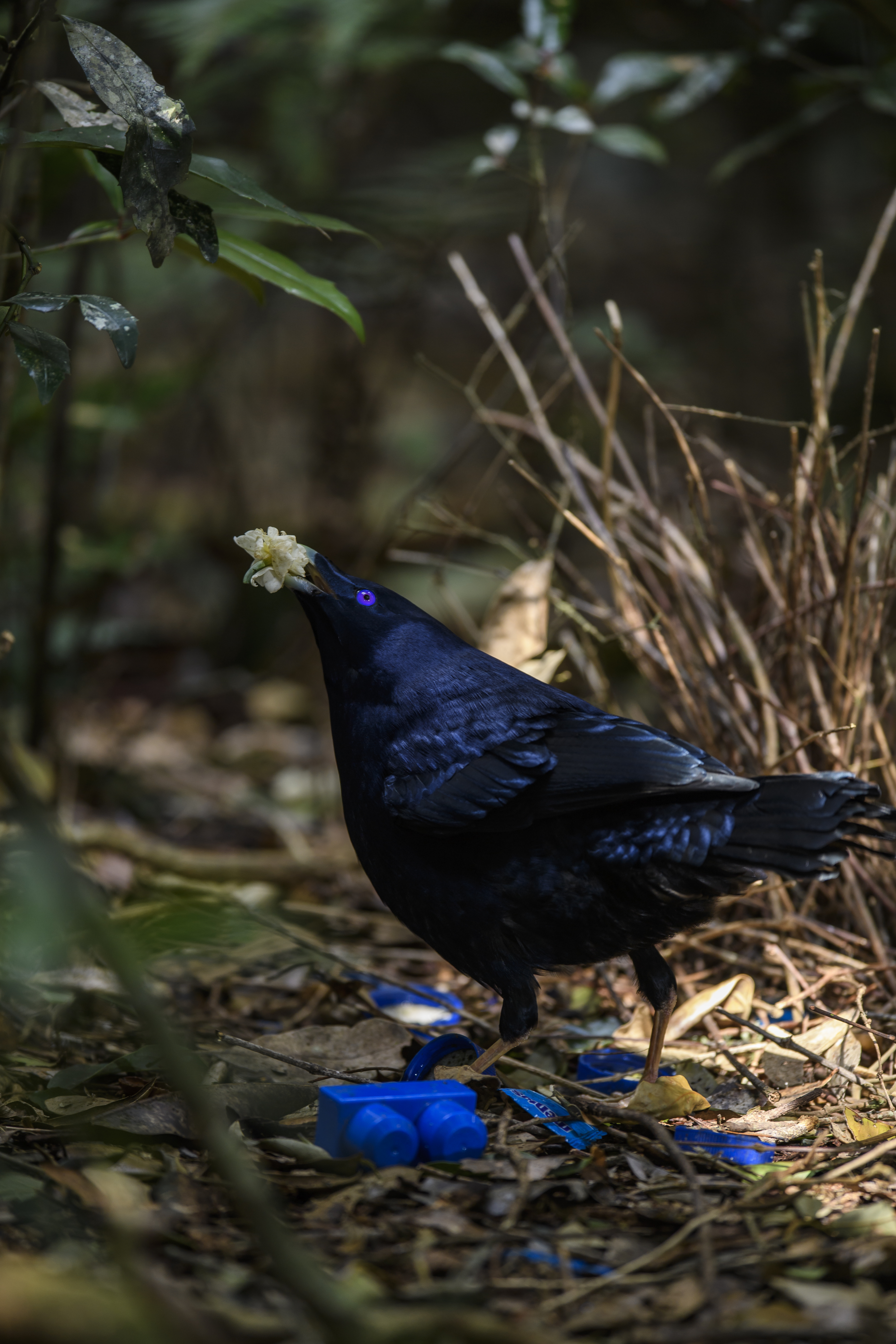
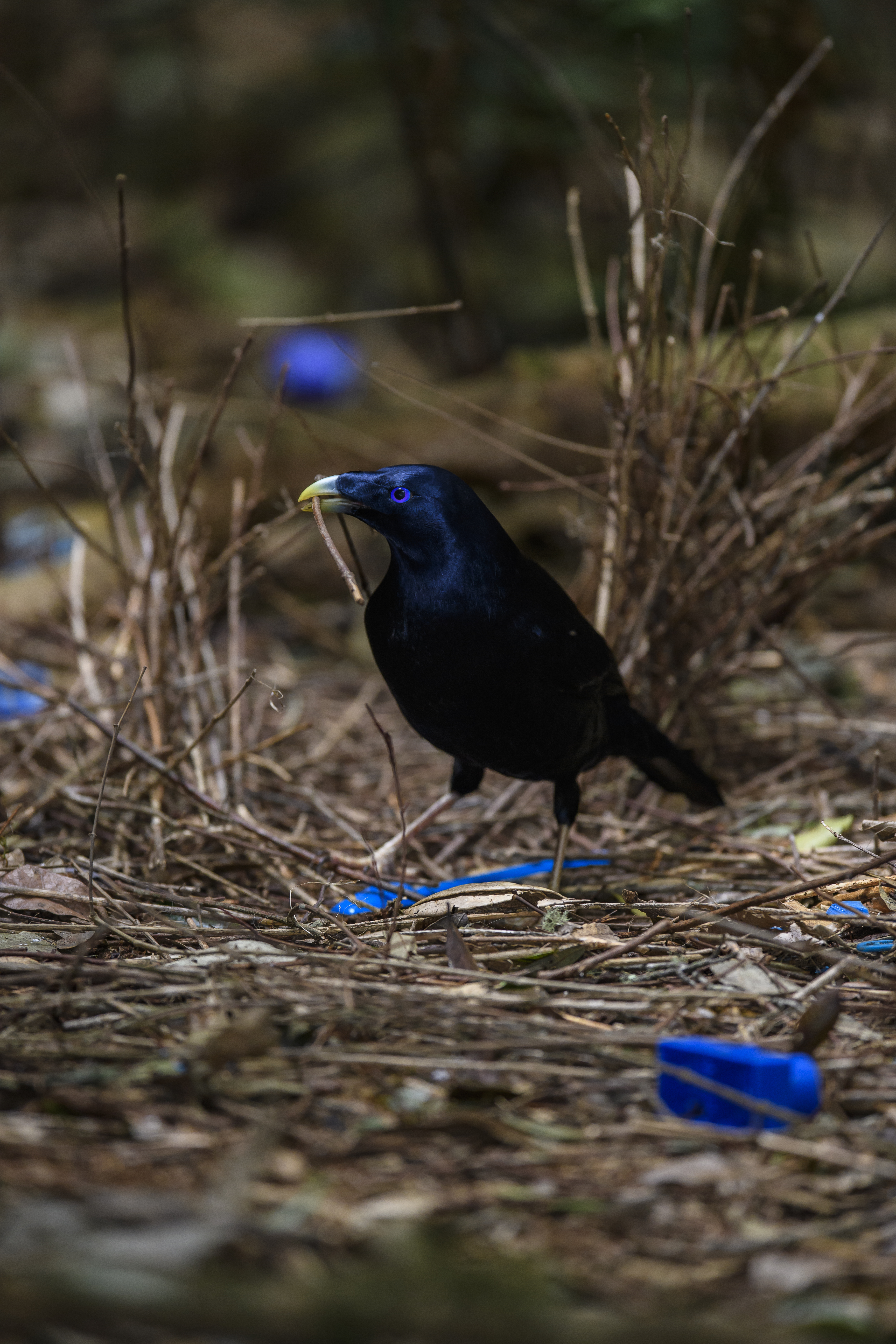
The most fascinating bird we encountered on our mid winter (August, 2016) journey in the Australian rainforest was the Satin Bowerbird.  I first discovered this most intriguing creature, a bird about the size of a Western Scrub Jay, many years ago on a 1998 PBS documentary by Sir David Attenborough called The Life of Birds.  Except for its eyes which at times appear lavender and at times, sky blue, the Satin Bowerbird isn’t colorful (the male has shiny black feathers, the female’s are olive green) but what it lacks in color, it makes up for in its mating behavior.   The male tries to attract female Bowerbirds by building a structure on the rainforest floor, a sort of bower, made of thin twigs which he obsessively places one by one to create an arched framework with an avenue through it.  He decorates the area around the bower with things he finds beautiful and that are blue.  I was amazed to discover that Sir David Attenborough’s documentary about the Satin Bowerbird that caught my attention so long ago, was filmed on location at a bower at O’Reilly’s in Lamington National Park, Queensland, Australia, where we were.

We visited the bower every day  we were at O’Reilly’s.  The bird was persistent in maintaining the bower, moving twig after twig in an endless pursuit to satisfy some inner instinct that said the bower wasn’t perfect enough.  He rebuilt and repaired the bower when the carefully structured display was disrupted by the Australian Brush Turkeys rooting through the forest floor.   One day we witnessed a standoff between the Satin Bowerbird and a Pademelon, a small Wallaby-like marsupial that was ubiquitous in the rainforest.  The Bowerbird prevailed and the Pademelon moved on.   Daily maintenance activities took place for long periods every few hours.   We photographed the Satin Bowerbirds from the rainforest path or a few yards away among the trees.  We used 600 to 800 mm lenses on tripods and gimbal heads with speed lights to help penetrate the darkness in the dense rainforest canopy.   To avoid a “flashy” look, we reduced the flash output by minus 3 stops.  We were close enough that teleconverters were not necessary.

While at one time, natural items like blue flowers and blue feathers decorated Bowerbirds’ bowers, the  current availability of blue plastic objects, disposable things like bottle caps, plastic forks, and straws, are now the decor of choice for Satin Bowerbirds.  Under normal circumstances, blue plastic objects in the rainforest would be considered litter, but in this case, visitors are encouraged to make blue offerings for the Satin Bowerbirds to use in their bowers.   I contributed a blue bottle cap.   Interestingly, the Bowerbird has to place the object himself.  If an object that he didn’t put there appears in or near the bower , he promptly removes it from the area.  But he will forage to find the precious blue objects and place them strategically around the bower in the hopes of attracting a mate.

He continually surveys his creation and adjusts both the bower itself and the placement of blue attractants constantly.  This is one OCD affected bird!  He does occasionally find something else to decorate with that isn’t blue.  One day he brought a couple of yellow leaves and another day he carried around a small white flower but the area around the bower is sprinkled with blue, mostly plastic objects.  One day, we heard a female Bowerbird answering the male’s calls.  He became quite agitated and started to scurry around but it was a false alarm and the potential mate quickly moved on so the male redirected his efforts at continuing to redecorate the bower for another potential mate.

I’m including more photographs than I usually include in a blog because I wanted to tell the Satin Bowerbird’s story and one or two just didn’t seem to tell enough.

Photo Below:  The male Satin Bowerbird surveys the bower to see what adjustments he needs to make to attract females to it.Satin Bowerbird 5

Photo Below: He selects a twig, then carefully places it upright in the bower.Satin Bowerbird 4

Photo Below:  A rare white object, a flower, gets consideration for placement in the bower. Satin Bowerbird 3

Photo Below: Looking through the bower at the array of blue plastic that decorates the surrounding area.Satin Bowerbird 2

Photo Below: On our last day, we saw that something, probably rooting Australian Brush Turkeys, had damaged the bower.  The male Satin Bowerbird was already hard at work making repairs when we arrived.Satin Bowerbird 1

Photo Below:  The Satin Bowerbird takes a break but perches near the bower.Satin Bowerbird 8

Photo Below:  Standoff between Bowerbird and  Pademelon.Satin Bowerbird 6

Photo Below: The only female Satin Bowerbird I saw, closer to another bower in the area.Satin Bowerbird female

Photo Below:  Rainforest path near the bower.Satin Bowerbird Habitat


2016—Forgotten Gems

I overlooked some photographs that I took in Galveston, TX when I went to visit my friend Connie this past April.    We packed so much into a few days on that trip, and I left immediately from there to go to Oklahoma for nine days of storm chasing, that it’s no wonder I am still discovering photographs I like from that trip.

Both are flying egrets taken late in the day at the Smith Rookery at High Island as the sun was going down.

Flying Egret Galveston

Flying egret with twig.jpg

2016—Frogmouth

The Tawny Frogmouth, a nocturnal bird native to Australia, is so-named because its broad beak comes to a point and resembles the mouth of a frog.  Late one afternoon, Luke, our guide at O’Reilly’s, told us that he knew of some frogmouths in a wooded area on a nearby farm belonging to a member of the O’Reilly family.  We had a brief window of time to get there and back that afternoon and Luke drove us there.     On this trip, most of our photography destinations were close  enough to walk to but the wooded area, overlooking a lovely valley, was at the end of an incredibly rutted and bumpy dirt road a half hour away by vehicle so we had to drive there.  The vehicle was not spacious enough to carry our camera bags and our tripods so with our tripods stowed,  we rode with our cameras and 600mm lenses cradled in our laps as we bumped and jostled to our designation.

Because frogmouths are nocturnal birds, they sleep during the day.  They are fairly large birds, measuring between 15 and 20 inches in length, and although their tawny, spotted feathers help them blend into the bark of the trees where they perch, we were able to find (with the help of our guide) a pair that seemed not to be distressed over our presence far below them.   To sleep, the pair nestles close together, the male behind the female with the support of the trunk behind him.  They were not active so we had time to photograph them, high up in a tree.

After taking a few shots with bright backlighting, I moved my heavy rig to the other side of the tree.  That move was not a smart one as I had to walk on uneven, hilly ground with a distinct slant, covered with slippery  grass and rocks and broken branches but I was determined.   Two from our group, our guide and Sharon, were already over on that side of the tree and if they hadn’t been, I wouldn’t have made it.  With the heavy camera, lens, and tripod slung on my shoulder, their weight behind me, I discovered slogging uphill was not as easy as it looked and I expected to pitch over backwards at any moment.  Sharon and Luke came to my rescue, preventing my backward slide and when I finally got settled and focused on the Tawny Frogmouths again, I discovered that there was a distracting branch protruding near them.  But, I took the photographs anyway and that shot is actually my favorite because the male has rested his beak atop the female’s head.  Awww.  That shot is also a better view of the fronts of the birds.  In the second shot  I was focused on the back feathers and the depth of field was too shallow so the heads are not in crisp focus.  But the long whisker like feathers above their beak look almost like long eyelashes.  These are thought to protect their eyes from insect prey that thrashes when caught.   We never got to see the characteristic frogmouth shape of their beaks but I found them to be charming, mostly, I guess, because of my tendencies to anthropomorphize the actions of non-human creatures.  I think this pair of frogmouths makes an adorable, loving couple.

Frogmouth 1


Frogmouth 3


2016—What Time?

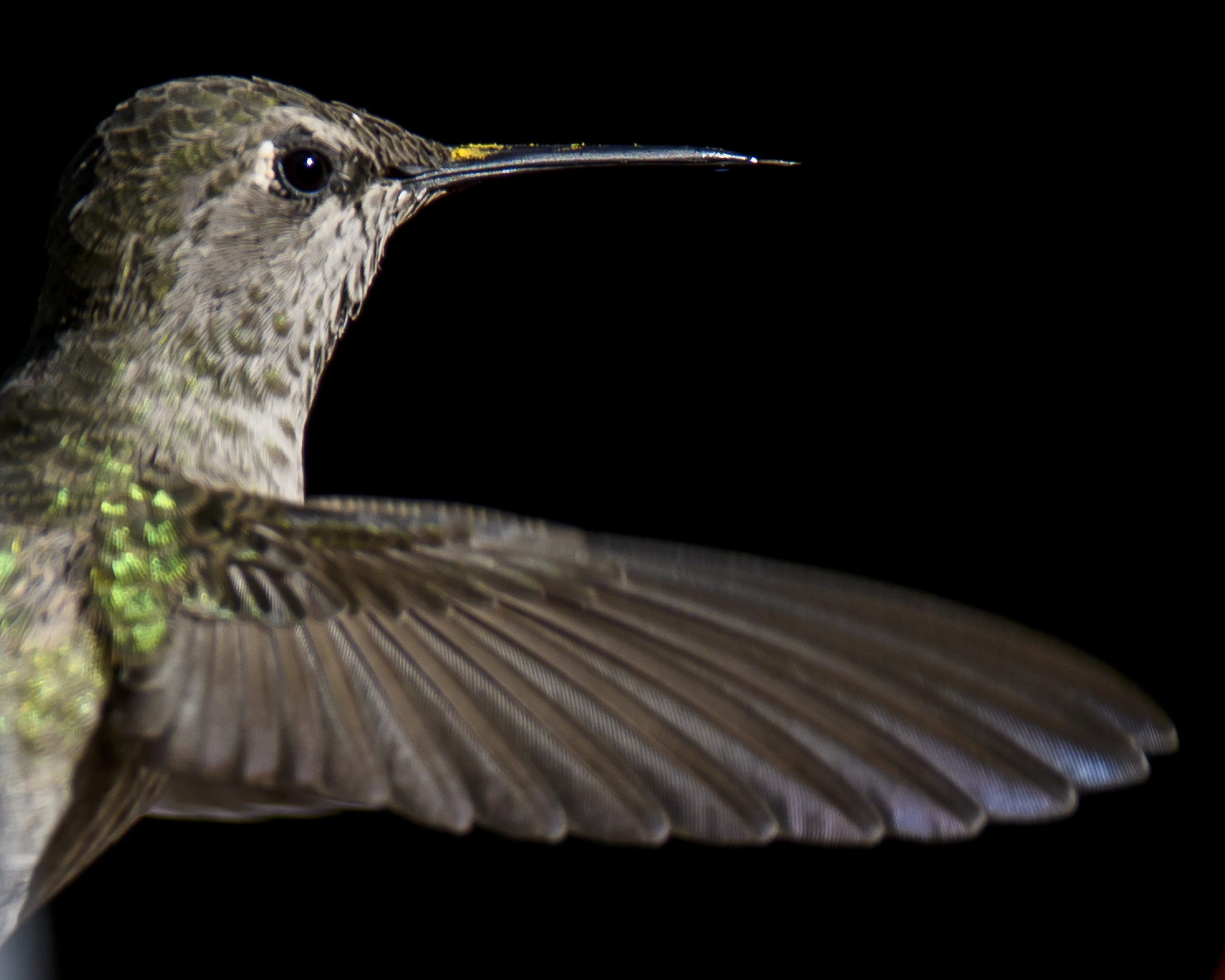
The EXIF data for this photograph says I took this shot at 2:20 AM.  What? Oh, oops. I completely forgot to reset my camera’s date and time stamp even though I’ve been home from Australia for over a week and I have taken many photographs with the D5 since my return. Details, details! The actual time I took the shot was 9:20 AM. I cropped it because the hummer’s tail was obscured by the shepherd’s hook that supports the hummingbird feeder but I liked the look of the spread wing and the balance it gives to the hummer’s pollen covered beak with its tongue tip protruding. 

early morning hummer

2016—Standoff

This male Anna’s hummer was quite agitated Wednesday morning because another hummer was at the feeder.  He is usually quite effective in driving off interlopers but when he chased this hummer to the trees, the interloper just sat, stared, and held its ground.  The standoff lasted a couple of minutes while the male Anna’s snapped its beak open and shut and hovered menacingly but the other bird (I think it’s a female) called his bluff.  Both birds eventually flew away.

2 HUMMERS 1


2 hummers 2