2018—Sunrise At Oxbow Bend

The route on our first morning in Grand Teton National Park led us to Oxbow Bend, known for its stunning views of Mount Moran in the Grand Teton Range.  Mount Moran was almost completely obscured by clouds but the early morning sun lit up the clouds and aspens in front of it for a glorious greeting to the day.

2018-Grand Tetons Day 1 0322-1.jpg

2018—Gourmand

This Black-tailed Prairie Dog in Theodore Roosevelt National Park in North Dakota is munching on a plant that must be quite tasty.  Although the prairie dog towns don’t have lots of vegetation around their holes which are surrounded by mounds of dirt, some hardy species thrive.  This must be one of them but I couldn’t find a name for it.  Apparently only certain kinds of plants can survive the constant munching by the Prairie Dogs, especially during the summer and fall when eating by these pudgy rodents becomes an almost perpetual activity.

Roos. Natl Park Day 3- 2485-1.jpg

2018—Grasslands


Theodore Roosevelt National Park in North Dakota is described by the National Park Service as where the plains meet the badlands.  Vast expanses of the park are covered with prairie grasses and gently rolling hills where bison and mule deer and prairie dogs and big-horned sheep all co-exist.  The orange and yellow and green colors of the grasses on the rolling hills create a beautiful vista.

Roos. Natl Park Day 2- 0457-1.jpgs

2018—Moonset

I don’t often get a chance to photograph a moonset.  It there’s a gorgeous sunrise, it’s overshadowed.  But on this morning in Theodore Roosevelt National Park, the sky was clear and a colorful sunrise was non-existent so we watched the huge-appearing moon as it set quickly behind the mountains in the Badlands of North Dakota.

Roos. Natl Park Day 2- 0021-1.jpg

2018—Yes, Deer

The Mule Deer in Theodore Roosevelt National Park were everywhere.  We saw them along the road, in the road, and out on the plains every day we were in the park.  The huge ears give them a comical look and we enjoyed watching them watching us.  When they sense a threat, they bound away, springing up until all four hooves are off the ground as they disappear from sight.

Roos. Natl Park Day 2- 0155-1


2018—Leap

During our week in Theodore Roosevelt National Park, we came across only one flock of Big Horned Sheep.  This group of about 28 grazed by the side of the highway for a short time as we watched.  The, one by one, they leapt over the barbed wire fence and disappeared into the woods.

Roos. Natl Park Day 4- 4317-1.jpg


2018—Big Bull

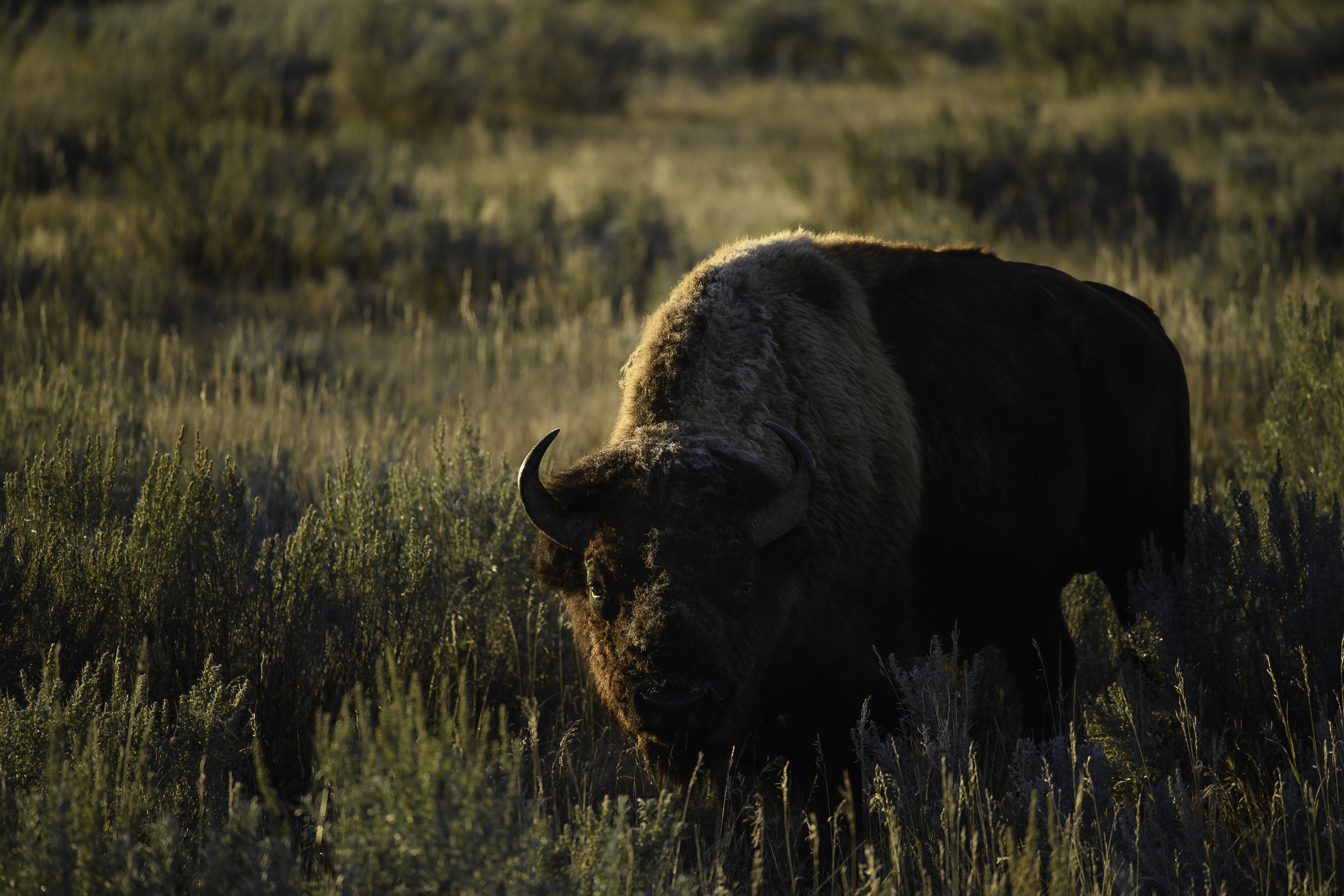
The GMC Yukon was between me and this bull Bison early Friday morning in Roosevelt National Park in North Dakota.  His cape was covered in frost as he nibbled his way toward us.  When he got too close to the road, Moose suggested I return to the vehicle so I wouldn’t become a park statistic.

Roos. Natl Park Day 4- 3623-1.jpg

2018—Textured Walls

One of the most intriguing features of Theodore Roosevelt National Park is the texture of the geologic formations in the Badlands.  The various layers seen in these formations are a visible record of the Earth’s transformation in this area going back 65 million years.  According to information from the National Park Service website, lightning strikes and prairie fires ignited coal beds that burned for years baking the overlying soft sedimentary layers into a hard, natural brick called “scoria.” The orange red color is the result of oxidation of iron released from the burning coal. The hardened rocks are more resistant to erosion than the unbaked rocks and over time, erosion has worn down the less resistant rocks, creating slumped hillsides, jumbles of knobs, ridges, cannonballs, and buttes, many topped with durable red scoria caps.

Roos. Natl Park Day 1- 0833-1.jpg

Roos. Natl Park Day 1- 0383-1

Roos. Natl Park Day 1- 1148-1

Roos. Natl Park Day 1- 1194-1.jpg