2026—Spring Crabapple Blossoms

A crabapple tree along the Ferrari Pond Trail is in glorious full bloom. When I looked up, a White-crowned Sparrow was pulling on the bright pink petals and consuming them. As the sparrow shredded the pink petals, it occurred to me that since crabapples are a favorite food for many different kinds of sparrows, this destruction of the flowers before fruit has set could mean a smaller crop of crabapples to consume later. I’m sure that wasn’t on this sparrow’s mind and it certainly was enjoying the spring feast. And, since there appears to be an awful lot of blossom clusters on this one tree, it is likely that this early obliteration of a few blossoms won’t matter this summer when the crop ripens.

2026—What Big Ears You Have!

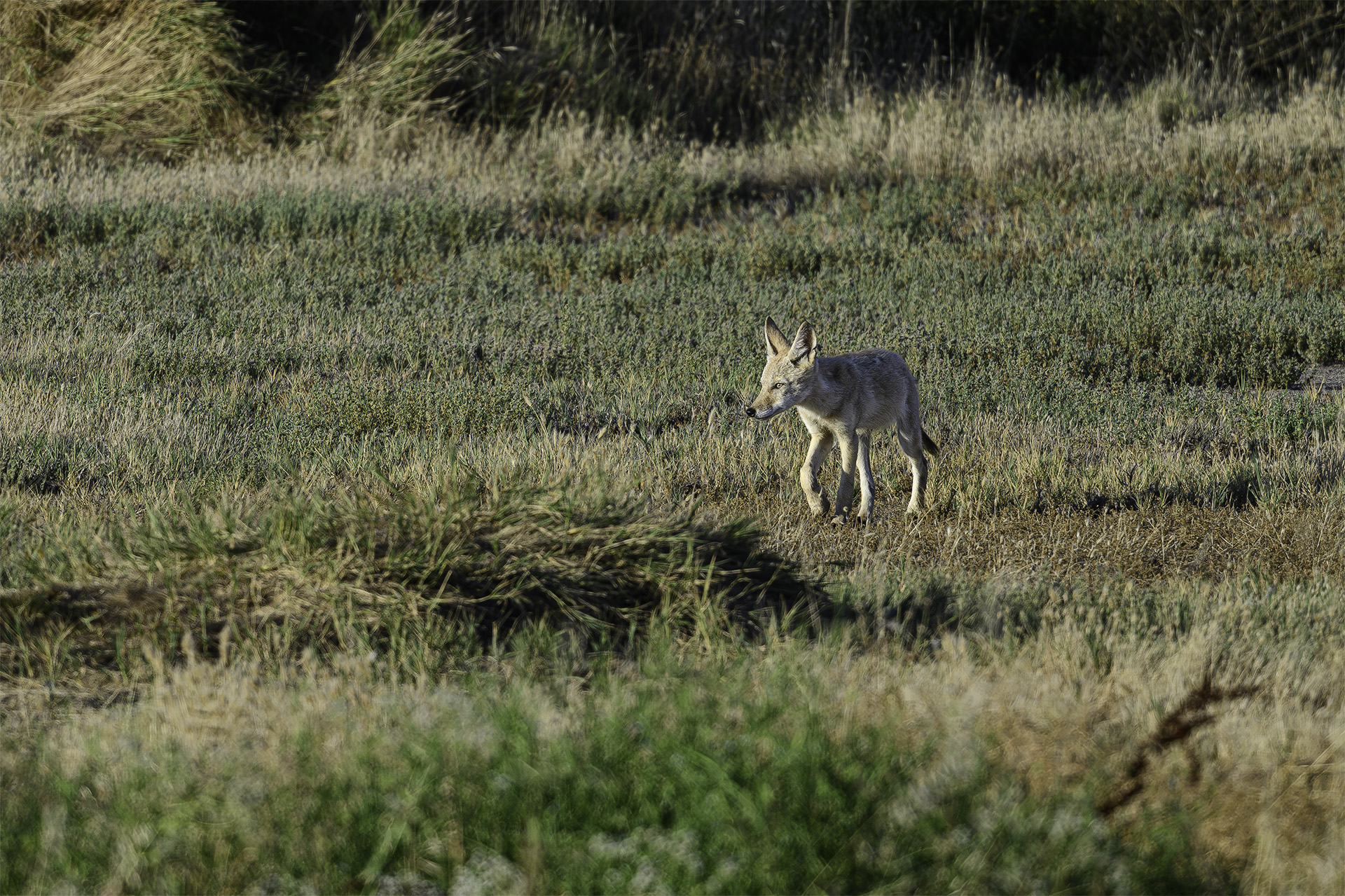
“What Big Ears You Have! All the Better to Hear You With.” Little Red Riding Hood had that conversation with the “big bad wolf” in the classic fairy tale. This image, of course, does not depict a wolf but it shows a Coyote and what big ears that Coyote has, one of the reasons they have such acute hearing. Yesterday at Ferrari Pond Trail here in Lincoln it was a two dog day for me because I saw two different Coyotes in different places. It’s spring and we’re starting to see a little more Coyote activity here. I can’t wait to see Coyote pups later this spring.

2026—Limping Along

According to the Florida Museum of Natural History, Limpkins got their descriptive name from their distinctive gait which makes them appear to limping when they are not. They are large birds related to cranes and feed almost exclusively on snails and mussels. When I was in Florida a couple of weeks ago, we visited a place near a neighborhood on the water where Limpkins limped through the reeds and long the shoreline seeking those snails and mussels. Once they find one, they use their long beaks sort of like a pickax, pounding the shell over and over, trying to break it open to expose the tasty morsel within. It looks like this Limpkin succeeded in getting this fresh water mussel to open up, exposing itself and rewarding the efforts of this interesting bird.

2026—Bird’s Eye View

Sometimes you unexpectedly get a bird’s eye view of a bird’s eye. At the Orlando Wetlands rookery boardwalk a couple of weeks ago, a Tri-colored Heron decided to preen while standing on the boardwalk’s railing, in full view of everyone on the boardwalk. Oddly, a few photographers walked past this two foot tall bird, completely oblivious to its presence. It stayed, preening and ignoring the passersby as well as the couple of us who were intrigued by this fascinating display of bird behavior. I was especially fascinated by the closeup of the upside-down head posture.

2026—It’s That Time

It’s that time of year when baby birds are hatching. In Florida, the Great Egrets have nestlings; the Roseate Spoonbills have nestlings; and here at home, the Anna’s Hummingbirds have nestlings. I’m home from the Rookery at Orlando Wetlands and by now the chicks pictured above have probably doubled in size, but the Anna’s Hummingbird chicks (I think there are three in the nest) are a bit younger. Their eyes should be open any day and they’ll be ready to leave the nest 25 or 26 days after hatching so I’ll have a couple of weeks to watch them grow.

2026—Coyote Day

March first was Coyote Day for me along the Ferrari Pond Trail. I saw three after not seeing them for months. I was chatting with Don and we were trying to identify a raptor flying in the distance and when we concluded that it was a Northern Harrier, I looked out and saw a lone Coyote trotting across the meadow. The first and the last images are of that Coyote. It was apparently following a scent that led it to something dead buried in the grasses. For about ten minutes, it rolled gleefully in the dead thing, repeatedly rising to shake, then returning to rub its face and body in the putrid remains. When it had had enough, it took off toward the Salt Pond. I walked up to the overlook for a better view and I saw a pair of Coyotes staring at me from the grasses. The first Coyote headed in their direction, then crossed the trail behind me and headed down to the Salt Pond, trotting through the shallow water toward the green grasses past the Salt Pond. I caught up to it briefly before it began mousing quite a distance away and disappeared into the reeds.

2026—Hiding in Plain Sight

It’s hard to fathom that a bird over two feet tall can be camouflaged in the reeds and vegetation on the edge of a marsh, but if it weren’t for Roger’s sharp eyes, we wouldn’t have noticed this American Bittern standing perfectly still among the reeds. Even when it moved out of the vertical forest of reeds that kept it hidden in the midst of the Orlando Wetlands, its mottled feathers helped it blend into the vegetation.

2026—The Horaltic Pose

Vultures, Cormorants, and Anhingas are often seen with wings spread open and their backs to the sun in a stance that helps them warm up, helps their wings to dry, and helps kill parasites on their feathers. This is called the horaltic pose and this Black Vulture offers a perfect example of that very pose. While I’ve witnessed this behavior often, with all three of these species, I didn’t know what it was called. Further sleuthing indicates that the term is possibly derived from the Egyptian god Horus, god of the sky, kingship, protection, and vengeance, and often depicted with the head of a Falcon with wings outspread.

2026—Birds in the Bramble

The blackberry bramble beyond the Salt Pond always has lots of birds. This time of year, when there are no leaves, the birds are more visible except there are lots of angled canes that intertwine with sharp, hooked prickles that can obscure the view. Sometimes, I luck out and the birds land on an arching cane with a clean background. Yesterday morning, the rain was just starting when I arrived at the blackberry bramble. I found an Anna’s Hummingbird apparently upset and yelling at something. Nearby, a Northern Mockingbird was deciding where to fly next and a Song Sparrow was singing its heart out.

2026—Whoopee!

When I saw this image, the word that immediately came to mind was “whoopee!” To me it is a gleeful representation of the impossibly pink Roseate Spoonbill. There were several pairs of nesting Roseate Spoonbills in a rookery at the Orlando Wetlands and this bird had just left nest duty and was stretching its wings in an apparent show of relief and joy at being off duty for the time being. Of course, now the responsibilities are to find food and the an additional stick or two to build up the sides of the nest as the chicks grow but the bird can finally stretch its wings and move!

2026—Through the Reeds

Great Egrets are big birds with a wingspan of about 5 feet. So, the other morning at Orlando Wetlands, I was surprised to see one maneuver expertly through what appeared to be a thick mass of reeds. Obviously, the opening was wide enough but from my point of view, it appeared that the bird pulled in its wings just enough to sneak through without disturbing the reeds.

2026—Barred Owl

The Orlando Wetlands held lots of surprises from nesting Great Egrets, Sandhill Cranes, and Roseate Spoonbills to a resting Barred Owl! On our last morning at the Wetlands, we decided to take the Bird Loop. We passed a friendly birdwatcher who told us that a Barred Owl was perched on a willow tree down the trail so we ventured down and there he was in plain view, on his day roost in the midst of a twiggy tree.

2026—Close Encounters

Yesterday was our last day at Orlando Wetlands. What a marvelous experience it was. So many birds. So many photographic opportunities. On our morning walk, as we took the 2 mile Bird Loop, we came across a pair of Sandhill Cranes, constructing a nest just off the trail. We stood a respectful distance away from the pair, photographing their efforts when suddenly, both birds stopped what they were doing and walked up to the road near where we were standing and proceeded to cross the road. As they crossed, they approached us closely, seemingly unconcerned about our presence, and giving us a close encounter we did not expect. We backed away but they were so close I was still able to get some fun headshots of each bird.