2025—Frosty Bison

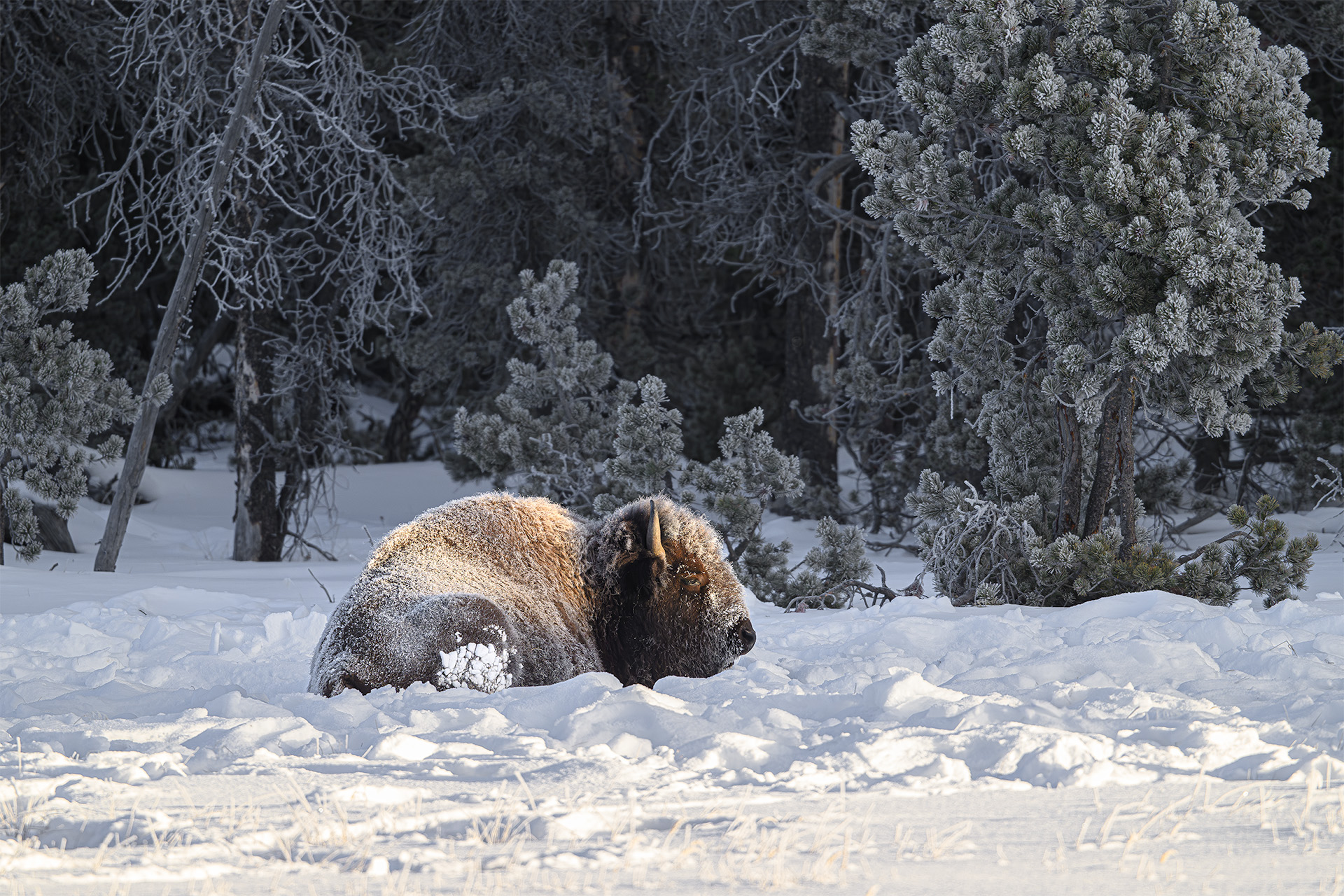
On the way to Old Faithful Geyser yesterday morning, we encountered a herd of Bison bedded down in the snow on the edge of the road. They were still in some shade and the sun was just beginning to hit them so the frost was still covering their heads, backs, and flanks. It’s always fun to see and photograph frosty Bison in Yellowstone.

2025—Another Dog Day!

Day 2 of the Yellowstone Winter Adventure was every bit as spectacular as Day 1. And, it was another Dog Day with about 28 dogs including both Wolves and Coyotes. We returned to the Bison kill from the day before in Hayden Valley as did many of the people who were also fortunate to witness what we did. The Wapiti Lake Pack was still in control of the carcass and at least 22 Gray Wolves were still in the vicinity of the kill. Day 2 brought out more of the scavengers working on the periphery. The Common Ravens and Black-billed Magpies kept their distance from the Wolves but pecked at the scraps surrounding the edge of the kill site, away from the carcass itself. At least three Bald Eagles perched nearby observing the situation. Although one courageous Coyote checked out the carcass on Day 1, Day 2 brought at least three, possibly four, Coyotes to the scene, still lurking at a safe distance from the carcass but keeping a close eye on it. Here are two of the Coyotes that crossed nearby on the rise behind us, possibly on a mission to check out the kill.

2025—Twenty-eight Dog Day!

Our first day in Yellowstone National Park was a twenty-eight dog day! The day started with the sighting of twenty-three Gray wolves from the Wapiti Lake Pack. As the day continued, we also saw four Coyotes, and a single Red Fox for a total of twenty-eight canines. A tip had us headed to Hayden Valley immediately after entering the park at 7 AM Monday morning. At first, the area was obscured by a low lying fog layer but then Moose noticed movement and there they were, the Wapiti Lake Pack, twenty-three strong on the valley floor. Some members of the pack were harassing a small group of Bison and they took one down.

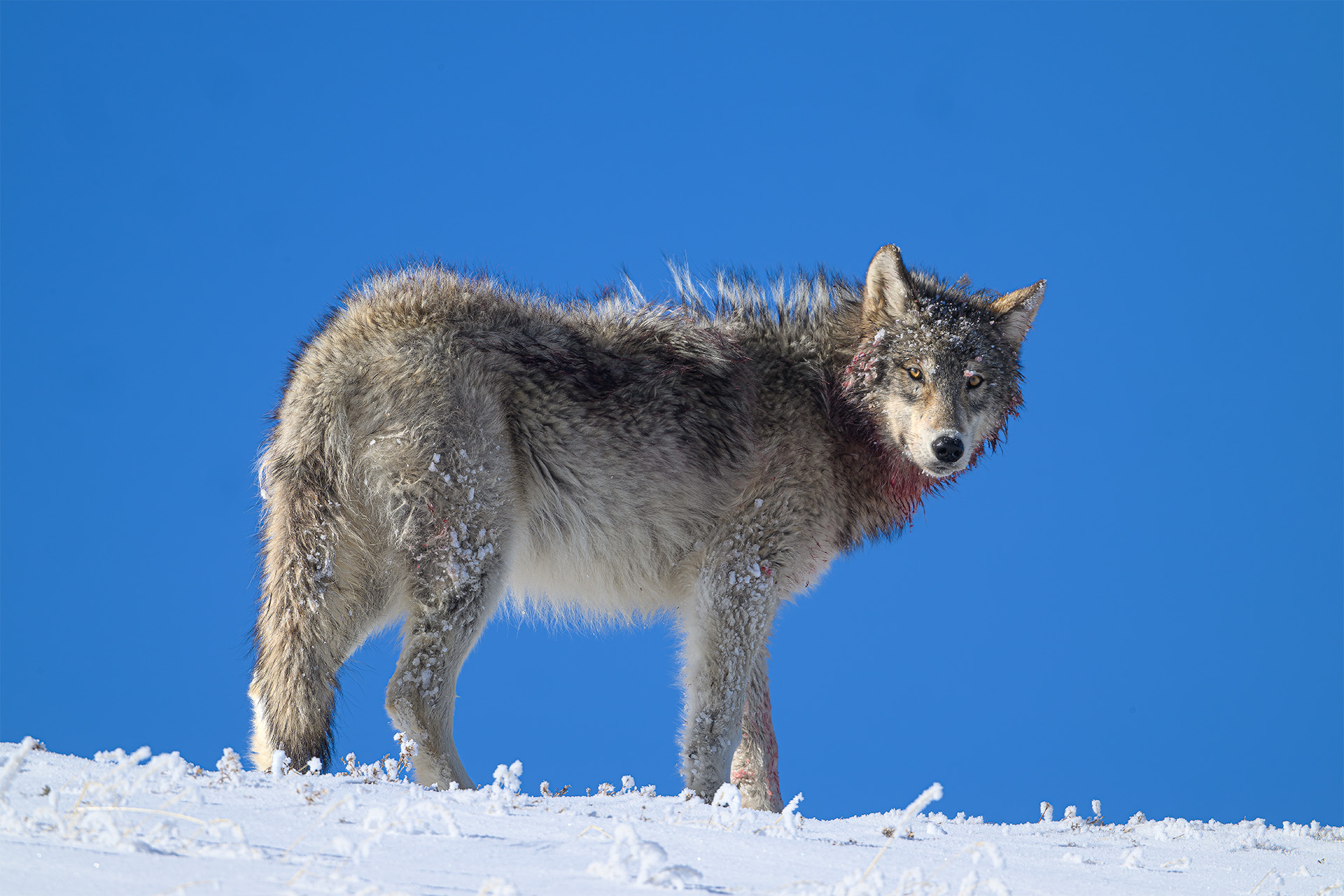
It was at once horrifying and mesmerizing to watch wild nature in action as the wolves killed the Bison. Eventually they set to howling, sounds so captivating that you stop doing what you’re doing to listen to them. A daring Coyote ventured close to the kill when most of the wolves had moved away to rest but he wisely retreated when the few wolves still at the carcass kept an eye on him. The Coyote bounded up the hill behind us and was quickly challenged by this Gray Wolf who also appeared on the rise behind us to make sure the Coyote went on its way. The wolf had already eaten and its face, neck, and chin are stained with blood. Despite the gruesome scene in front of us, we felt privileged to witness something that occurs every day in Yellowstone but mostly out of view of its visitors. What an unexpected but fabulous start to a winter trip there. And, just what will happen on day 2?

2025—The Bounty of Gray Lodge

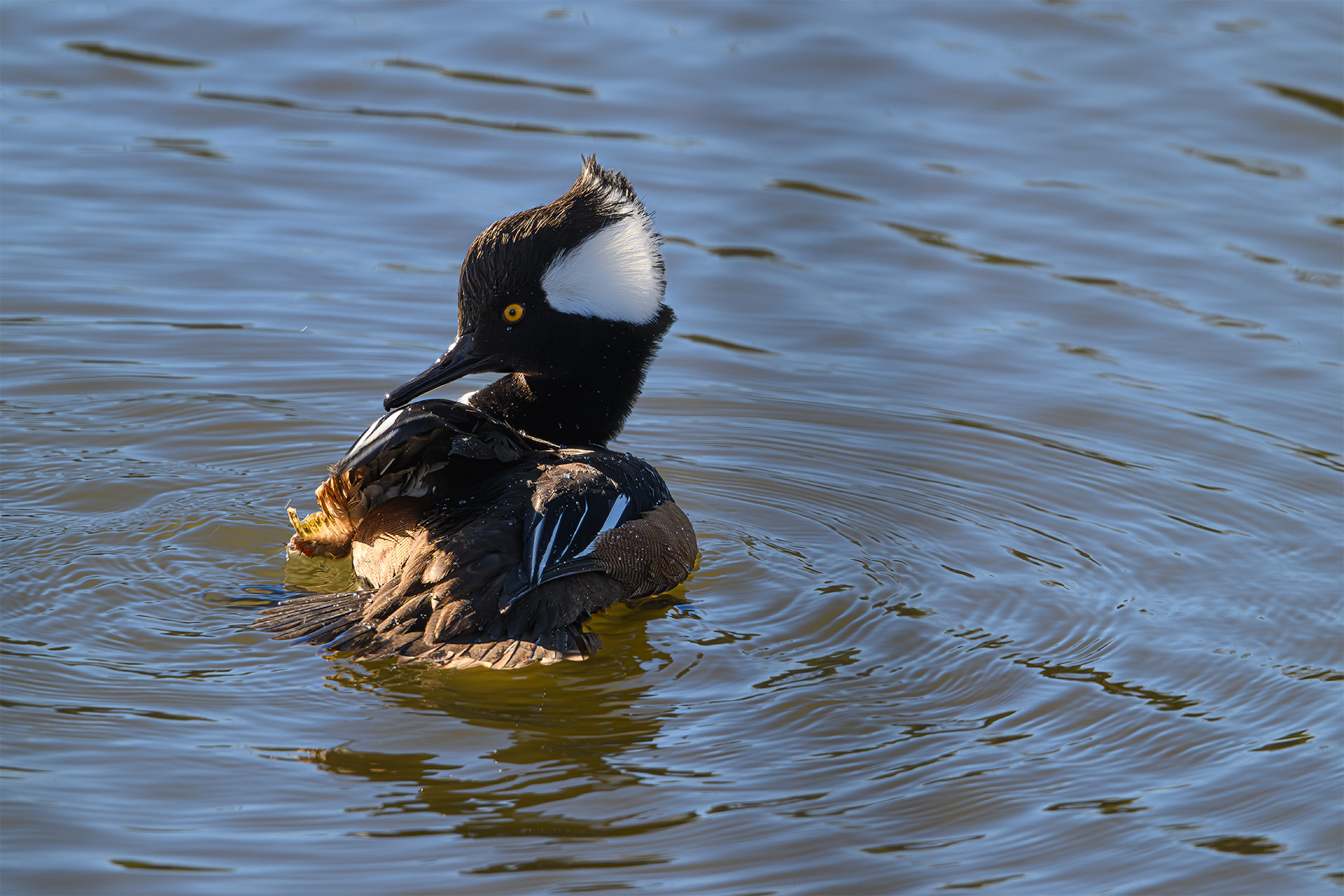
Driving the loop at Gray Lodge was like a treasure hunt. And the birds we found as we drove along the loop were the bounty. This male Hooded Merganser was preening near the edge of a pond. The breeze was stiff and he twirled around as I photographed him from the back seat of the car. I’m not sure if his twirling was on purpose of if the breeze propelled him (look at the feathers on his head, curled up by the breeze) but it was a fun challenge to capture him at the moment he lifted his head from under his wing and when I could see an eye.

2025—Great Gray Owl Video

Our week in Sax-Zim Bog was capped off on the last afternoon with a four hour visit with a Great Gray Owl. He was amazingly calm and aloof, seemingly unbothered by the people watching him. Much of the time, he sat motionless. When he left one perch for another, he immediately settled down again, watching for prey in the snow beneath him. He would occasionally swivel his head in what seems like a 360° swivel (it’s not) to respond to something he heard behind him, then he’d swivel around again and resume watching in front of him. I took a couple of videos while we watched him. Video is a work in progress for me. I can’t seem to keep the camera and lens still, despite using a tripod. Fortunately, Adobe Premiere has a function that stabilizes shaky video. This is a 15 second clip created from a two and a half minute video that illustrates just how still he can be; then he abruptly swivels in a motion that appears like his head isn’t attached to his body; and after several seconds, he again abruptly swivels back and looks directly into the camera.

2025—A Big Gaggle

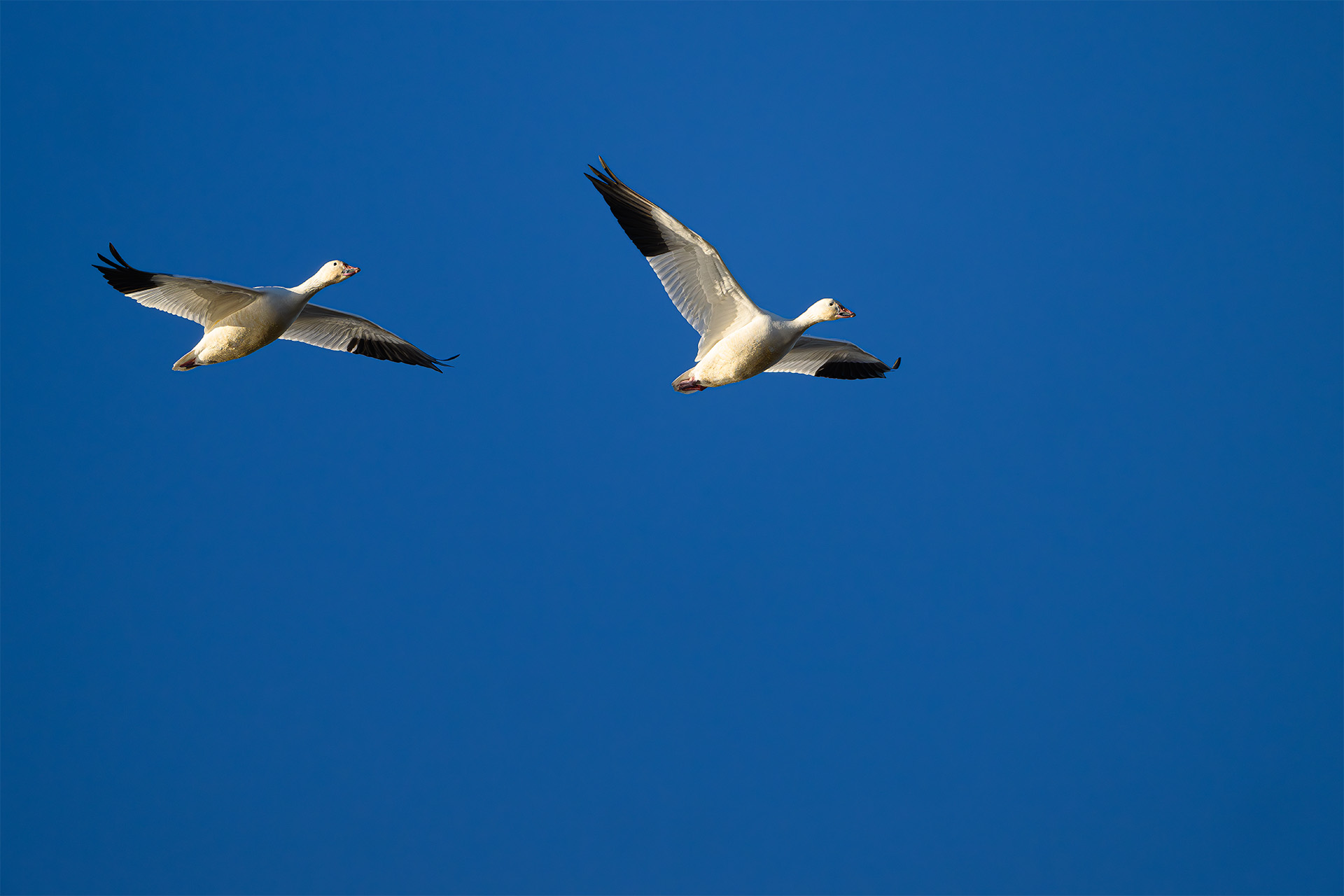
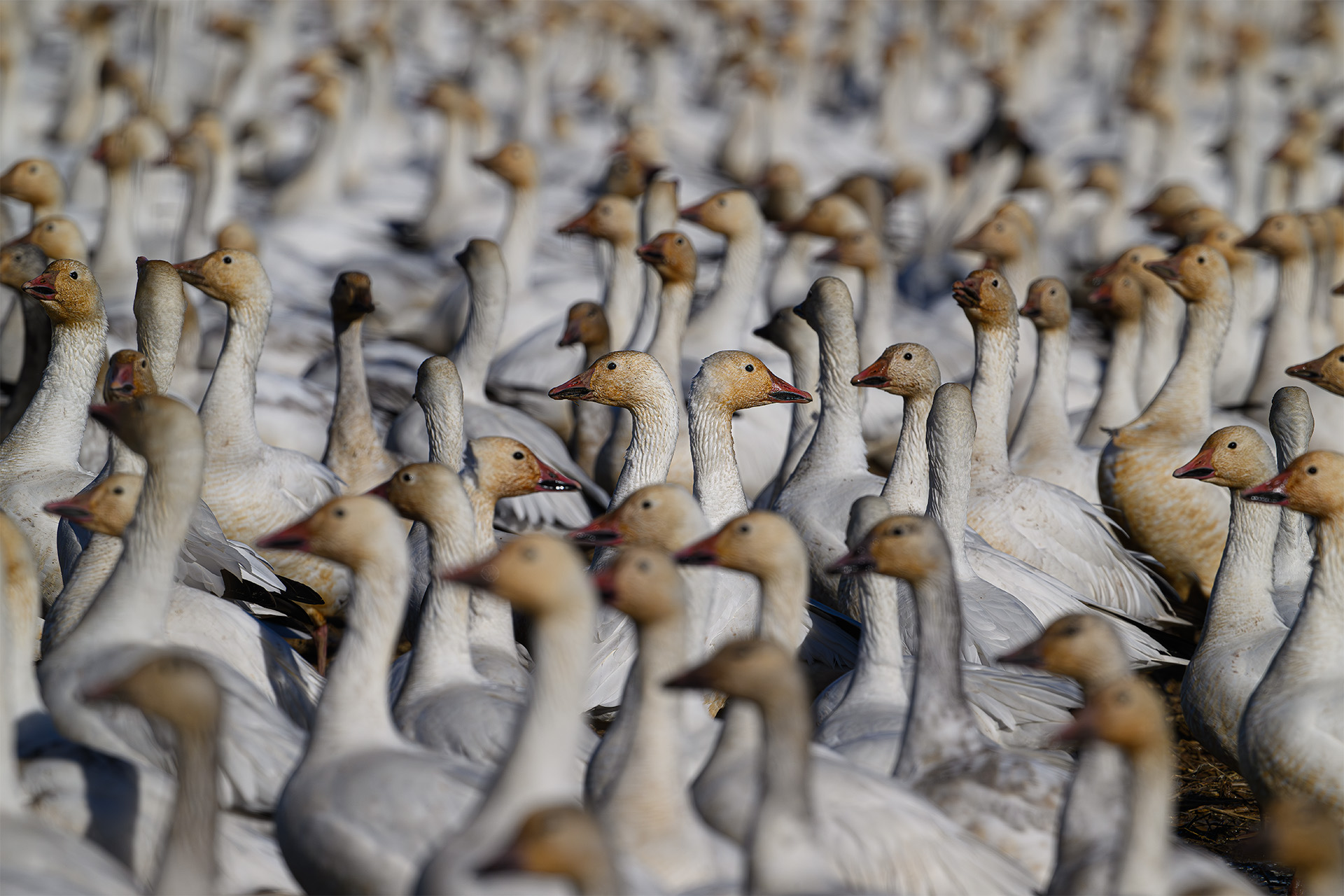
Thousands of Snow Geese filled the ponds at Gray Lodge, occasionally exploding into the air with a cacophony of sound, both wingbeats and squawks. It was a pretty big gaggle of geese. I got a chuckle out of this image because of the one in the center looking behind it, the opposite direction all the other geese were facing— okay, maybe one other is doing it too. It struck me that maybe he’s the lookout to make sure nothing is sneaking up behind the group. It was usually a predator that set them off. There were plenty of predators there, mostly raptors like Bald Eagles, Northern Harriers, Red-tailed Hawks, Red-shouldered Hawks, Cooper’s Hawks, and I’m certain I saw a Sharp-shinned Hawk disappear into the shrubs as we stood photographing the Green Heron. When I’ve seen Snow Geese at Bosque del Apache, they didn’t have the rust staining on their head and breast feathers. I have read that it is caused by the iron-rich soils where they feed here that stain their white feathers with iron-oxide.

2025—Long-billed Curlew in Rice Field

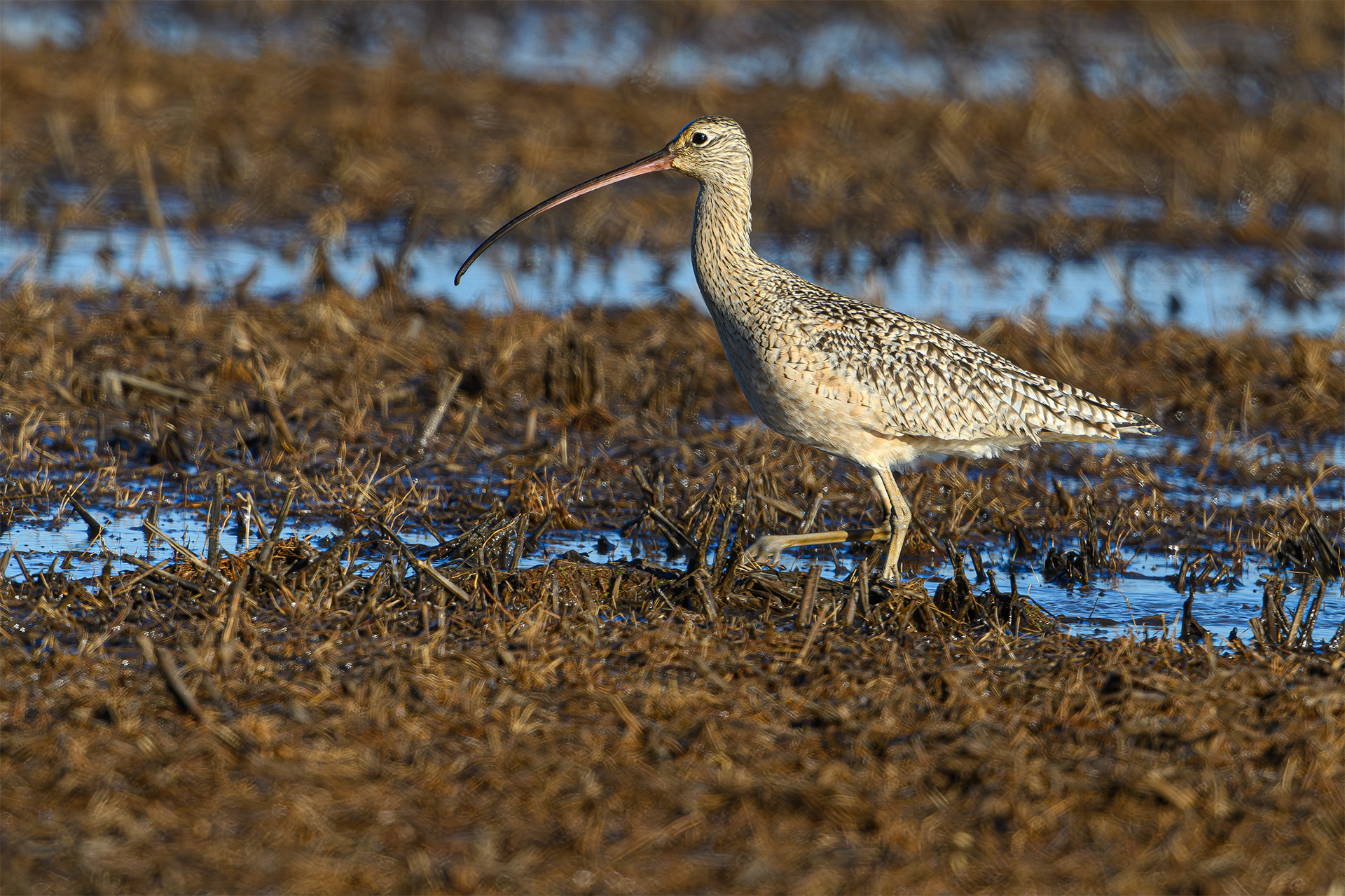
Long-billed Curlews are shorebirds and, until the other day, I thought they stayed at the shore. I’d only seen these large birds with the impossibly long bills on sandy beaches, usually in Texas. Turns out, they do come inland. The other day driving home from Gray Lodge, we diverted through the rice fields in Sutter County and there, in one of the harvested fields, was a lone Long-billed Curlew, poking its long beak through the rice stubble and into the soft mud hunting for whatever lives in that environment. According to Sibley’s, these birds winter in marshes and fields. A rice field is pretty marsh-like so it’s the ideal setting for one. And, I had the perfect vantage point, shooting from the back seat of the vehicle.

2025—Green Heron at Gray Lodge

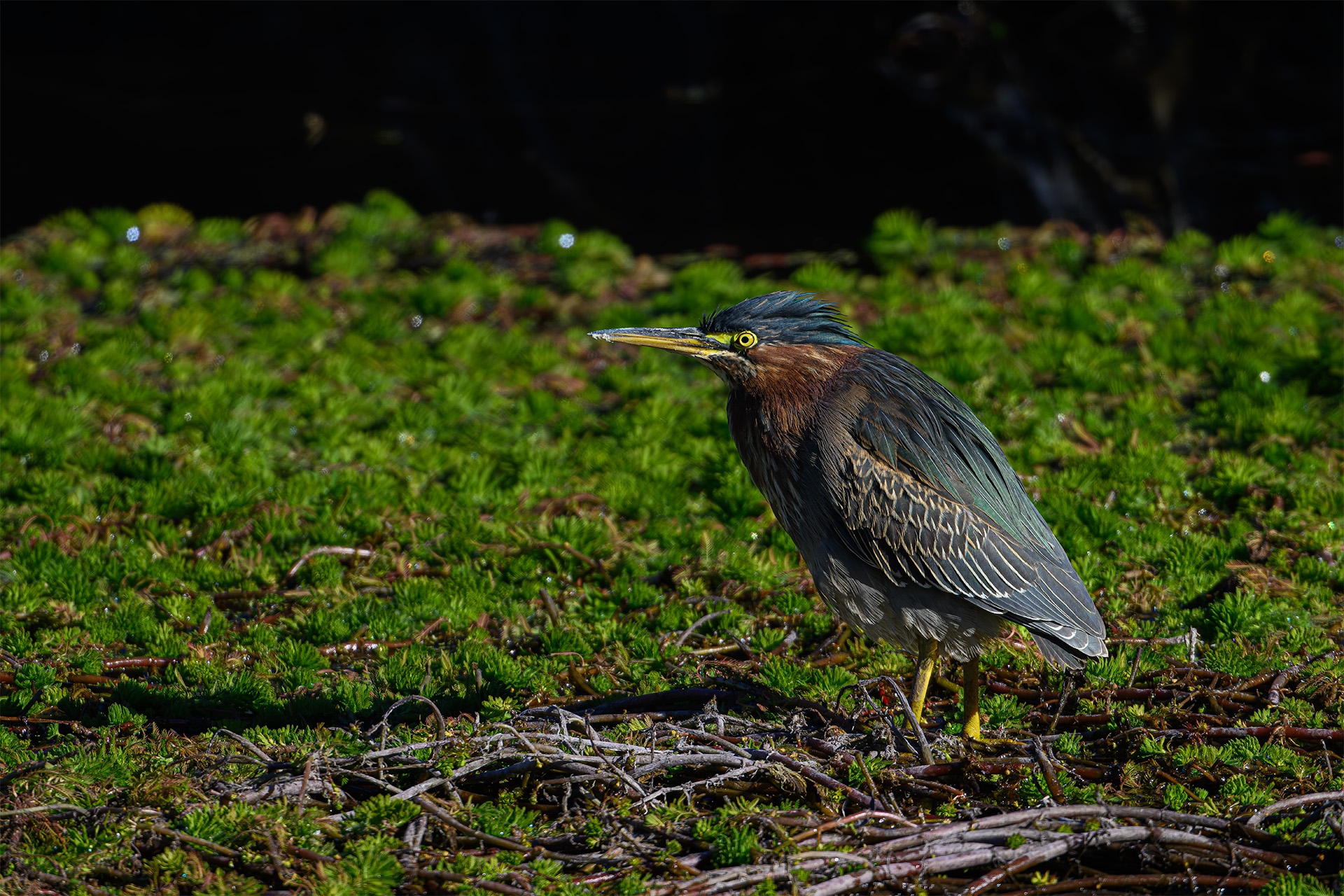
Gray Lodge Wildlife Area is a wetland preserve near Gridley, CA that is known for the variety of birds that it attracts. I was there for the first time on Monday with my Photography Club. I photographed 23 different species of bird and saw at least a half dozen more. After driving the auto loop, we took one of the trails and came upon this Green Heron in a small pond. The edge of the pond where the Heron was standing, was covered with an invasive species of aquatic plant called, among other names, Parrotfeather. Its dense mats of intertwined brownish stems in freshwater lakes, ponds, and canals, like the ponds at Gray Lodge compete with native plant species. The Green Heron didn’t seem to mind as he concentrated on finding his next meal.

2025—Those Expressive Eyes

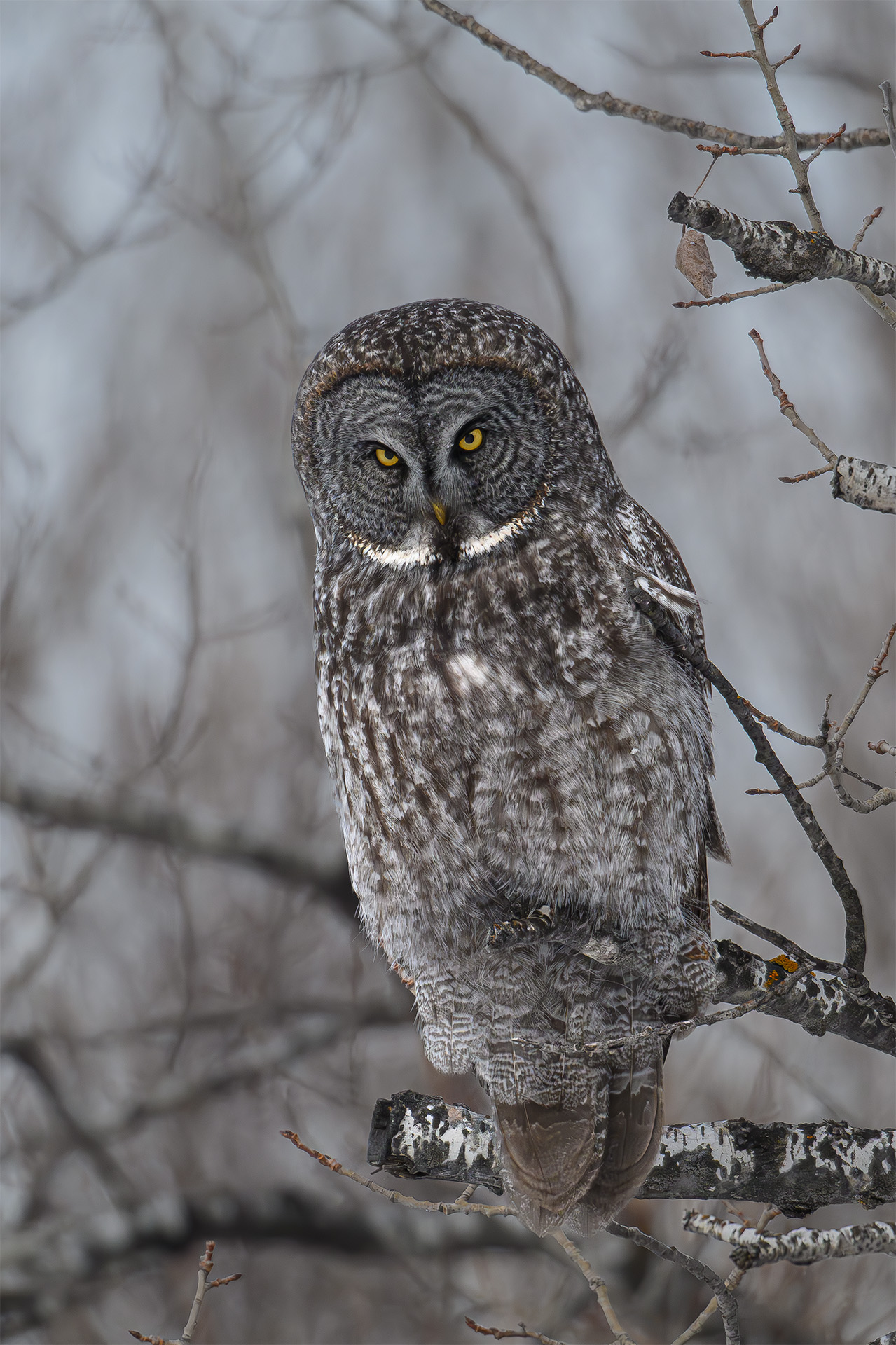
Last week at Sax-Zim Bog in Minnesota, where most of the time the temperatures hovered below zero, we had a number of photographic opportunities with Great Gray Owls that made me realize what expressive eyes they have. Because an owl’s eyes face forward, unlike most other birds, their eyes convey, to us humans anyway, feelings that our innate instincts anthropomorphize. This is one of my favorite looks from a Great Gray Owl. I’ll leave it up to you to decide what you think is on his mind.

2025—From Birb to Borb to Floof

A few years ago, the Audubon Society took up the challenge of defining the word “Birb,” a word used on-line as a generic reference to birds that are generally small, round, and cute. Their definition went on to clarify and to distinguish Birbs from “Borbs,” which are fatter cute birds, and then they tackled “Floofs,” which are Borbs with feathers fluffed. The more I looked at this Black-capped Chickadee, one of dozens that were feeding at the Winterberry Bog section of Sax-Zim Bog last week, my impression of it quickly went from Birb to Borb to Floof. The icy temperatures, hovering well below zero, is probably what tipped the scales from Borb to Floof.

2025—Posing

I couldn’t get enough of Great Gray Owls at Sax-Zim Bog. We had marvelous encounters with them on three out of the four days we were in the Bog. On our last afternoon there, one very cooperative Great Gray posed for us. Part of the time he was taking his midday nap and his eyelids were heavy, often closed. For a while he spun his head what seems like 360° as he listened and looked for prey in the snow. He would fly to a new perch; I think there were six different perches that he visited. It was from this perch that he spotted a vole and he flew across the road, pounced, and swallowed it in three gulps. When it was prudent, we moved in his direction to improve our view. Other times we stayed put although some of the gaggle of photogs who always gather when a Great Gray is in view, spoke loudly, made wild gestures, and ran after him when he moved. It is amazing to see how foolish some photographers can be, thinking their photograph is more important than the well-being of the wild animal they’re photographing. It was even more amazing to me that this owl ignored their antics and spent his time napping or searching for prey. When all of the other photographers left in pursuit of another owl, we were alone with this magnificent bird for a couple of hours. Our time with him zipped by. After four hours, the light began to dim and we could no longer capture good images but we had spent lots of quality time with him so our day, and our entire trip, was a resounding success.

2025—Hiding in Plain Sight

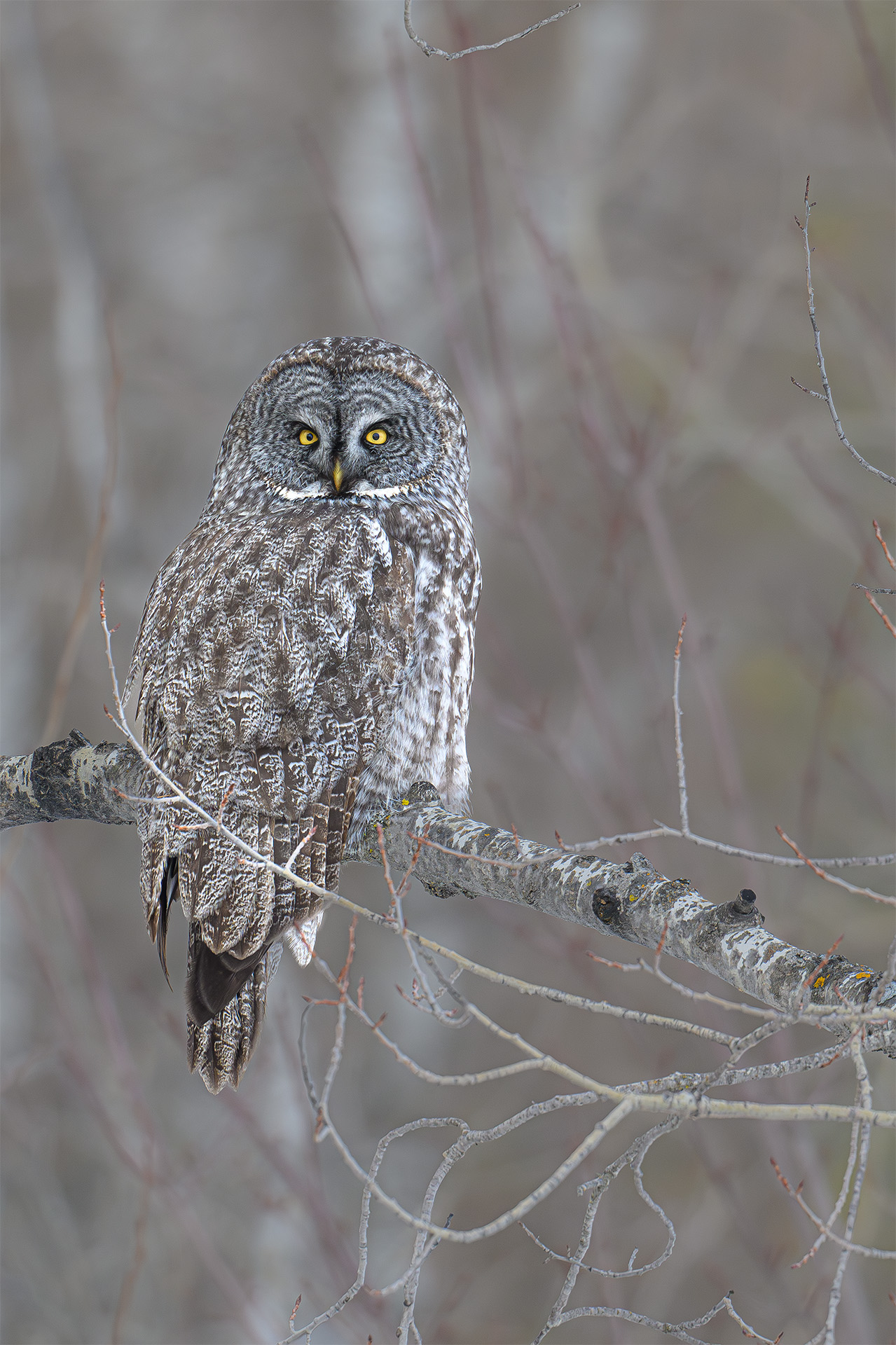
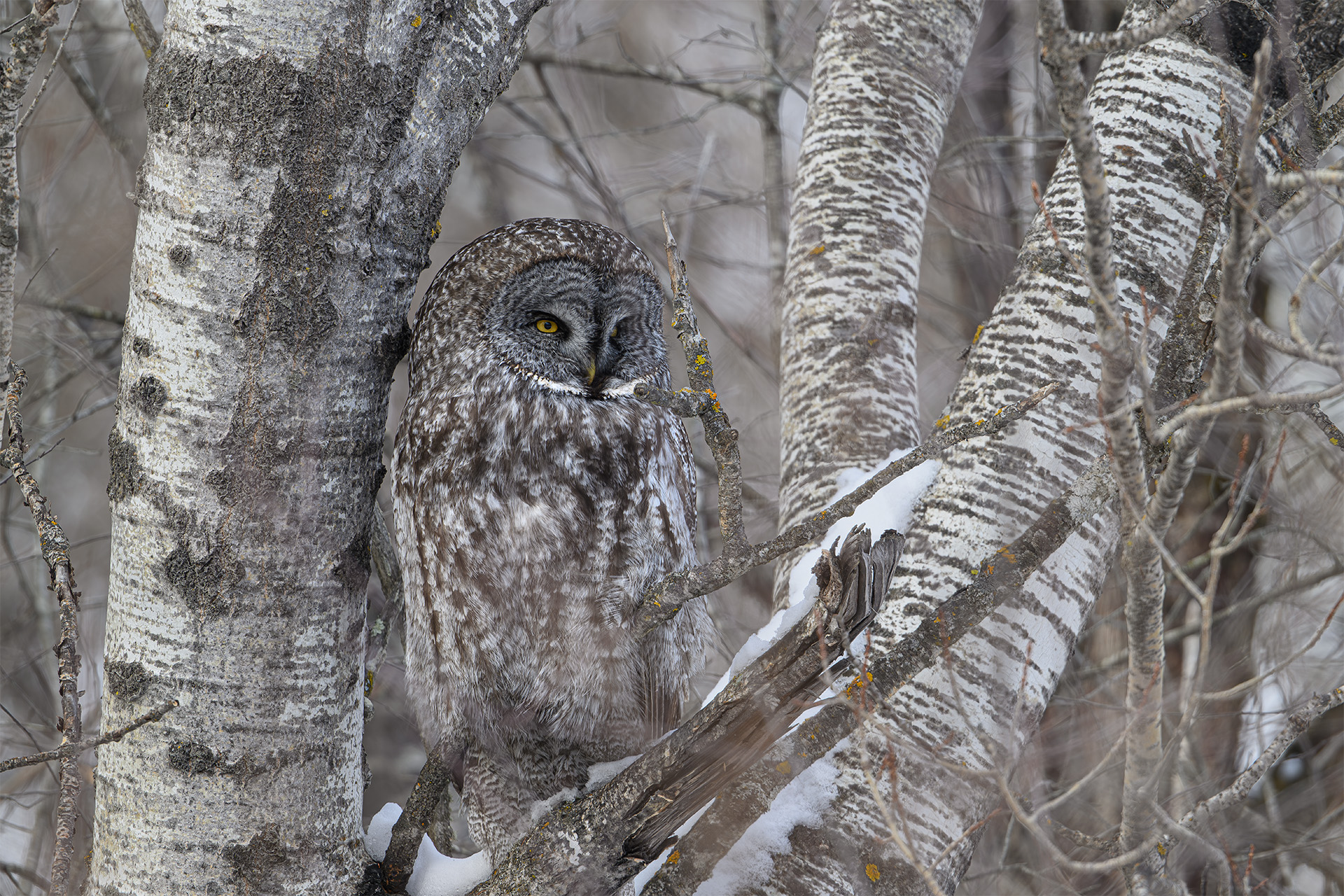
The Great Gray Owl is the largest owl in North America with a wingspan of almost 5 feet and head to tail length of two feet. It has an imposing look about it with an intimidating gaze. But, as large as it is, it can easily disappear into its surroundings, its natural camouflage blending into its surroundings. When we arrived back at the bog on Thursday afternoon, I didn’t see him right away because he perched in the crotch of a birch tree that matched the coloration and patterns of his feathers. He was, in fact, hiding in plain sight.

2025—What a Day!

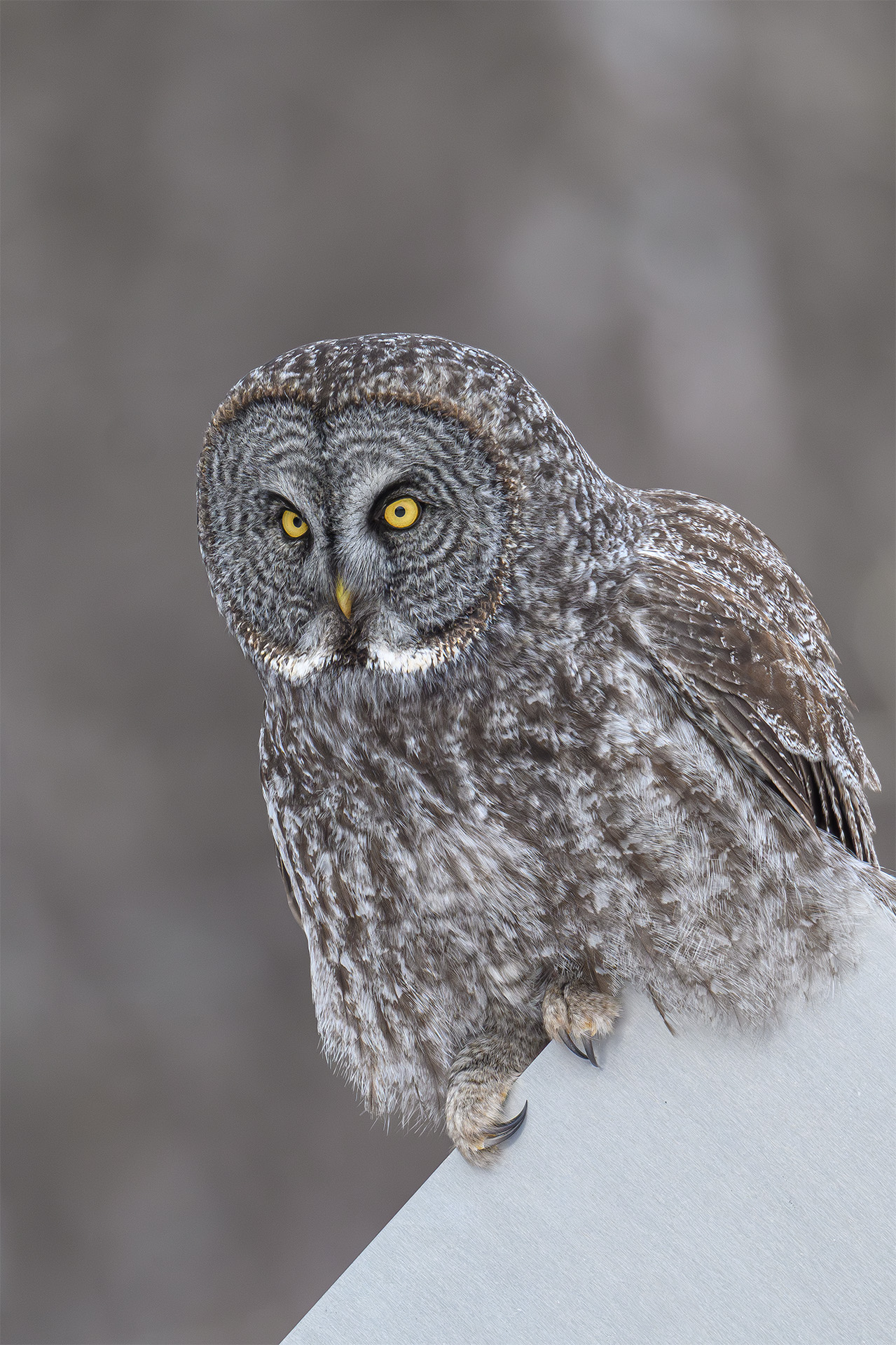
This year’s trip to Sax-Zim Bog (it’s my 6th year in a row) was definitely a success. Except for one day, our shooting has been mostly of Great Gray Owls. After a disappointing day on Wednesday, though, we decided to go to a place a couple hours away called Two Harbors where there is a lighthouse (it’s on Lake Superior) and where we were told there was an irruption of owls, both Great Gray and Boreal. While we were there, we got some great shots of the Two Harbors Lighthouse but we did not see a single owl. Returning to Sax-Zim Bog for the afternoon, we learned that a Great Gray had been hanging out since morning in an area where we’d photographed him a couple of days before. We also heard that someone had captured a shot of a Great Gray perched atop the Owl Road sign, the street the Sax-Zim Bog Welcome Center is on. It didn’t take much prodding to get us to head over to where the owl was seen, and there he was, nestled in the crotch of a birch tree. When he flew off a short time later as he started to hunt, he landed on the top edge of a diamond shaped sign, perhaps to get a better lookout for his next meal. The concentration of his stare shows his determination and the feathers that formed his facial disk help him to direct and intensify sounds in his search for prey. The way he is barely clinging to the edge of the sign with his talons made me think his hold was a bit tenuous and he soon settled back onto a branch on the birch tree. What a rush it was to spend all afternoon with him yesterday, watching and shooting as he occasionally changed perches, catnapped, and even caught and gulped down a vole.

2025—Sunrise on the Bog

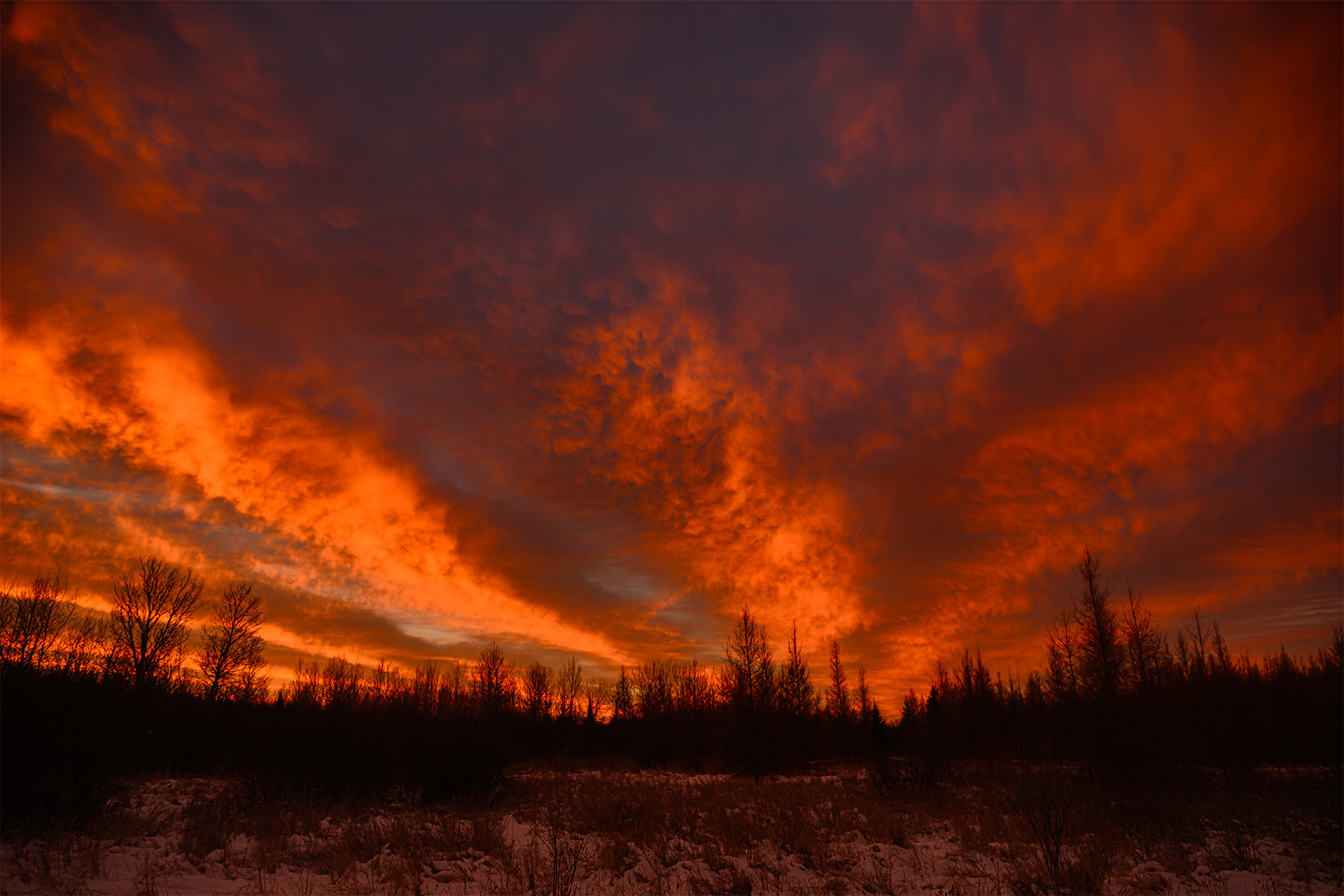
Our first two mornings here in Sax-Zim Bog had clear skies and sub-zero temperatures that started at -12 and got colder as those mornings wore on. The sunrises on those days were unremarkable. Yesterday’s, however, was simply gorgeous and I was not expecting such a display. It reminded me of the sunrises on Caddo Lake in Texas/Louisiana that started with intense color that got deeper and lasted longer than most sunrises. At the Bog yesterday, the skies were filled with clouds and the temperatures were slightly higher than the previous two days (but still sub-zero at 7 AM). We watched as the red color kept deepening and intensifying for about 45 minutes. And then, it faded quickly and was gone. It was a spectacular start to the day. As it turned out, it was the only photography we did yesterday. We saw no Great Gray Owls and no Barred Owls as we traversed the roads in Sax-Zim Bog for hours and only a few other birds. I’m looking forward to seeing what today has in store for us.

2025—What a Great “Great” Day!

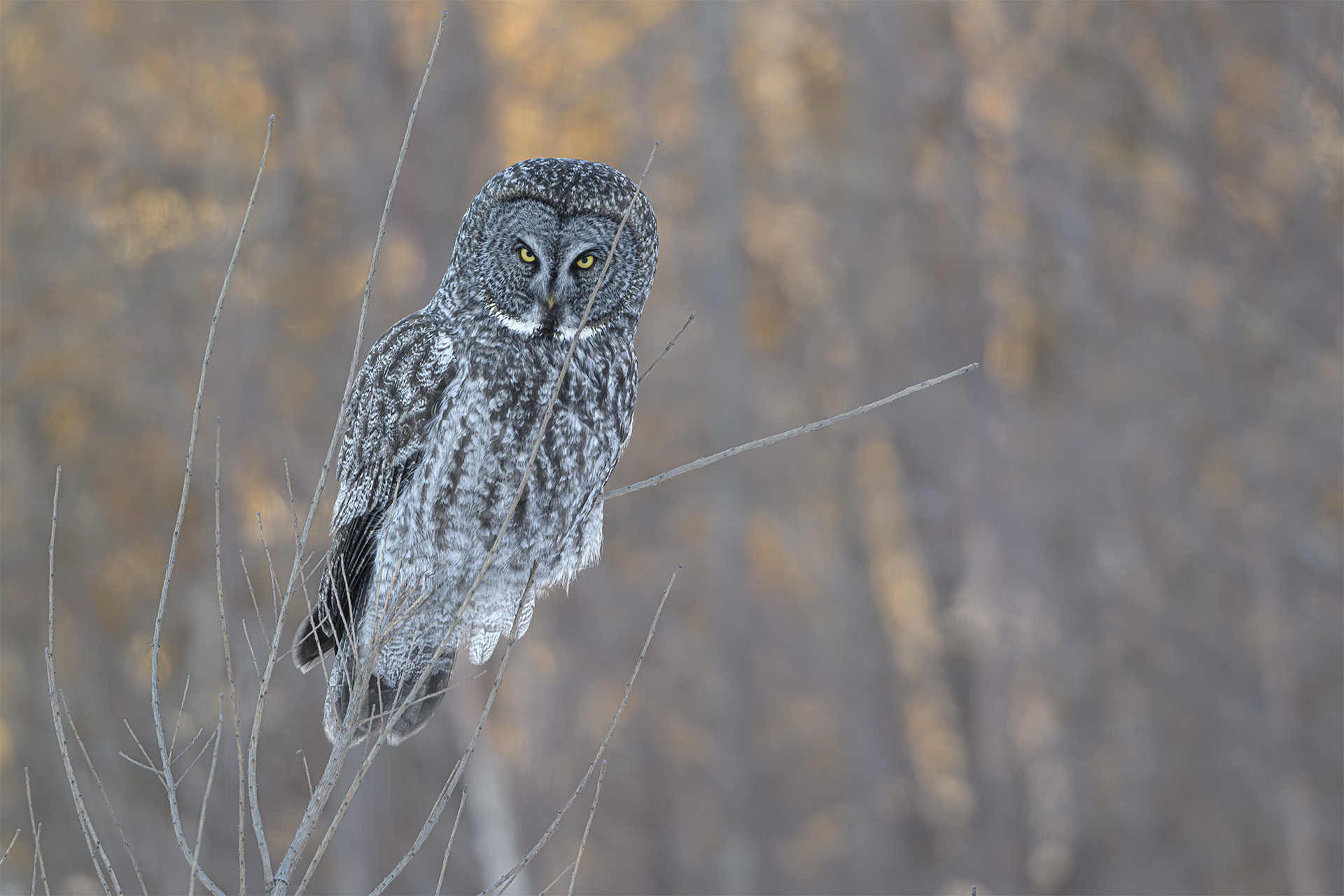
After thinking we couldn’t top Day 1, on Day 2 we did! Day 2 turned out to be a really great “Great” day. We had four successful photography encounters with Great Gray Owls starting before 9 AM and finishing late in the afternoon with this one that we followed down the road and around the corner as he hunted for voles. He changed perches about six times, and he finally did catch a vole and swallowed it whole in three gulps. Then, after spending more than an hour and a half with us while he let us photograph him, he flew into the dense forest and disappeared from our view. We’ve had tremendous fortune finding Great Grays this trip. The cold temperatures have been daunting but when you’ve got a Great Gray in your viewfinder, you forget the cold and focus on the subject so minus 21 degrees doesn’t seem so cold. It was -21 when we stopped before 9 AM to photograph the first Great Gray of the day. Because of the nature of their habitat, the backgrounds are often busy, unattractive, and distracting. Sometimes the owls choose perches in deep shade or in contrasty light and with shadow on their bodies. But we can’t choose where they perch so we have to figure out what works to get a good shot. This was the best background we had, a kind of mottled gray and orange from the birch trees that were a far enough in the distance that they dissolved into abstract colors and shapes. Unfortunately, the deciduous shrub on which he perched had small twigs that obscured his face much of the time. One specific twig was of great concern to several of the photographers around me who grumbled that they couldn’t get a shot from any angle and kept moving to find a place where they could eliminate the twig. Unfortunately, there was no place that was possible. I just waited until he turned his head enough that both eyes were between the v formed by the twigs. And, lucky for me, that happened at the same time he decided to look straight at me.

2025—Setting a High Bar

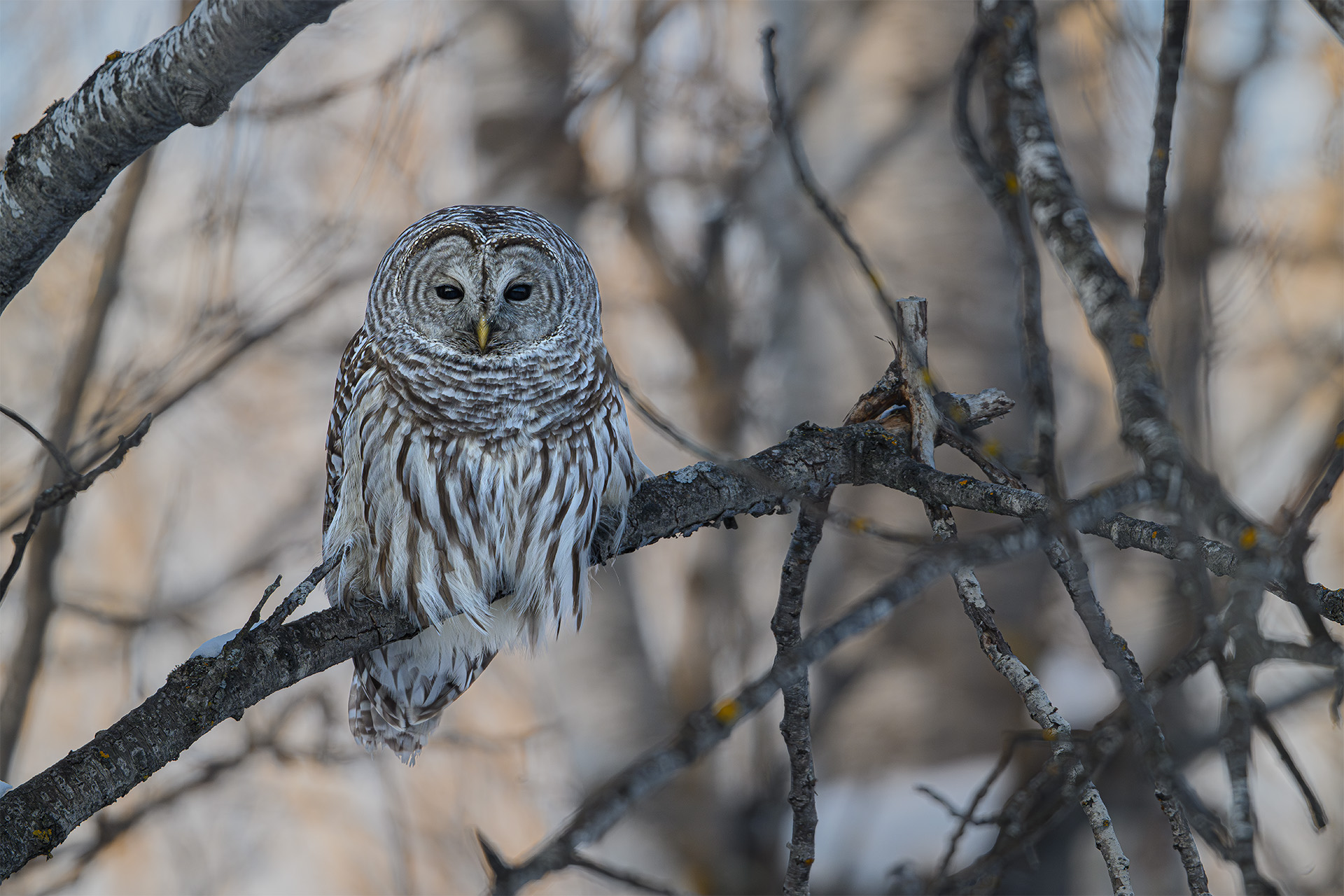
Our first day in Sax-Zim Bog in Minnesota set a pretty high bar for the rest of the trip. We started the day taking images of the Wolf Moon setting over the Bog. Then, despite bone-chilling temperatures, we photographed a cooperative Great Gray Owl within the first hour of our arrival when the temperature had dropped to -21°. Temperatures hovered in the negative mid-teens for most of the morning but by early afternoon had started to drop a little when we encountered a perched Bald Eagle surveying the area. By the time we found the cooperative Barred Owl, above, in late afternoon, -4° didn’t seem too bad. And, we ended the day with a colorful sunset, something I don’t recall seeing here on any previous visit. Encountering and photographing two owls on our first day and doing a little bit of landscape photography too was a great start. Day 1 has set a high bar but I can’t wait to see what Day 2 brings.

2025—Back to the Bog

Today I’m heading back to Sax-Zim Bog in Minnesota where the temperatures are expected to be, well, cold, negative to low teens. I don’t remember what the temperature was last January when I photographed this Great Gray Owl there (it is our primary target species) but it was cold, windy, and snowing in the early morning. The snow and the cold temperatures do not keep us from venturing out to photograph birds there. Somehow, the excitement of seeing a creature as magnificent as a Great Gray Owl perched on a branch in the midst of a snow flurry as it looks for its next meal mitigates any discomfort due to the weather conditions and it’s all about the photography. Of course my many layers of clothes, heavy duty jacket, hand warmers, and glove options that include heated gloves and a pair of Beaver mittens that have saved me more than once, all contribute to my comfort and allow me to focus on my photography. So, I’m going prepared for the cold as well as the photography.

2025—It All Depends

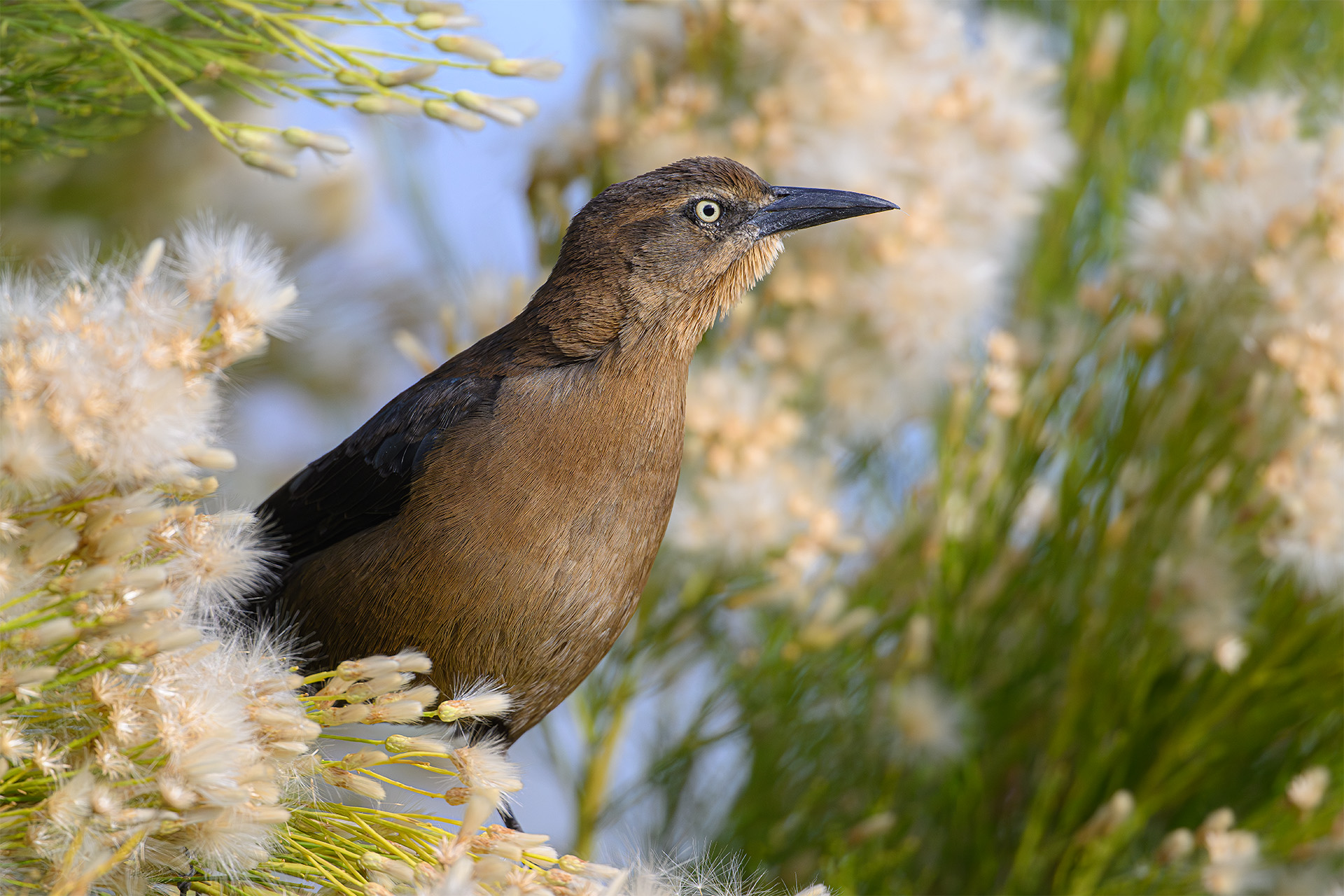
Over the years, I have come to appreciate various species of blackbirds, whether they’re singing in the dead of night (thank you, Paul) or baked in a pie (thank you whomever penned “Sing a Song of Sixpence”) or perched in a line on telephone wires (thank you, AT&T). But, until I started to photograph birds, I’d neaver thought much about common blackbirds and people often dismiss them as noisy pests. Blackbirds seem so common and uninteresting until you really look at them: like the Red-winged Blackbird’s red epaulets flared or a Bronzed Cowbird whirling like a Dervish. Like other black birds, Great-tailed Grackles are large blackbirds that are often considered pests but their black feathers have an iridescent glow and are really quite beautiful. Sometimes, a common bird like the Great-tailed Grackle shows up someplace that makes them stand out. That happened at the Riparian Preserve at Water Ranch in Gilbert, AZ. A female Great-tailed Grackle, the females usually being the less attractive of a bird species, suddenly appeared in the midst of a large stand of Desert Broom that was going to seed. We had been photographing much smaller birds there including the adorable Verdin. But, I found her stance and her fixed gazed quite compelling and she looked quite beautiful in the midst of the fluffy broom flowers, so I guess it all depends whether a bird is appealing or a nuisance.

2025—The Genius of Nature

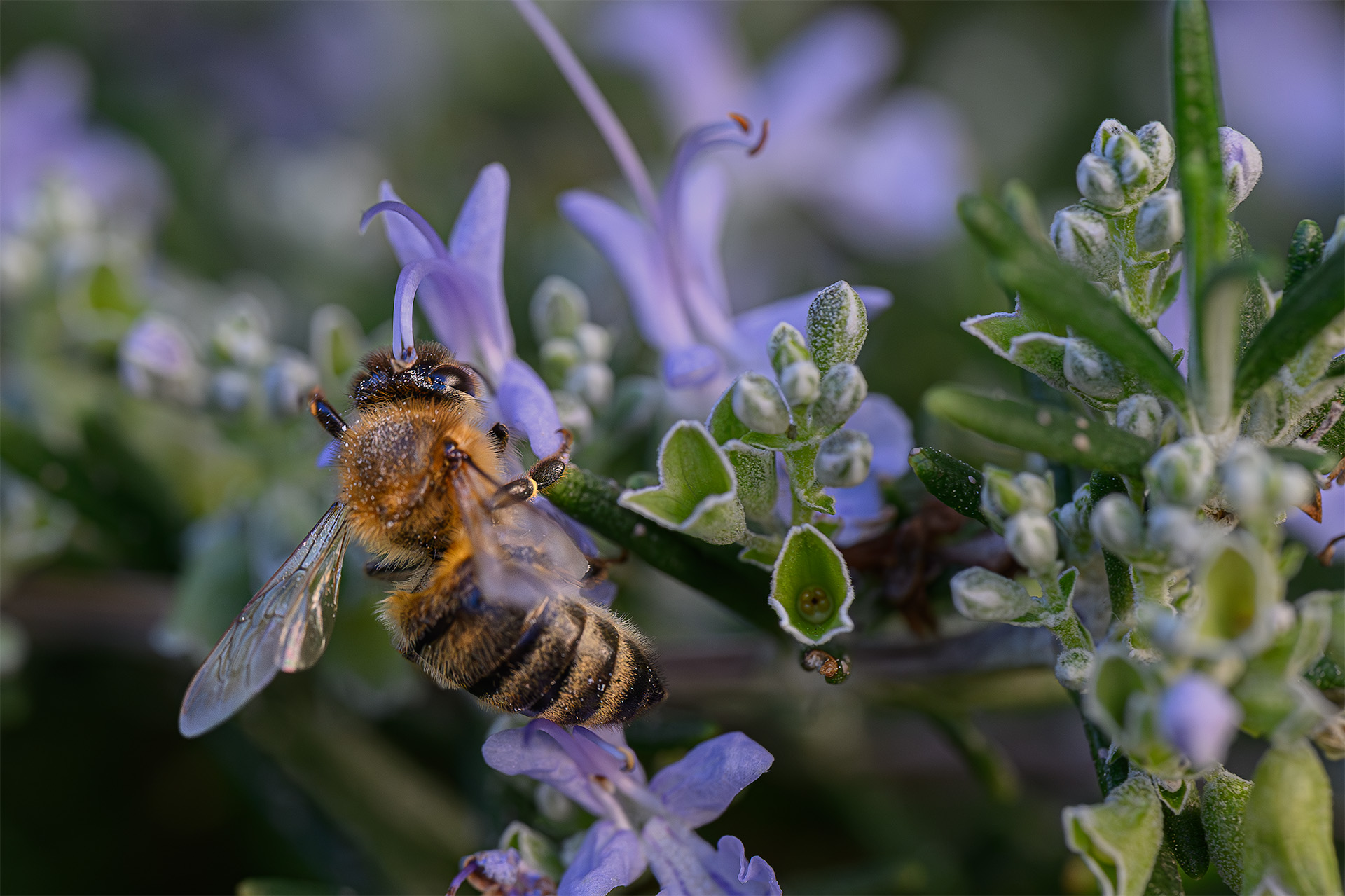
If you ever wondered how bees serve as pollinators, or if you slept through high school biology class, just sit by a Rosemary plant in full bloom and you will learn. Plus, the pungent aroma of the Rosemary will start you salivating and hungry for a savory Rosemary-forward dish for dinner. When I put the garbage can back after yesterday’s pick up, it was quite warm because the sun was out and the warmth brought out the aroma of the gigantic Rosemary shrub under the equally gigantic lemon tree on the side of my house by the gate. I walked over to admire the shrub which was covered in small lavender colored flowers. I heard buzzing and I knew the Honey Bees were hard at work extracting nectar from the tiny blossoms. I never pass up a photo op if I can help it so I went inside and returned with my Nikon Z8 with the 105mm Macro lens attached. I sat on my gardening bench and waited. At least half of the photos I took showed the stamen rubbing the top of the bee’s head as the bee extracted nectar from the flower. So that’s why every bee buzzing around had white pollen sprinkled on its head and thorax. Hmmm. And the next flower it visited would get some of that pollen. A biology lesson in my own backyard. Genius.