
A European Starling hitches a ride on the back of a Bison bull in Yellowstone National Park in October. Another Starling flies on by, seeming to prefer its own method of propulsion.
A European Starling hitches a ride on the back of a Bison bull in Yellowstone National Park in October. Another Starling flies on by, seeming to prefer its own method of propulsion.

Bison use their heads to shove aside snow that is covering what is left of the grasses that they eat in the winter. This bull’s face is caked with the remnants of snow he has shoveled aside to get at some nourishment. While a Bison makes this task look effortless, the hump, consisting of huge muscles between his shoulders, creates the power that allows these huge bovines to push away the snow so they can eat.

I am quite taken with the canines of Yellowstone National Park and I’ve been privileged to photograph Gray Wolves, Coyotes, and Red Foxes there. Our most recent adventure in Yellowstone started off with a bang as we spent a couple of hours photographing several Coyotes while they dined on a half frozen Elk carcass in the Lamar River. This Coyote sports a thick and gorgeous winter coat as it watches the other Coyotes feasting on the Elk.

Two years ago in Yellowstone National Park, we had the most amazing series of encounters with a gorgeous Red Fox vixen. At the time, I posted a similar photograph of this lovely lady but as I look back at the images from that encounter, I decided I like this one because I captured her looking directly at me. She was busy that day, mousing in the field, caching her prey in the snow banks behind us, then returning across the road to mouse some more. I was hoping to see her again last month but when we returned to her meadow, she was not in evidence.

The ultra-charming River Otters that cavorted in the Lamar River in Yellowstone National Park near the half-frozen Elk carcass in the water took a brief break from their lively antics and watched the Coyotes from a distance. This is one of the few shots that had all their faces showing. Their movements were so quick and so fluid that it was an unexpected bonus to see them all when they paused, ever so briefly.

“Bend over let me see you shake a tail feather.” The Five Du-Tones recorded those words in the early 1960’s and I bought their 45 single of Shake a Tail Feather at Tower Records in Sacramento a couple of years later after one of my college roommates played it for me. I realize this is NOT a tail feather. It is one of Bobo’s wing feathers that she molted yesterday morning. And, besides, I sing “Shake a Tail Feather” to her all the time and I thought it made a good blog theme. The past few days Bobo has rallied and seems like her old self again, eating normally, interacting with me, not constantly sleeping, and talking, whistling, and calling out to me when I leave the room. I hope it continues. I photographed this feather using my 105mm macro lens and my two new ProFoto A10 flashes, one with a grid to keep the light from spilling and just to enhance the green part of the feather, and one with a snoot to concentrate the light just on the downy barbs. After I looked at this image, I was surprised to see that some of the downy barbs were in fact yellow. I had to look at the feather with a magnifying glass in sunlight and indeed, they are yellow.

When we arrived at the edge of the Lamar River where the Elk carcass was half submerged, a small pack of Coyotes was nearby, drinking from an area of open water. Then, one by one, they followed a narrow trail in the snow to return to feed on the carcass. Once the trail is cleared, it’s easier for the animals to use and they don’t have to waste energy breaking a new path.
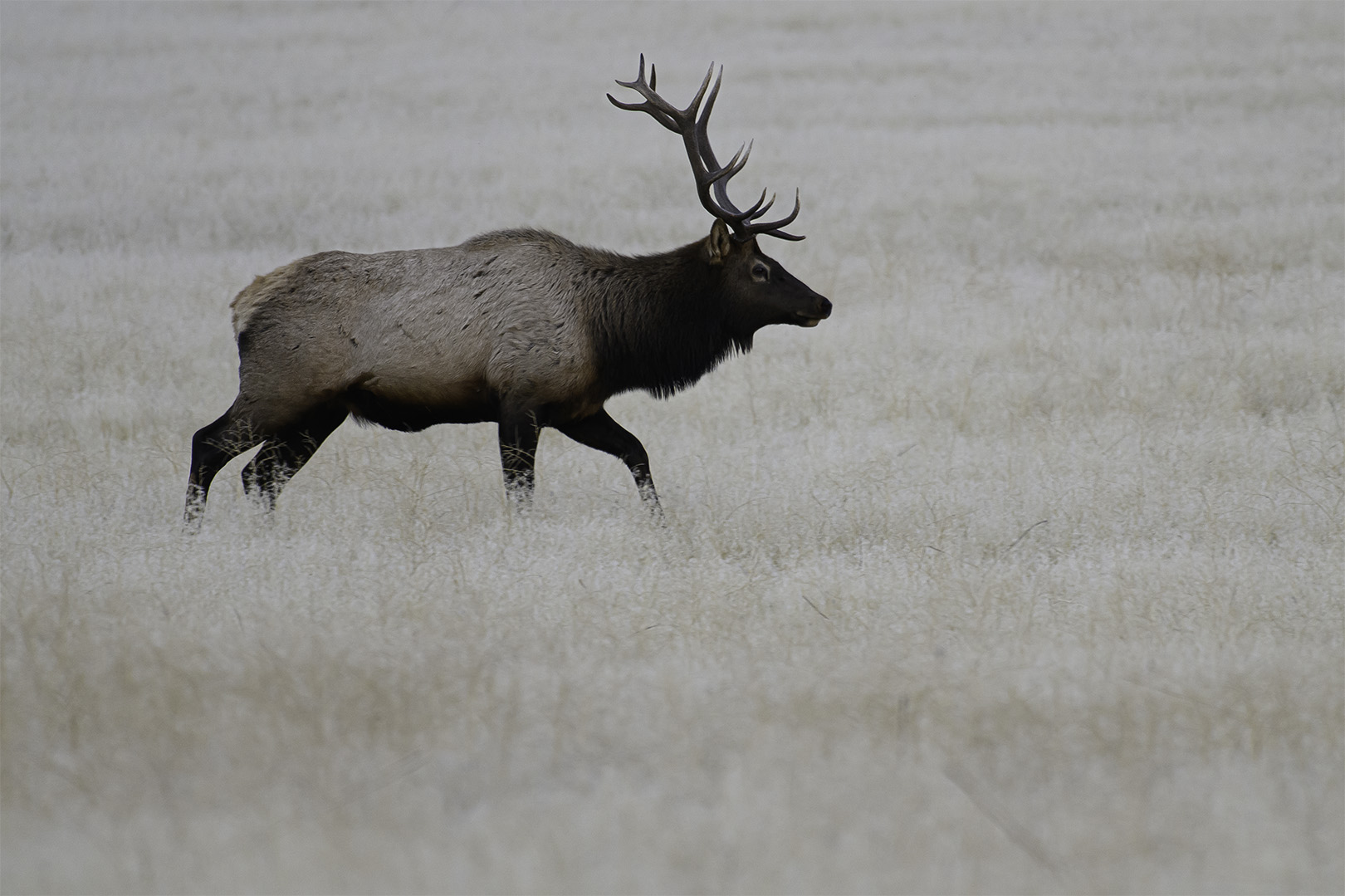
A handsome bull Elk walks with purpose through the grasses in a meadow outside Yellowstone National Park just off the Old Yellowstone Road in October. The fading grasses almost look like they’re dappled with snow but when we were there in October, there was no snow. It came a few days after I took this photograph.