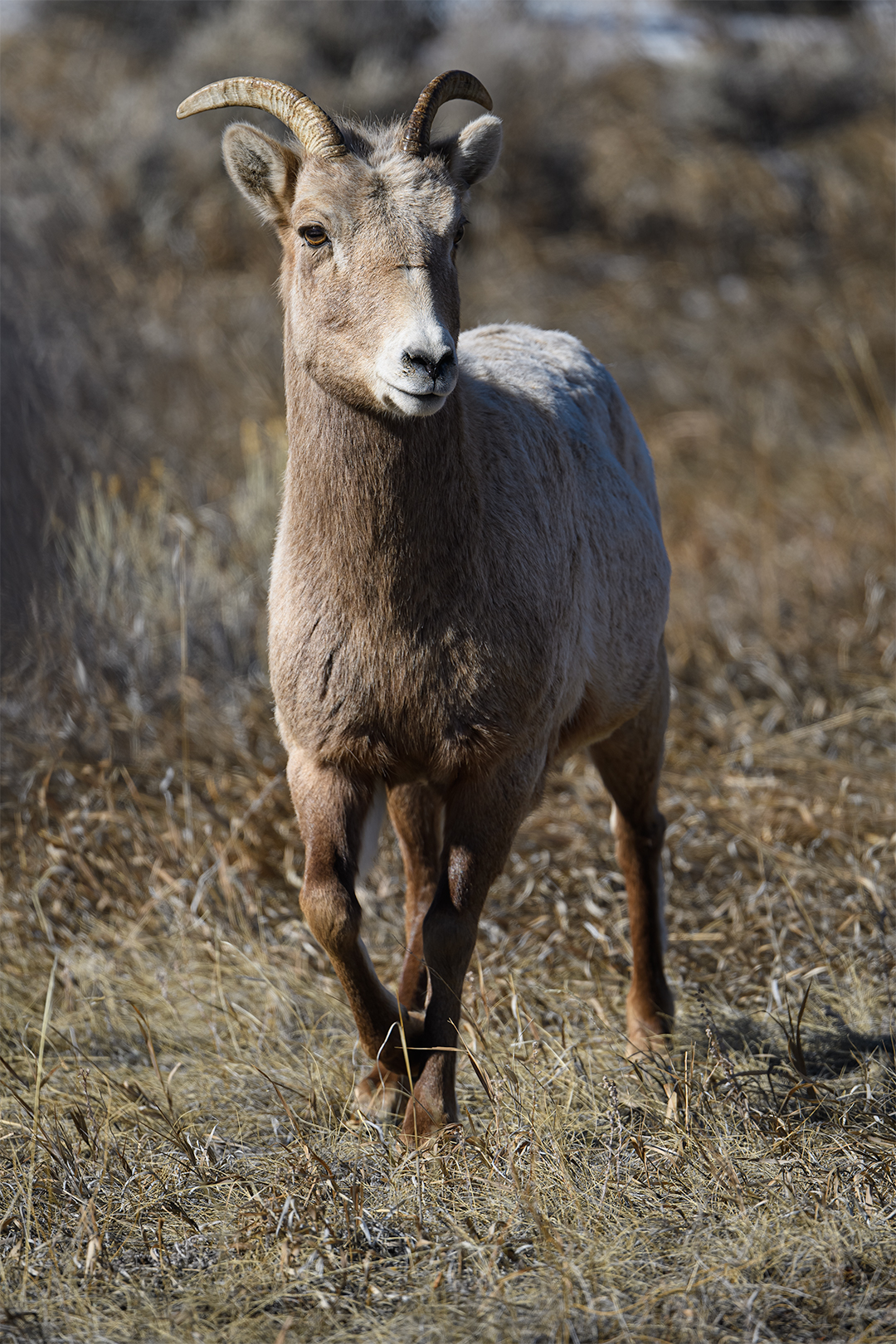
2020—Hello There

The Rocky Mountain Bighorn Sheep in Wyoming were not concerned about us or our proximity to them. They got so close to us that I had to back up in order to keep the entire animal in the frame. My Nikon 500mm PF super telephoto lens has a narrow angle of view and strong magnification, making the individual quite large in the frame especially at close distances. This ewe walked right up as if to greet me and say, “Hello there!”
2020—Yearling

This year’s trip to Wyoming to photograph Rocky Mountain Bighorn Sheep was a huge success! Despite finding only a few of the purported 1200 member herd in Wyoming we had some incredible experiences and encounters with those we met. We counted three young rams among the two bands we photographed but none of the hefty rams with large curls that we photographed last year. Most of the bands we saw were ewes that were very accepting of our presence. And, we found one absolutely adorable yearling. On our last afternoon in Dubois, I was able to photograph this yearling in the Whiskey Basin Wildlife Management area.

2020—Observation Post

Rocky Mountain Bighorn Sheep are comfortable on narrow ledges where they feel safe from predators. Early mornings near Dubois, Wyoming we wold find a small band hunkered down on red rock crags just observing what was going on around them. This ewe watched us as we photographed her and some of the members of her small band as they relaxed on the mountainside soaking in the warm early morning sun as the temperatures hovered in the 20’s.

2020—The Girls

The furious winds calmed on Thursday, the third day of our visit to Wyoming to photograph Rocky Mountain Bighorn Sheep. We were hopeful that the change in the weather would give us more opportunities to observe the sheep at closer range. That morning we drove to the area of the Whiskey Basin Wildlife Habitat Area where last year we photographed a large band of sheep so close we could practically reach out and touch them. Driving into the area, we saw a group of three ewes on a rocky outcropping. We turned around and parked in an area close by. While we stood quietly outside the vehicle, the three ewes made a bee-line toward us. They eventually ventured so close to us that we could have touched them. They were coming to the area where we parked because of the mineral content of the soil there which they need for their diet.

2020—Curiosity

Day Two of our Rocky Mountain Bighorn Sheep Adventure got off to another great start. The wind was relentless and there were some gusts in excess of 50 MPH which was more than likely keeping the sheep hunkered in place. But, early in the morning, we found a small band of about a dozen ewes on the side of HWY 287 munching grasses at the edge of the roadway, close to where we saw them on Tuesday. As we watched the small group as it seemed to be trying to decide whether to cross the highway, one looked up to the craggy red rocks above then decided to stay instead of crossing. When we looked up, we saw another ewe at the top of the rocks, slowly making her way down. We trained our lenses on her, hoping she’d sprint down the sheer cliff side but instead she watched us with what appeared to be great curiosity. She never did go down the steep rock. Eventually, she turned and disppeared above us. Eventually, the small band that originally caught our attention followed her up the slope and disappeared.

2020—Rocky Mountain Bighorn

Whiskey Basin Wildlife Habitat Management Area near Dubois, Wyoming provides crucial winter range for Rocky Mountain Bighorn Sheep. According to the Wyoming Department of Game and Fish, Whiskey Basin is home to the largest herd of Rocky Mountain Bighorn Sheep, numbering about 1200. Tuesday morning we drove to the area on US 287 where the day before, we’d seen an electronic sign alerting drivers to the presence of Bighorn Sheep and to use caution in the area. About 13 miles out of Dubois, we saw some ewes in the snowy, sage covered hillside on the side of the road. As we watched, we found about 13 ewes. Just before 8AM, a lone ram appeared, leaping effortlessly to reach the top of the red rock crag. It was a great start to the trip.

2020—On the Beach

Last April I had a chance to participate in a workshop with Moose Peterson at Silver Strand State Beach, a narrow strip of sand on Coronado Peninsula that separates San Diego Bay from the Pacific Ocean. The workshop gave me a chance to practice one of my favorite types of bird photography, something I call Beach Panning. I lay flat on the sand and sometimes in the waves, photographing shorebirds with a long lens. It is exhilarating, especially when I am able to photograph birds I don’t get a chance to see often like this Marbled Godwit, and I get to see them down at their level. In this shot, the waves are breaking behind the Marbled Godwit as it roams the beach looking for tiny crustaceans and clams. I used my crop sensor NIkon D500 and the Nikkor 500mm PF so my focal length was 750mm.