2020—Tattered Hangers-On

The rain storm a few days ago brought down most of the remaining leaves from the Red Oaks that line the route on my morning walk. A few tattered hangers-on, almost unrecognizable as oak leaves, caught my attention with the morning light shining through them yesterday. For once I had a camera other than my phone camera so I stopped to capture the moment.

2020—Dazzling

Spending time in Yellowstone National Park watching a Red Fox going about its business and ignoring those of us who were there documenting it, was an incredible and memorable experience. This vixen was gorgeous and her red fur was dazzling in contrast to the white snow. You couldn’t miss a move she made. We were lucky that she had become acclimated enough to people that if those people did not harass her, she acted as if we weren’t there. What a privilege it was to observe this gorgeous wild creature in her natural habitat.

2020—Over the Colony

The colony on Bird Rock at Cape St. Mary’s in Newfoundland is a cacophony of calls and a mass of white and gold as tens of thousands of Northern Gannets congregate there during nesting season. It’s an incredible sight especially because the birds are packed together so closely that there is little space between them. Nevertheless, these large sea birds, who mate for life, find their mate and their nesting sight and stick the landing with the precision of a gymnast. This bird is preparing to do just that.

2020—Denizen of the Boreal Forest

The boreal forest is the world’s largest land biome and is comprised mainly of coniferous tree species such as pine, spruce and fir with some broadleaf species such as poplar and birch. Boreal forests grow in high-latitude environments where freezing temperatures occur for 6 to 8 months of the year. This past February, I visited just such a boreal forest in Minnesota called Sax-Zim Bog. One of the denizens of Sax-Zim Bog is the aptly named Boreal Owl. While we were there, the temperatures dropped to a bone-chilling negative 31 degrees in the daytime. The owls, including this Boreal Owl, were often perched in trees, feathers fluffed against the cold, dozing in the daylight and occasionally opening their eyes to peek at the groups of photographers watching them and to watch beneath them where uncrusted snow under the trees facilitated access to prey.

2020—Reflecting the HeadLight

Despite the horrific state of the world in 2020, I have had many memorable photographic journeys this year! Among my many fantastic adventures was my first visit to the beautiful state of Maine where I fell in love with the lighthouses there. I saw and photographed eight of them, including the Portland Headlight. This is a view of that lighthouse from the back. I took most of my favorite shots of this lighthouse from the opposite side using long exposures but for this shot, there weren’t many clouds to blur and there were no crashing waves. What caught my attention was the light reflecting off the structure onto the water and I took the photograph with my Nikon Z7 set to the monochrome picture control.

2020—Graceful Leap!

Red Foxes are quite graceful as they leap into the air prepared to plunge head first into the snow after a tiny vole they have sensed is burrowing there. We watched this vixen leap over and over as she roamed the large meadow in Yellowstone National Park last month. Most of the time she emerged with a snow-covered muzzle and jaws grasping her meal. She was so successful that she didn’t eat most of the voles we saw her catch. Instead, she cached them around the meadow, pushing her quarry into the snow to keep it hidden and safe for her to retrieve later.

2020—Stalking

This Great Egret was on a mission, stalking something to eat in the shallow bayou water. The egret’s neck and body show reflected patterns from the water as it surveys the area. The surface of the water is covered by a noxious plant, the Giant Salvinia, an invasive species from Brazil discovered in the lake less than 15 years ago. It can double its biomass in days and threatens the health of the ecosystem in which it thrives so potentially this Great Egret could be adversely affected by it. There are currently modestly effective efforts underway to control the weed.

2020—Shooting on the Bayou

To get the most out of a visit to the bayou on Caddo Lake, it is essential to get onto the water. The bayou is a living, breathing, vibrant place. On the water, you’re surrounded by it, enveloped by it, you become a part of it. This photographer knew what to do. We saw several photographers on the water in kayaks, some even using tripods that they put into the water. The water is shallow and without much movement so their cameras were not in danger of getting swamped in the swamp. We finally got out onto the water on the third day of our visit. I’m so glad we were finally able to do it. When I photographed this photographer on our second day there, I didn’t realize what I was missing. What a way to experience the bayou!

2020—Bayou Bird

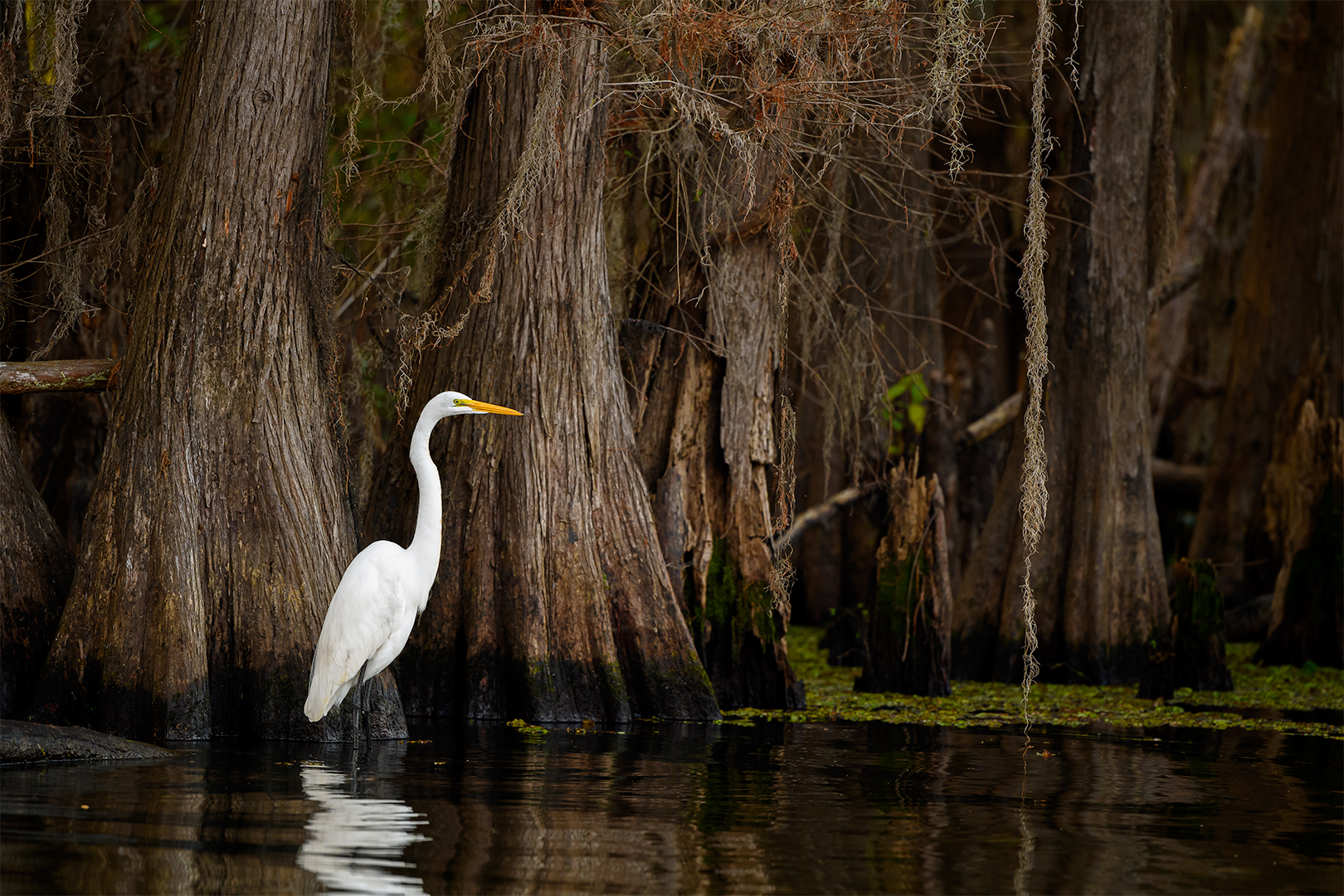
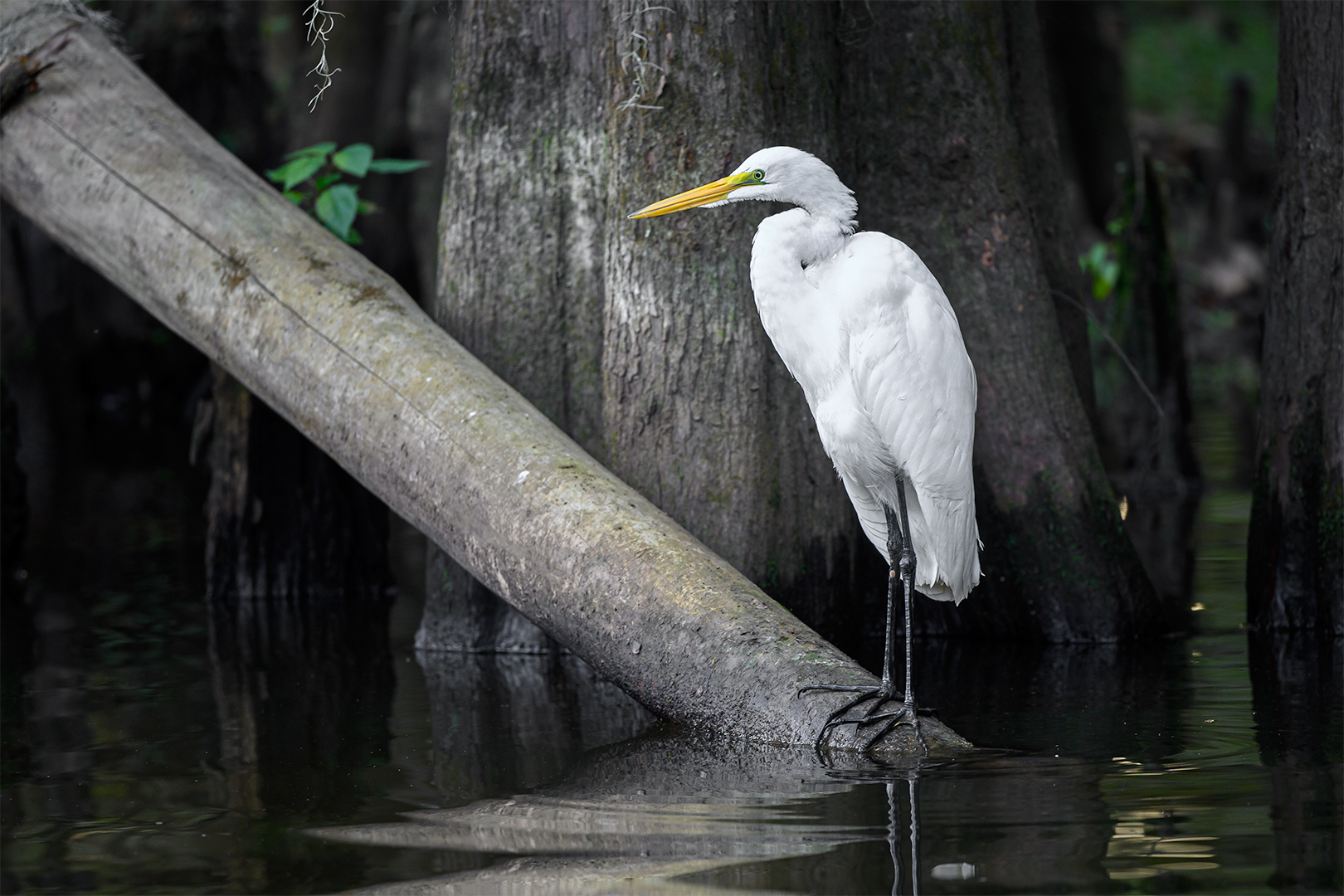
It’s hard to miss a Great Egret on the Bayou, even if it’s tucked motionless in among the distinctive trunks of the Bald Cypress on the edge of the swamp. Its brilliant white feathers make it stand out from the dark tree trunks and the darker water. They are such elegant creatures with their long curved necks and regal stature. It’s always a thrill to see them, no matter where they are.

2020—Sunrise on Caddo Lake

Caddo Lake is such an enchanting place in the early morning. The moss-draped Bald Cypress, rooted in shallow waters, emerge majestically and reflect in their watery surroundings backlit by the intense red from the rising sun that colors the clouds. The stunning scene is all too brief and when the sun appears above the horizon the scene changes to its daylight view, still stunning but not quite as enchanting or mysterious.

2020—Buoyed

A line of buoys strung across the waters just ahead of Caddo Lake Dam caught my eye on our first day there. I walked along the edge of the water until I got just the view of a single buoy in my viewfinder. The bright orange float reflecting in the dark waters struck me as an appealing and uplifting scene. Seeing it then buoyed my spirits. And seeing it again now, still gives me an uplifting feeling.

2020—Morning on the Bayou

Morning on the Bayou is still, peaceful, and serene. The Bald Cypress forest is thick surrounding Caddo Lake in Texas. The Spanish moss fills in most of the cracks and spaces between tree trunks, keeping light off the forest floor. At eye level, floating by in a pontoon boat, it’s almost impossible to discern what might be lurking in the darkness. The morning sun strikes the Cypress branches on the edges of the thicket and reflects off the draping moss.

2020—Well, Hello There

Yellowstone National Park rules say that 25 yards is the minimum safe distance for viewing Bison. Sometimes maintaining that distance is not possible. A couple of weeks ago in Yellowstone, we stopped our van to watch a small herd of mostly cows and calves cross the road in front of us and continue up the snowy slope on the other side. This cow was determined to walk right past the open van door and couldn’t resist peeking inside as she passed by. Well, hello, there!

2020—Vixen

The little Red Fox Vixen that we photographed on three of our days in Yellowstone a couple of weeks ago was clearly used to people. She hunted in the same meadow every day and photographers swarmed to the area. We respected her space so we were not a threat to her like many of the other photographers who moved erratically and raced to get closer to her. She avoided the photographers who chased her down and harassed her as she moused in the large meadow by the road. They would follow her as she moved throughout her territory, sometimes moving off the road the into the snow with their tripods and video equipment so they could theoretically get closer photographs. Sadly, for them, all that did was cause her to move further away. After a while, many of them lost interest and left. In the meantime, we stayed by our vehicle parked away from the other vehicles and did not move to the edge of the road. She clearly sensed that we were not a threat. On more than one occasion, she walked between us to cross the road to cache her quarry and then crossed the road again nearby to continue mousing. When the few remaining photographers saw that she had moved closer to us, they moved quickly en masse, stepping in front of us and encroaching on the fox’s space. When she had had enough, she disappeared in the distance. Before that happened, as she moved closer to us to avoid the harassment, we were able to photograph her, her ears are perked up, not laid back indicating she was alert but not threatened by us. She even stopped to check us out.

2020—A Most Memorable Experience

A pair of young wolves frolick in the snow as the mists from the nearby hot springs drift by them in Yellowstone National Park in January 2018. As a photographer, in particular as a wildlife photographer, I have been exceedingly lucky to be in the right place at the right time to document some incredible moments. These moments are forever seared in my memory and I am privileged to share some of the images from those moments. Without a doubt, one of my most memorable photographic experiences, as well as one of my top life experiences, took place almost three years ago in January 2018 in Yellowstone National Park when we watched the 8-Mile Wolf Pack as they played, slept, and fed on a Bison they had killed earlier in the day. I have been thinking about that experience a lot lately after learning that, as improbable as it sounds to me, the Gray Wolf was de-listed as an endangered species. And, I was disheartened to learn that a visitor to Grand Teton National Park shot and killed a Gray Wolf in late October. But I had good news Friday morning, talking with a friend who lives in Colorado. I learned that Colorado voters approved a proposition to reintroduce wolves there. And, although on my recent visit to Yellowstone National Park in early November, I didn’t photograph any wolves, on our last day there, we heard the Wapiti Pack singing and then watched them through binoculars as they rested on a slope far in the distance. Seeing and hearing wolves! Always a memorable experience.